
Mercurius of Caesarea
The Holy Great-martyr Mercurius of Caesarea in Cappadocia
Great Martyr · d. c. 250
Commemorated 24 November — Martyrdom at Caesarea in Cappadocia (Greek usage keeps November 25)
Mercurius of Caesarea (†c. 250) is the great-martyr and soldier-saint of the persecutions of Decius and Valerian, a young officer of Scythian descent who, armed by an angel with a sword, won a great victory for the Roman army and was made its commander, but who then cast down his honours and confessed Christ, enduring fierce tortures and beheading at Caesarea in Cappadocia. He is venerated above all for a wonder wrought a century after his death: in answer to the prayer of Basil the Great, the martyr — depicted spear in hand upon an icon of the Theotokos — was sent from heaven to slay Julian the Apostate on his Persian campaign, the tradition to which the dying emperor's cry, "Thou hast conquered, O Galilean," is joined. His feast is November 24 (Greek usage November 25).
.jpg)
Origins and military service
The passio makes Mercurius a Scythian by descent and a soldier of the Roman army under the emperors Decius (249–251) and Valerian (253–259), whose edicts commanded universal sacrifice to the gods on pain of torture and death. When a barbarian host fell upon the empire and Decius took the field, an angel of the Lord appeared to Mercurius in the likeness of a shining man and put a sword in his hand: "Fear not, Mercurius; go bravely against the enemy, and when you have conquered, do not forget the Lord your God." With that sword the young soldier cut through the enemy ranks and slew their king, winning the battle for Rome. Decius, in gratitude, loaded him with honours and made him commander of the whole army.
Confession and martyrdom
The angel appeared to Mercurius again in his glory, reminding him by whom the victory had been given and foretelling that he would suffer for Christ and receive the crown of the kingdom. The saint remembered that his father Gordian, and his forefathers, had confessed Christ; though baptized, he grieved that he had not given his life to God as they had. Summoned by the emperor and pressed to sacrifice in the temple of Artemis, he withdrew; denounced as a Christian by a certain Catullus, he was brought before Decius, and there openly confessed Christ, casting down his soldier's belt and cloak at the emperor's feet and renouncing every honour he had received.
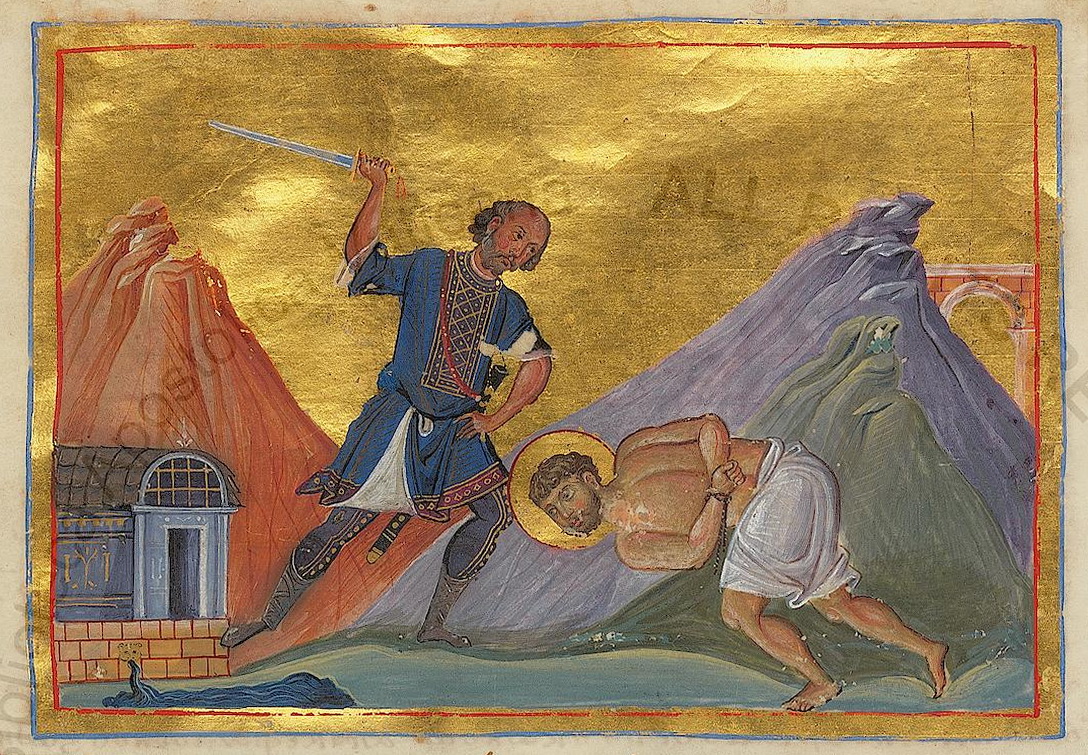
He was cruelly tortured — stretched between four posts and burned with fire, his flesh cut with knives until his own blood quenched the flames — and thrown back into prison nearly dead, where the Lord healed him, to the confounding of the pagans. Condemned at last to death, and granted a vision of Christ who promised him a swift release, the great-martyr Mercurius was beheaded at Caesarea in Cappadocia. His body, the tradition says, gave off a fragrance like myrrh and incense, and many sick were healed at his tomb.
The slaying of Julian the Apostate
Mercurius is chiefly remembered for a wonder wrought long after his death, when "even in death the warrior of Christ did soldier's service for the Church." In the reign of Julian the Apostate (361–363), who had forsaken Christ and set out to restore the persecution, Basil the Great (commemorated January 1) prayed before an icon of the Most Holy Theotokos on which Mercurius was depicted as a soldier bearing a spear, beseeching God that the apostate might not return from his Persian war to renew his oppression of the faithful. As Basil prayed, the figure of the martyr on the icon vanished, and reappeared with its spear reddened with blood. At that very hour, on the Persian campaign, Julian was struck down by the spear of an unknown horseman who at once disappeared; the mortally wounded emperor flung his blood toward heaven with the cry, "Thou hast conquered, O Galilean." The Church receives the tradition that the Theotokos, at Basil's prayer, sent the great-martyr Mercurius to strike down the enemy of Christ. The story is transmitted in the Byzantine Life of Basil ascribed to Amphilochius of Iconium and repeated in the synaxaria; it is also carried in the tradition of Basil of Caesarea (see the entry for Basil the Great, to be authored) and colours the Byzantine memory of Julian's death.
Feast and commemoration
Mercurius is commemorated on November 24 (church date; Old Calendar civil December 7), together with the great-martyr Catherine. The Greek books keep his feast, like Catherine's, on November 25; the Slavic and Antiochian usage, followed here, keeps November 24. His veneration is universal, and he is numbered among the great warrior-martyrs of the East alongside George, Demetrius, Theodore and Procopius.
Hymns
Troparion — Tone 4
Thy martyr Mercurius, O Lord, in his contest received the crown of incorruption from Thee our God; for having Thy strength, he cast down the tyrants and broke the feeble boldness of the demons. By his intercessions, O Christ God, save our souls.
Original translation from the Greek
Iconography
Mercurius is depicted as a young warrior-martyr in military dress, commonly holding a spear (the attribute bound up with the slaying of Julian) and a sword, sometimes with shield and the martyr's cross; the manuscript miniatures of the middle-Byzantine synaxaria show his beheading. The stored image is the miniature of his martyrdom from the Menologion of Basil II (c. 985, Vatican Ms. Vat. gr. 1613), the standard public-domain source for the martyrs of the fixed year.
Disputed questions
- Date and reign. The passio sets the martyrdom under Decius and Valerian (mid-third century); the death is conventionally dated about 250. Some witnesses place elements of the account under other emperors, and the historical kernel is difficult to recover behind a developed legend.
- The Julian tradition. The posthumous slaying of Julian by Mercurius is a hagiographic tradition of the Basil cycle, not a datum of contemporary history (which records only that Julian fell to a spear-wound of uncertain origin in 363). The Church's liturgical memory receives it; the historical circumstance of Julian's death is recorded here beside it.
- Not to be confused with the martyr Mercurius of Smolensk (†1238), the Russian soldier-saint and defender of Smolensk against the Tatars, who is commemorated on the same day (November 24); nor with Mercurius the Faster of the Kiev Caves (14th c.), also of November 24 (deferred — see 24 November). The three share the day and the soldier's or ascetic's name but are distinct persons of the third, thirteenth and fourteenth centuries respectively.