
Mercurius of Smolensk
The Holy Martyr Mercurius of Smolensk
Martyr · d. c. 1238
Commemorated 24 November — Death defending Smolensk against the Tatars
Mercurius of Smolensk (†c. 1238) is the soldier-martyr and patron of the city of Smolensk, a warrior of Slavic — the tradition says Moravian and princely — birth who served the prince of Smolensk and secretly led an ascetic life. When a Tatar host under Batu's invasion threatened the city, the Mother of God, it is related, summoned him through her wonderworking Smolensk icon to go out against the enemy; he fell upon the Tatar camp by night, slew their champion and struck down many, aided by radiant heavenly warriors and by the Virgin herself, until he died in the battle. Buried in the Dormition cathedral of Smolensk, where his sandals were long preserved, he was venerated as the city's special defender from the sixteenth century. He is commemorated on November 24.
.jpg)
The account of Mercurius comes from the local Smolensk tradition. He was, it says, a Slav — probably of Moravia — of a princely line, brought up in Orthodoxy, who in zeal for the true faith left his homeland for Rus′ and took service in the army of the prince of Smolensk. Beneath a soldier's life he lived secretly as an ascetic: strict in fasting, chaste, spending his nights in prayer, and preparing himself inwardly to suffer for Christ.
In the winter of the Mongol invasion — the tradition dates it to 1238–1239, when Batu's Tatars had already laid waste many cities of Rus′ — a horde encamped some twenty-five versts from Smolensk at Dolgomostye, threatening to destroy the city and its holy places. A sacristan keeping night vigil in the cathedral before the wonderworking Smolensk icon of the Theotokos (the icon "Hodegetria") heard the voice of the Queen of Heaven bidding him find the warrior Mercurius and tell him: "Go forth into battle, for the Sovereign Lady summons you." Mercurius came himself to the cathedral, heard the same commandment from the All-pure Virgin, and set out that very night for the Tatar camp.
There he fought and killed the leader of the enemy host, a giant of great strength, and, calling on the name of the Lord and of the Theotokos, cut down many of the Tatars, who watched in terror as lightning-bearing men and a radiant Woman fought at his side. Unable to stand against him, the enemy fled. Mercurius himself was slain in the battle — the tradition says by the son of the giant he had killed. The people of Smolensk, delivered by the mercy of God and the Mother of God, reverently buried the soldier-martyr in the cathedral of the Dormition. Soon after, he appeared to the sacristan and directed that his armour be hung over his grave, promising the city his abiding help in every sorrow and struggle.
Veneration
The sandals of the martyr were long kept in the Smolensk cathedral. His formal commemoration was established toward the end of the sixteenth century, though already in 1509 the people of Smolensk were invoking him as their special patron. His memory is bound up with the defence of the city and with the great Smolensk Hodegetria icon, and he is honoured as one of the warrior-saints of the Russian land.
Feast and commemoration
Mercurius is commemorated on November 24 (church date; Old Calendar civil December 7), the day he shares with the two ancient great-martyrs Catherine and Mercurius of Caesarea. His feast is kept in the Russian Church and by the OCA; he is also numbered among the Synaxis of the Saints of Smolensk.
Iconography
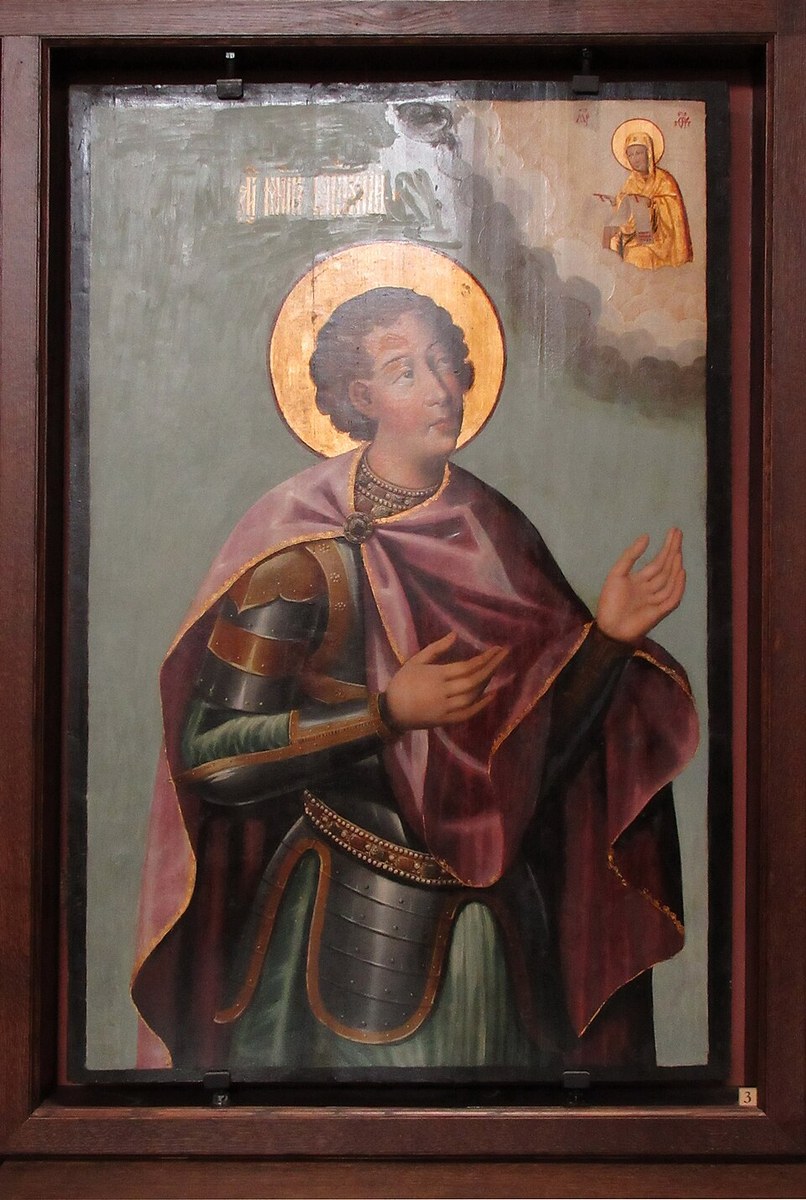
Mercurius of Smolensk is depicted as a young warrior in armour, bearing spear and shield or the martyr's cross, often against the walls of Smolensk or beside the Smolensk Hodegetria; he may appear together with Abramius of Smolensk. The stored image is a late-seventeenth-century Russian icon by Karp Zolotaryov, now in the State Historical Museum, Moscow, showing the holy martyr Mercurius in military dress.
Disputed questions
- Date. The martyrdom is placed in the Mongol invasion of the late 1230s; the year is variously given as 1238 or 1239, and the historical details rest on later local tradition rather than contemporary record.
- Not to be confused with the great-martyr Mercurius of Caesarea (†c. 250), the ancient Roman soldier-martyr commemorated the same day (November 24), nor with Mercurius the Faster of the Kiev Caves (14th c.), also of November 24. Iconography and local usage sometimes also pair this Mercurius with Abramius (Avraamii) of Smolensk, a distinct saint of the city.
- Not to be confused, above all, with Mercurius of the Kiev Near Caves, the bishop of Smolensk (†1239, principal feast August 7, also kept November 24), who was a monk of the Caves before his consecration and whose coffin was carried down the Dnieper to the Lavra. That saint is a hierarch, this one a layman and soldier; they share a name, a city, a decade, a Tatar enemy and the November 24 commemoration, and the calendars confuse them constantly. Some lists carry this martyr on August 7 as well; on the evidence that is a cross-listing of the bishop's day, and no August 7 feast is recorded for the soldier-martyr here.