
Metrophanes of Constantinople
Our Father among the Saints Metrophanes, Archbishop of Byzantium and first Patriarch of Constantinople
Patriarch · Bishop · d. c. 326
Commemorated 4 June — Repose at Constantinople
Metrophanes was bishop of Byzantium in the years when the little see on the Bosporus became the see of the New Rome, and is honoured by the Church as the first Patriarch of Constantinople. The tradition makes him the son of Dometius, a convert brother of the emperor Probus, and the third of his family to hold the throne of Byzantium after his father and his brother Probus. Already extremely aged when the First Ecumenical Council met at Nicaea in 325, he could not attend in person and sent the presbyter Alexander as his vicar; Constantine the Great honoured him, and the Fathers of the Council are said to have confirmed his primacy in the new capital. He named Alexander his successor, foretold the patriarchates of Paul of Constantinople and of Athanasius of Alexandria, and reposed in extreme old age about 326, on June 4.

Origins: a Roman family on the Bosporus
The synaxarion account, which the Byzantine and Russian traditions transmit in substantially the same form, sets Metrophanes' family in the imperial house of the third century. His father Dometius is described as a brother of the emperor Probus (276–282) who, perceiving the emptiness of the pagan cult, came to faith in Christ. Persecution at Rome drove him east, and he brought with him his two sons, Probus — named for his uncle — and Metrophanes. At Byzantium the family found a bishop of holy life named Titus, who catechised them and, seeing the father's zeal, ordained Dometius presbyter.
The chain of succession that follows is the tradition's own, and it is a family one: after the death of Titus, Dometius was raised to the throne of Byzantium; after Dometius, his elder son Probus; and after Probus, Metrophanes. The Greek synaxarion gives Metrophanes' episcopate as 313–327; the account followed by the Russian Lives dates his father's episcopate 272–303, that of Probus 303–315, and sets Metrophanes' accession in 316. Modern prosopography of the see, working from the fragmentary early lists rather than from the synaxarion, places Metrophanes earlier still, roughly 306–314. What all the sources agree on is that he was bishop of Byzantium in the reign of Constantine and that he was, at the end of his life, a very old man.
Byzantium becomes Constantinople
Metrophanes' episcopate spans the transformation of his city. The tradition relates that when Constantine first came to Byzantium he was struck by the situation and beauty of the place, and no less by the holiness and good sense of its bishop, whom he took with him to Rome; and that when he resolved to move the seat of empire from Rome to the Bosporus he brought Metrophanes back with him to the city that was to bear the emperor's name. To the years of his episcopate the Greek synaxaristes attributes the founding of the great churches of the Queen City — of the Holy Wisdom, of Holy Peace (Hagia Eirene), and of the Holy Power (Hagia Dynamis) — that is, the first, Constantinian foundations on the sites that their vast successors would occupy.
The point of substance behind the story is that Metrophanes is the hinge between two conditions of one church: bishop of a provincial see of the province of Europe, subject in the ordinary way to the metropolitan of Heraclea, he ended his days bishop of the imperial city. The canonical consequence — the honour "after the bishop of Rome" — belongs to the councils of 381 and 451 and not to his lifetime; but the Church's memory, reading the outcome back into the man, styles him first Patriarch of Constantinople, and it is under that title that he stands in the calendar.
The First Ecumenical Council
When the Council of Nicaea was convoked in 325 against the doctrine of Arius, Metrophanes was too old and too ill to travel the short distance across the Propontis. He sent in his place his chorepiscopus — the Greek accounts call him protopresbyter — Alexander, described as a willing and God-fearing man. This absence is the reason his name is not among the subscriptions of the Council, and it is the ground on which the tradition insists all the more firmly on his orthodoxy: he was, the kontakion says, one who "proclaimed the Word consubstantial with the Father in the midst of the God-bearing Fathers," his voice being carried by his vicar.
The synaxarion adds that at the close of the Council the emperor and the assembled Fathers came to visit the sick bishop, and that at Constantine's request Metrophanes named his own successor: Alexander, the very man who had represented him (commemorated August 30). To this the account joins two prophecies — that the reader Paul would in time hold the throne after Alexander, and that the archdeacon Athanasius would succeed Alexander of Alexandria. Both came to pass, and it is for this that the second kontakion praises him as one who "received manifestly the grace of prophecy from God."
Repose
Metrophanes reposed about 326 (the Greek books say 327), and the tradition, which makes him a nephew of an emperor who died in 282, is obliged to give him an enormous age: one hundred and seventeen years. He was buried in the city, and a church of Constantinople was afterwards dedicated in his name, where his relics were kept. His memory is fixed at June 4 in the Synaxarion of Constantinople and in every Byzantine-rite calendar since, and he heads the roll of the hierarchs of the imperial city in the Synaxis of All the Archbishops and Patriarchs of Constantinople.
Feast and commemoration
June 4 (church date; New Calendar civil June 4, Old Calendar civil June 17), the day of his repose. The commemoration is universal, and in the Greek books it heads the day, with the sisters of Lazarus following. The Apostle appointed with it is the hierarch's reading from Hebrews (7:26–8:2). He is commemorated again, with the whole company of his successors, in the Synaxis of the Hierarchs and Patriarchs of Constantinople. The Greek synaxarion sets over the day this distich, playing on his name — Metrophanes, "mother-manifest":
Having gone forth from the mother earth, all-blessed Metrophanes, thou wast borne away to where the Father of all is great.
Hymns
Apolytikion — Tone 4
A rule of faith, an image of gentleness, a teacher of abstinence did the very truth of things show thee to be unto thy flock; therefore hast thou gained the heights by humility, and riches by poverty. Father and hierarch Metrophanes, intercede with Christ God that our souls may be saved.
Kontakion — Tone 4
Let us hymn with one voice the hierarch of Christ, Metrophanes, the light-bearing lamp of the Church, who in the midst of the God-bearing Fathers proclaimed the Word to be of one essence with the Father, who adorned the throne of the Queen City among the first, and who plainly received from God the grace of prophecy.
Original translation from the Greek
Iconography
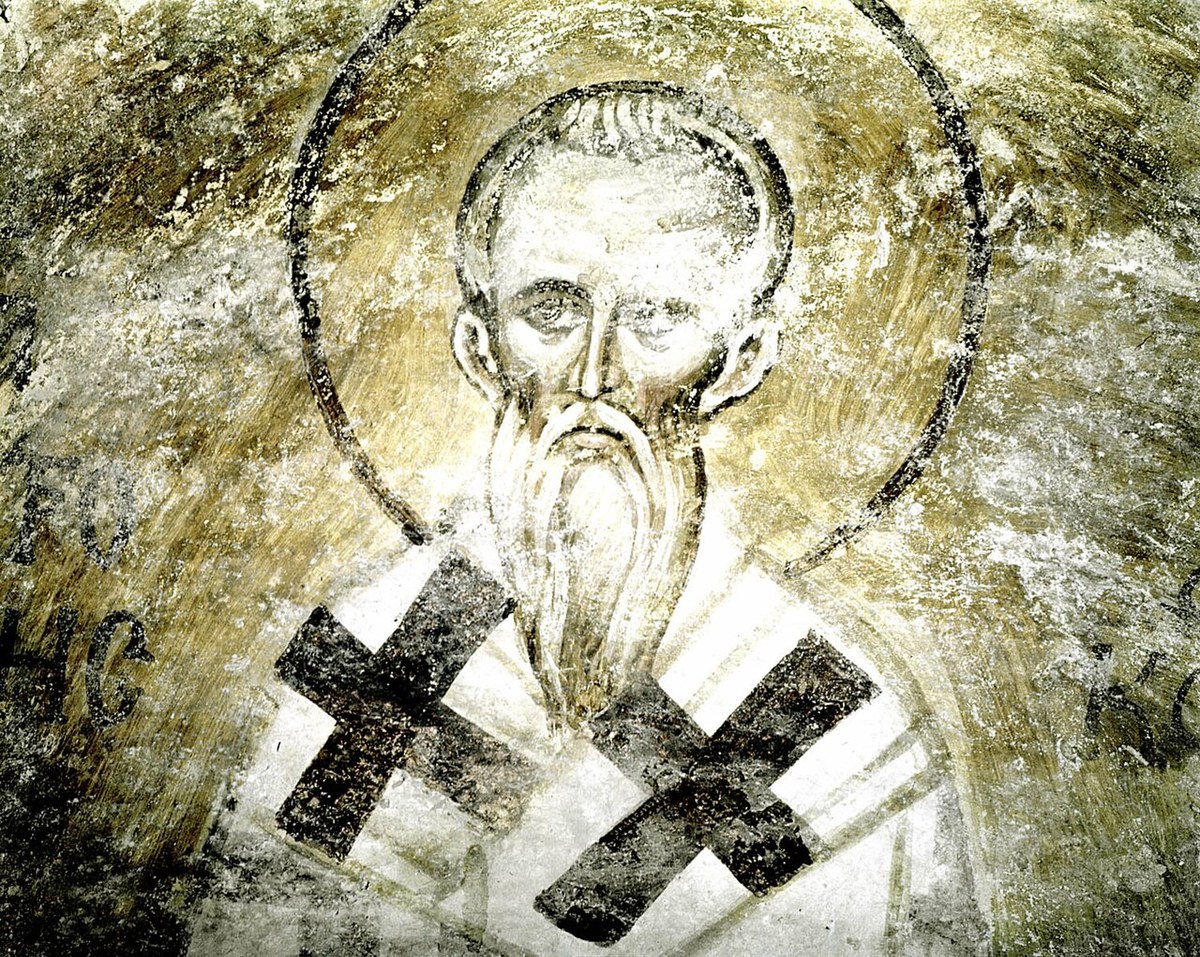
Metrophanes is painted as a very aged hierarch — high forehead, thin white hair, a long pointed white beard — vested as a bishop of the Byzantine rite in the polystaurion phelonion (the white vestment patterned with dark crosses that marks the patriarchal rank), the omophorion with its great crosses laid over the shoulders, the epitrachelion and, at the hip, the epigonation; he holds the jewelled Gospel in his veiled left hand and blesses, or holds the book with both hands before him. Because his place in the tradition is architectural rather than dramatic — the first of the patriarchs — he appears above all in the ranks of hierarchs painted in the sanctuary and prothesis of Byzantine churches, where the bishops of the Church stand in a row concelebrating, and in the composite icon of the Synaxis of the Patriarchs of Constantinople. He is not given a martyr's cross or any instrument, and no scene of his life is part of the standard repertory.
The stored image is the fresco of Saint Metrophanes on the south wall of the prothesis of the parekklesion of the Pammakaristos at Constantinople (now the Fethiye Camii), painted about 1310 in the mortuary chapel built by Martha Glabas — one of the finest surviving cycles of the Palaiologan renaissance, and a portrait of the saint in his own city. The detail reproduced here shows the bust: the aged, ascetic face within the halo, the crossed omophorion, and at the left the surviving letters of the inscription. The full-length photograph of the same figure in the niche shows him holding the red jewelled Gospel, in the cross-patterned phelonion with the epigonation hanging at his side.
Disputed questions
- Not to be confused with Metrophanes of Voronezh (1623–1703, commemorated November 23), the first bishop of Voronezh, in the schema Macarius, of the age of Peter the Great. The two are separated by fourteen centuries and by everything else; but Russian icons and Russian name-day usage inscribed simply "Saint Metrophanes" almost always mean the Voronezh hierarch, and the June 4 commemoration of the ancient patriarch is frequently mistaken for his.
- Not to be confused with Metrophanes, bishop of Smyrna (mid-ninth century), the hymnographer. The Canons to the Holy Trinity sung at the Midnight Office in the Octoechos are the work of the Smyrnaean Metrophanes, not of the first patriarch — a correction the synaxaria themselves take pains to make, because the two names in a hymnographic heading invite exactly that confusion. Nor should he be confused with Metrophanes of Radonezh, the elder who tonsured Saint Sergius, or with the later patriarchs Metrophanes II and III of Constantinople.
- The dating of the episcopate. Three reckonings are in the field: the Greek synaxaristes (313–327), the account behind the Russian Lives (316–326), and modern critical lists (c. 306–314). They cannot be harmonised, and the disagreement is not trivial, since on the earliest reckoning Metrophanes was no longer bishop when Nicaea met and the story of the vicar Alexander would belong to his successor. This repository records the traditional dating as the Church's own and the critical dating as the state of the scholarly question.
- The imperial kinship and the title. The descent from a brother of the emperor Probus, the family succession of three bishops, and the conferral of the patriarchal title by the Fathers of Nicaea are all elements of the hagiographic tradition rather than of the documentary record; the see acquired patriarchal rank by conciliar legislation later in the fourth and fifth centuries. The Church's use of the title for Metrophanes is honorific and retrospective, and is not thereby untrue: he was in fact the bishop under whom Byzantium became the capital.