
Metrophanes of Voronezh
Our Father among the Saints Metrophanes, First Bishop of Voronezh, in schema Macarius
Bishop · b. 1623 — d. 1703
Commemorated 7 August — Glorification and uncovering of relics (1832), 23 November — Repose (1703)
Metrophanes of Voronezh (1623–1703), in the world Michael and in the schema Macarius, was the first bishop of the newly erected see of Voronezh and one of the most venerated Russian hierarchs of the age of Peter the Great. A parish priest until his widowhood, he became a monk at forty, rose through the abbacies of two monasteries, and in 1682 was consecrated for Voronezh, which he governed for twenty years — building churches, reforming his clergy, caring for the poor, and supporting Peter's shipbuilding at Voronezh for the Azov campaign, while fearlessly rebuking the tsar over the pagan statues at his court. He died in 1703, having taken the schema; Peter himself bore his coffin. His relics were found incorrupt and he was glorified in 1832. He is commemorated on November 23.

Origins and early life
Metrophanes was born on 8 November 1623, most likely into a priestly family of the Vladimir region — his own will says only that he was "born of pious parents and reared by them in the incorrupt piety of the Eastern Church." For the first forty years of his life he lived in the world as Michael: married, the father of a son named John, and serving as a parish priest in the village of Sidorovo on the River Molokhta, near the town of Shuya. After the death of his wife he received monastic tonsure, taking the name Metrophanes, at the Dormition Monastery of Zolotnikovsk in 1663.
Monastic ascent
His gifts were quickly recognised. After three years as a simple monk he was chosen igumen of the Cosmas of Yakhroma Monastery, which he governed for about ten years, building there a church of the Icon of the Saviour Not-Made-by-Hands. In 1675 Patriarch Joachim raised him to archimandrite of the great Makariev-Unzha Monastery, where he oversaw the building of a stone church of the Annunciation with refectory and bell-tower.
First Bishop of Voronezh
The Moscow council of 1681–1682, seeking to strengthen Church life against the Old Believer schism, resolved to multiply dioceses, and among the new sees was Voronezh. Metrophanes was summoned to the capital and consecrated its first bishop on 2 April 1682 by Patriarch Joachim. Arriving in a poor and troubled frontier diocese, he set to work at once, sending his clergy an encyclical urging them to be themselves "the light of the world," feeding their flocks by teaching, by the Mysteries, and by the example of a righteous life. In his twenty years the number of churches in the diocese rose from 182 to 239; he founded two monasteries, disciplined the existing ones to a stricter rule, built a new stone cathedral of the Annunciation (consecrated 1692), and made his own house a hostel for strangers and a hospice for the sick. A defender of widows, orphans and the wronged, he prayed by name for the departed, and especially for soldiers fallen for the fatherland, inscribing them in the cathedral's memorial book. He was bound in deep friendship with Saint Pitirim of Tambov (July 28), with whom he founded the Tregulyaev Monastery of the Forerunner.
Relations with Peter the Great
Metrophanes was an ardent patriot who understood and supported the reforms of Peter the Great, and above all the building at Voronezh of the fleet for the Azov campaign against the Turks — a project many thought useless. He not only urged the people to support it but gave the treasury his own means for its construction. Yet his loyalty never bent his faith. When summoned to the tsar's palace, adorned with statues of the pagan gods, the bishop refused to enter until they were removed, though disgrace and the tsar's wrath threatened him; Peter, respecting his firmness, had the statues taken down and honoured him the more. The bond between saint and sovereign is remembered in Peter's own words at the funeral.
Repose
Metrophanes died in 1703 in great old age, having received the great schema shortly before his death with the name Macarius. His funeral, on 4 December, was conducted according to his monastic rather than his episcopal rank — which thereafter became the established practice for the burial of a bishop — and Peter the Great himself helped to carry the coffin from the cathedral to the grave, saying as he took leave: "I have no other such holy elder as he. Memory eternal to him." His Spiritual Testament survives, closing with the homely counsel: "Work, keep measure, and you will be rich; drink temperately, eat little, and you will be healthy; do good, shun evil, and you will be saved."
Relics and glorification
His relics were found incorrupt, and healings were reported at his tomb. The Church established his general commemoration and glorified him in 1832, when his relics were solemnly uncovered — the feast kept on August 7. A second finding of the relics, after their Soviet-era removal, took place in 1964 and is noted in the Russian calendar on September 4. He is one of the most beloved wonderworking hierarchs of the Russian Church, invoked especially by the people of Voronezh.
Feast and commemoration
November 23 (church date; Old Calendar civil December 6), the day of his repose, is his principal feast in the Russian Orthodox Church and the OCA. The glorification and uncovering of his relics (1832) is kept on August 7, and the second finding (1964) on September 4. The feast falls within the Nativity Fast and the afterfeast of the Entry of the Theotokos.
Hymns
Troparion — Tone 4
A rule of faith and an image of meekness, in word and in life wast thou to thy flock, O humble-minded father Metrophanes; therefore in the splendours of the saints thou hast shone brighter than the sun, adorned with the crown of incorruption and glory. Entreat Christ God that our land and thy city may be saved in peace.
Original translation from the Slavonic
Kontakion — Tone 8
Having subdued the body to the spirit by abstinence, and made thy soul equal to the angels, thou wast clothed in the hierarch's vesture as a crown of the priesthood; and now, standing before the Master of all, pray, O all-blessed Metrophanes, that our souls be granted peace and salvation.
Original translation from the Slavonic
Iconography
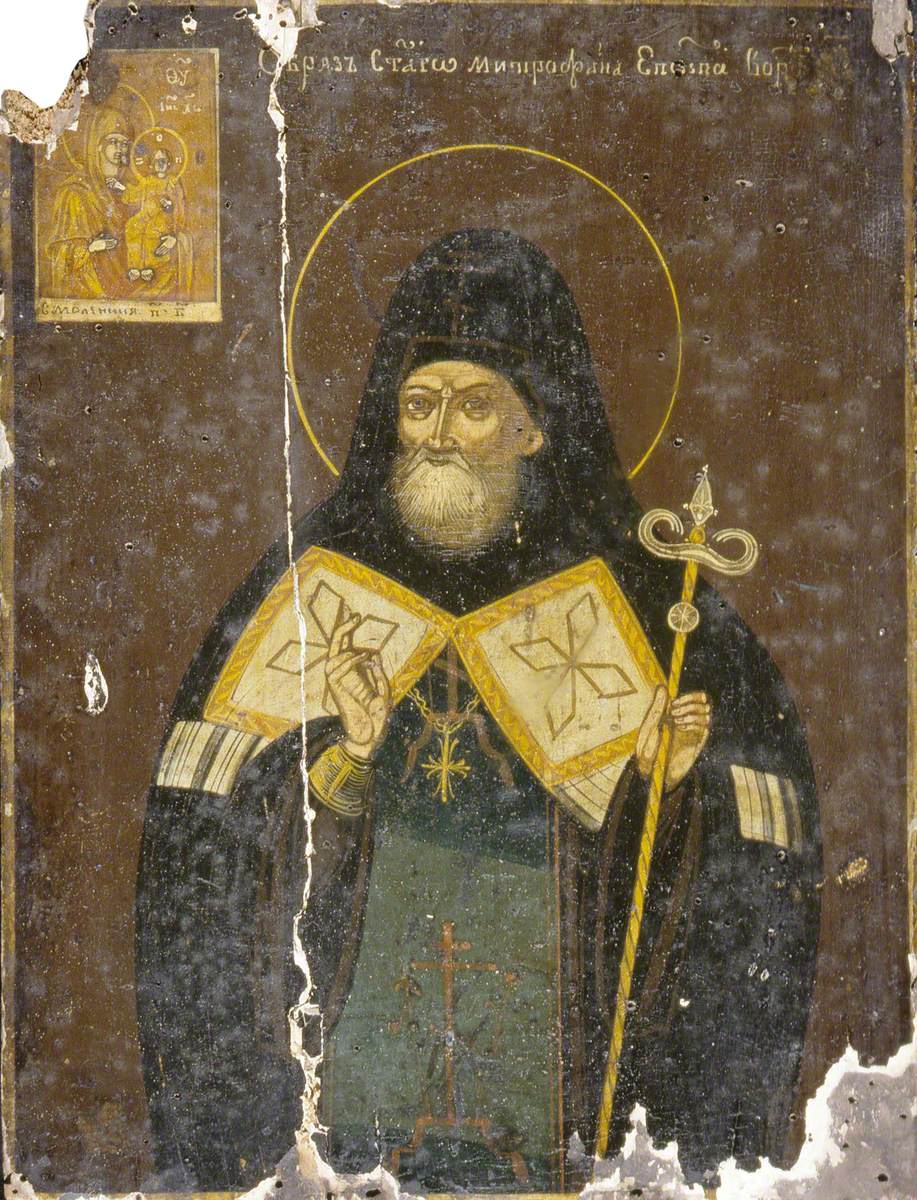
Metrophanes is depicted as an aged Russian hierarch in bishop's vestments — mitre, sakkos and omophorion — or, in reference to his death in the schema, in monastic schema-habit; he holds the Gospel or a scroll and blesses. His incorrupt relics and the schema-name Macarius are often recalled in the accompanying inscriptions. The stored image is a nineteenth-century Russian icon of the saint (Brighton Museum & Art Gallery), identified in its cataloguing as Metrophanes of Voronezh.
Disputed questions
- Not to be confused with Metrophanes of Constantinople (†c. 326, commemorated June 4), the first bishop of Byzantium to be styled Patriarch, the ancient hierarch of the age of Constantine and Nicaea. The Voronezh saint is the seventeenth–eighteenth-century Russian bishop; Russian icons inscribed simply "Saint Metrophanes" almost always depict him.