
Michael and Theodore of Chernigov
The Holy Martyrs and Confessors Michael, Prince of Chernigov, and his Boyar Theodore, Wonderworkers
Martyr · Confessor · Prince · Wonderworker · b. 1179 — d. 1245 or 1246
Commemorated 14 February — Translation of the relics to Moscow, 1578, 20 September — Martyrdom at the Horde
Michael Vsevolodovich, Prince of Chernigov and for a time Grand Prince of Kiev, and Theodore, his boyar and faithful counsellor, were put to death at the camp of Batu Khan in 1245/6, in the first generation of the Mongol yoke over Rus'. Summoned to the Horde to receive the khan's charter for his principality, Michael was willing to bow to the khan as an earthly ruler but refused the pagan rites demanded of arriving princes — passage between the purification fires and veneration of the Mongols' idols and elements — and was beaten and beheaded; Theodore, offered his master's principality if he would conform, followed him in the same confession and death. The protomartyrs of the Horde, glorified as wonderworkers of Chernigov, their relics have rested since the sixteenth century in the Moscow Kremlin.
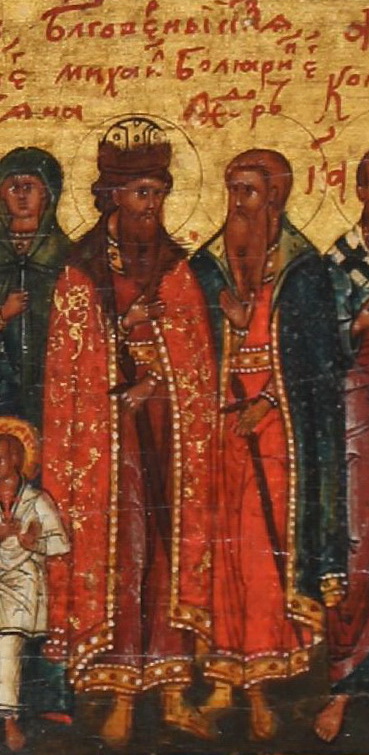
_-_September_-_34_Michail_and_Theodore_of_Chernigov.jpg)
Origins and early principate
Michael was born in 1179 (so the older chronicle reckoning; see Disputed questions), son of Vsevolod Svyatoslavich Chermny ("the Red," † 1212), of the Olgovichi line of Chernigov, and through his mother connected to the princely house of Poland. The hagiographic tradition remembers the boy as pious and meek, and of frail health: in 1186 he was taken to the ascetic Nikita the Stylite at Pereyaslavl-Zalessky, whose prayer — and the wooden staff the stylite handed down from his pillar — restored him, a healing the Russian church remembered in the services of both saints.
His adult life was passed in the endless rotation of princely seats that marked pre-Mongol Rus'. He fought in 1223 at the disastrous battle of the Kalka, the Mongols' first blow against the Rus' princes, where his uncle Mstislav of Chernigov fell; Michael succeeded to Chernigov. In 1225, and again in 1229, Novgorod called him to its princely seat; the chroniclers credit him there with justice and mildness — he relieved the taxes of the poorer citizens — and his accession reconciled Novgorod with Grand Prince George of Vladimir, whose wife Agatha was Michael's sister. Declining to hold Novgorod, he returned to Chernigov, telling the Novgorodians that their cities should be as kindred, and he their bond. The 1220s and 1230s show him at the centre of the princes' quarrels and reconciliations — restrained from war with Oleg of Kursk in 1227 by Metropolitan Cyril, mediating between Kiev and Galich the same year — and from 1235/6 he held Kiev itself, taking the title of Grand Prince as the Mongol storm gathered.
The Mongol invasion
In 1237–1238 the armies of Batu annihilated Ryazan, Suzdal and Vladimir; in 1239 they ravaged the lands of Pereyaslavl and Chernigov. When the khan's envoys came before Kiev demanding surrender, Michael refused to treat (the chronicles say his men killed the envoys), and, knowing the city doomed, he rode west to seek help: to Hungary, where he sought (and eventually made) a marriage alliance for his son Rostislav with the daughter of King Béla IV, and toward Poland and the Empire. No coalition came; Kiev fell in December 1240, and Michael returned by stages to the ruins, living first on an island below the city, then again at Chernigov. He did not abandon the hope of a common Christian front: at the Council of Lyons in 1245, Metropolitan Peter (Akerovich), sent from Rus' — the hagiographic tradition counts him Michael's emissary — pleaded the plight of the devastated land before the West; nothing followed but the Latin powers' own designs on Rus'.
The summons to the Horde
The Mongols consolidated their rule by charter: each surviving prince was summoned to the Horde to bow before the khan and receive his yarlyk, the patent to rule his own land. The summons came to Michael. He understood — the Life is explicit — that submission to the khan's earthly authority was lawful and, for his ruined people, necessary; but he knew also that princes arriving at the Horde were required to pass through the ritual fires, held by the Mongols to purge evil intent, and to venerate their idols and the sun — and that this a Christian could not do. He sought the blessing of his spiritual father, Bishop John, who confirmed him in his resolve and gave him and his companion the reserved Holy Gifts against the death they foresaw. With him went his boyar Theodore, his counsellor of many years and companion of his embassies, of one mind with his prince.
Martyrdom
At the camp of Batu on the lower Volga, in 1245/6, the Mongol priests commanded Michael and Theodore to pass between the two fires and worship the sun, the fire, and the idols of the khan's ancestors. Michael answered: "A Christian worships the one God, the Creator of the world, and not the creation." Batu's officer Eldega put the choice plainly — perform the rite, or die. Michael replied that to the khan, to whom God had given the kingdoms of the earth, he would bow; but the rites he would not perform, for he was a Christian. His grandson Boris, prince of Rostov, was present and pleaded with him to yield, his boyars offering to take the penance of the act upon themselves; Michael answered with the word of the Gospel — whoever would save his life shall lose it — and would not, he said, be a Christian in name and do the deeds of the pagans. Prince and boyar received the Holy Gifts they carried, sang the psalms of the departing, and waited. The executioners fell on Michael, beat him long and savagely, and at the last a renegade Christian named Doman (of Putivl, in the Russian account) cut off his head. Theodore was then courted as well as threatened: the khan's men promised him honour and his late master's principality if he would pass through the fires. He refused, confessed Christ as his prince had done, was tortured and beheaded in his turn. The bodies, thrown to the dogs, were preserved unharmed — the tradition records a pillar of fire seen over them — until Christians buried them secretly. The martyrdom is dated 20 September; on the year (1245 in the church books, 1246 in the chronicles and in the report of the papal envoy John of Plano Carpini, who crossed the steppe months later and recorded the prince's death) see Disputed questions.
Relics, glorification, and later cultus
The martyrs' effect on their conquerors is soberly noted by the tradition: the Horde thereafter ceased to demand the pagan rites of arriving Russian princes, convinced that these would die rather than conform — so that the protomartyrs of the Horde, as the Russian church calls them, purchased with their blood the religious liberty of all who came after. Their bodies were brought back and laid at Chernigov, where a cathedral of the "wonderworkers of Chernigov" long guarded them and miracles were recorded at the shrine. Local veneration began almost at once — the earliest short accounts of the martyrdom were written within the generation, one redaction associated with the priest Andrew, a witness-tradition of the event — and the pair were among the saints confirmed for church-wide veneration by the Moscow councils of 1547 under Metropolitan Macarius; the full Life and the service were composed in the mid-sixteenth century by Zinovy of Otensk. In 1572 (the received church date, February 14, 1578), Tsar Ivan IV had the relics translated from Chernigov to Moscow, to a church built for them in the Kremlin; they were moved to the Sretensky cathedral in 1770 and in 1774 to the Archangel Cathedral of the Kremlin — the burial church of the Muscovite princes — where they rest today. Michael stands at the head of a remarkable line of sanctity: his daughter Euphrosyne of Suzdal (September 25) and his grandson Oleg of Briansk (September 20, the same day) are glorified saints, and the later princely martyrs of the Horde — Roman of Ryazan, Michael of Tver, and the rest — died with his example before them.
Feast and commemoration
September 20 (church date; Old Calendar civil October 3), the day of the martyrdom, kept within the afterfeast of the Elevation of the Cross; and February 14 (Old Calendar civil February 27), the translation of the relics to Moscow. The commemoration is of Russian origin and belongs to the Slavic universal calendar: it is kept by the Moscow Patriarchate and the whole Russian tradition (with the saints also honoured in the Synaxis of Moscow Saints, Sunday before August 26, as Kremlin wonderworkers, and in the local synaxes of Chernigov, Bryansk and Tula saints) and appears in the OCA calendar, whence this day's enumeration; the Greek synaxaria do not list it. OCA styles the feast "Holy Martyr and Confessor Michael and his councilor Theodore, Wonderworkers of Chernigov."
Hymns
Troparion — Tone 4
Having accomplished your lives in martyrdom and been adorned with the crowns of confession, ye ascended to the things of heaven, O most wise Michael with the valiant Theodore: pray Christ God to preserve your fatherland, and the city and the people, according to His great mercy.
Original translation from the Slavonic
Kontakion — Tone 8
Accounting the kingdom of the earth as nothing, thou didst forsake its glory as a passing thing, coming of thine own accord to the contest; thou didst proclaim the Trinity before the impious tormentor, O passion-bearer Michael, with the valiant Theodore: standing before the King of hosts, pray that your fatherland, the city and the people be preserved unharmed, that we may honour you unceasingly.
Original translation from the Slavonic
Iconography
Michael is depicted as a middle-aged prince with a rounded dark beard, in the fur-trimmed cap and brocaded mantle of the Rus' princes, most often holding a cross (the martyr's attribute) and sometimes a sword; Theodore stands beside him as an elder layman, bearded, in boyar's dress, likewise with the martyr's cross — the two almost always shown as a pair, a princely counterpart to the warrior pairs of Byzantine iconography. Narrative scenes of the martyrdom — the fires, the idols, the beheading — appear in illuminated chronicles and hagiographic border-scenes (zhitiynye kleyma) of Russian icons, and the pair enter the great menaion-icons for September. Their shrine-cultus in the Kremlin produced images into the seventeenth century, including frescoes in the Archangel Cathedral where the relics lie. The stored image is the September panel detail from a Central Russian menaion icon of the first quarter of the 17th century (Church Archaeological Cabinet of the Moscow Theological Academy), showing the two martyrs standing together.
Disputed questions
- Year of birth. The chronicle-based reckoning gives 1179; modern scholarship, doubting a sixty-six-year-old at the Horde and re-reading the genealogies, often places his birth c. 1185–1195. The OCA life records both 1179 and 1195. Undecidable on the sources; 1179 is kept in the entry's record as the traditional figure.
- Year of martyrdom. The Russian church books and the OCA calendar head the feast "†1245"; the Hypatian chronicle dating and the account of John of Plano Carpini — who was at the Horde within the year — point to 20 September 1246, and the OCA's own life speaks of the journey of 1246. Both are recorded here (died: 1245 or 1246); the day, September 20, is uncontested.
- Classification. The calendars title the pair "Martyrs and Confessors" — the double title (мученик и исповедник) is traditional and is kept in this entry's types, though in strict usage a confessor is one who suffers without dying: here it honours the public confession before the khan that preceded the death. They are martyrs in the full sense — killed precisely for refusing pagan worship — and not passion-bearers (the type of Boris and Gleb, who accepted unjust death not demanded on account of the faith), although the Tone 8 kontakion addresses Michael with the word "passion-bearer" (страстотерпче) in the loose older usage.
- Not to be confused. This Theodore, a lay boyar of the thirteenth century, is distinct from the hieromartyr Theodore of Alexandria (September 12), from the martyr Theodore of the company of Urban and Medimnus at Nicomedia (September 5), and from the great-martyrs Theodore the Recruit and Theodore the General. Michael of Chernigov is distinct from the later prince-martyr Michael of Tver (†1318), who also died at the Horde.