
Michael of Klopsk
Our Venerable Father Michael the Fool-for-Christ of the Klops Monastery, Novgorod
Fool for Christ · Venerable · Wonderworker · b. late 14th century — d. c. 1453, at the Klops Monastery near Novgorod
Commemorated 11 January — Repose at the Trinity–Klops Monastery
Michael of Klopsk (late 14th century – c. 1453) was a fool-for-Christ of Novgorod, one of the most beloved of the Russian holy fools. Of noble birth — the tradition makes him a kinsman of the Muscovite grand-princely house, of the line of Demetrius Donskoy — he abandoned rank and name to hide his sanctity under the mask of madness, and appeared one night, unbidden and unexplained, in the locked cell of the little Trinity monastery on the Klopsko river south of Novgorod. For some forty-four years he lived there in extreme asceticism, refusing to say who he was, reading and chanting in church, and receiving the gift of clairvoyance: he foretold the birth of the grand prince Ivan III and the fall of Novgorod's independence, rebuked princes and boyars to their faces, drew water from the dry ground in a drought, and multiplied the monastery's bread in famine. He reposed about the year 1453 and is commemorated on January 11.
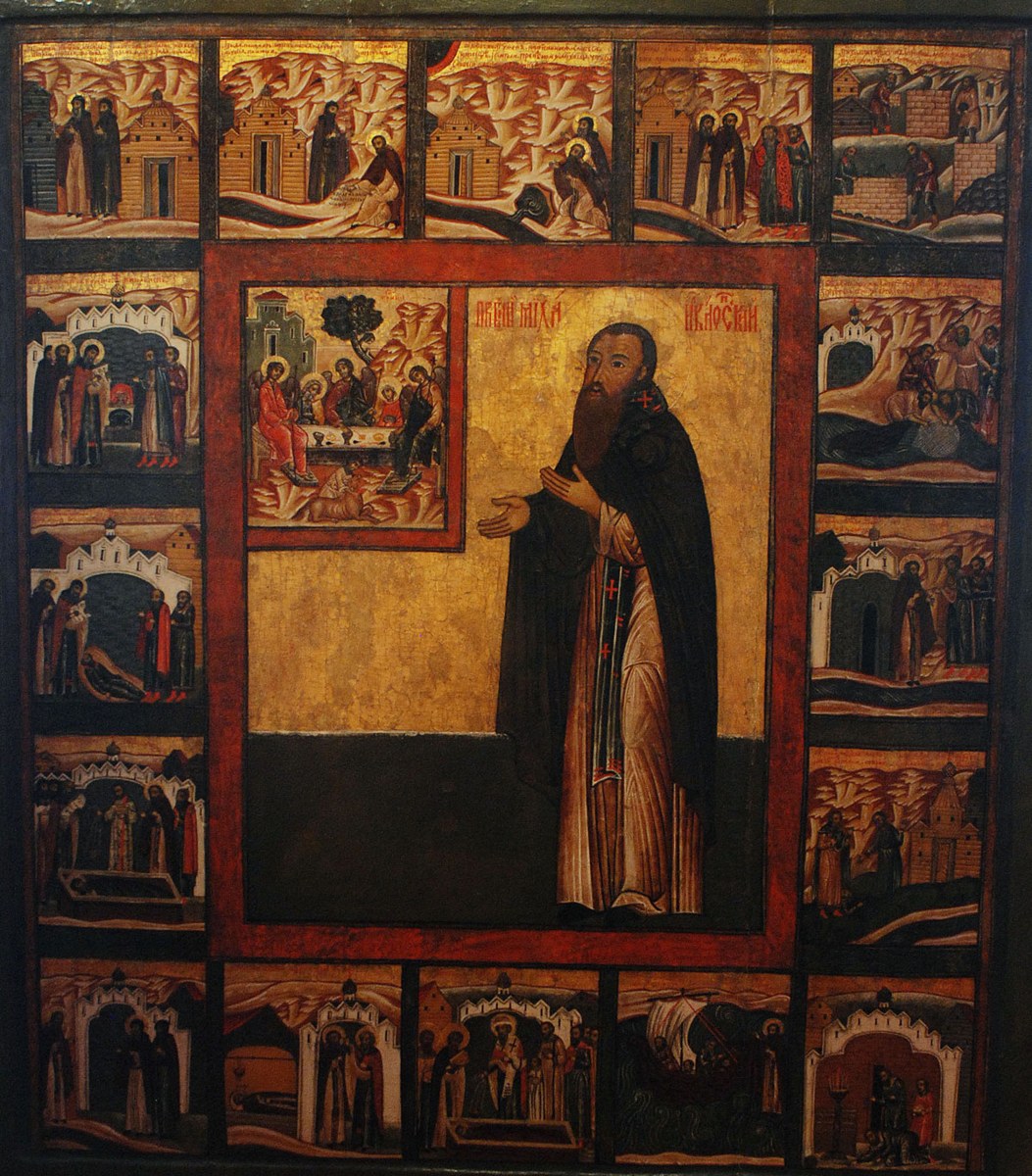

The memory of Michael of Klopsk is preserved chiefly in a Russian Life (the Povest) that took shape in Novgorod within a century or so of his death and was reworked more than once in the fifteenth and sixteenth centuries — a vivid, half-legendary text, rich in the sharp sayings and pointed prophecies that were the currency of the holy fool. Its outline is as follows.
The stranger in the locked cell
In the reign of the Novgorodian and Muscovite princes of the early fifteenth century, on the eve of a feast, the priest-monk Macarius of the little Trinity monastery on the Klopsko — a stream flowing into the Veryazha some fifteen miles south-west of Novgorod — returned from the service, censed his cell, and found it, though he had left it locked, already occupied: a man he had never seen sat within by candle-light, copying out the Acts of the Apostles. Neither the monk nor the abbot could learn who he was or how he had come in; to every question the stranger only repeated the question back, word for word, and would tell them neither his name nor his country. They received him nonetheless, seeing that he was a man of God, and gave him a place in the community. Because he was found writing the Apostle, and because the day was near a feast, the brethren took to calling him simply the stranger; the Life has the abbot name him Michael at the Liturgy.
His identity, the tradition says, was disclosed by accident. When a visiting prince, Constantine Dmitrievich — brother of the grand prince of Moscow — came to the monastery and heard the stranger reading aloud (from the Book of Job, the Life says), he knew him at once, bowed to the ground before him, and named him: Michael Maximovich, of the grand-princely kin. Only then was it understood that a man of the highest birth had chosen to bury himself, nameless, in a poor northern monastery, taking upon himself the folly for Christ's sake that he might flee the praise of men.
Ascetic life and the gift of prophecy
Michael lived at Klopsk, the Life reckons, some forty-four years, wearing out his body with labour, vigil and every kind of privation — sleeping on the bare ground, exposing himself to heat and cold, rain and snow, keeping a rigour of fasting that never relaxed. In church he sang in the choir and read the Epistle, and read the lives of the saints at the common meal, so that the brethren were moved by the grace of his reading. And to this hidden ascetic God gave the gift of clairvoyance and prophecy, which he used with the freedom of the holy fool, sparing no one.
He foretold the birth of the grand prince Ivan III — the Life gives the date, 22 January 1440 — and prophesied that this child would one day gather all the Russian land and put an end to the liberty of Novgorod, as indeed came to pass in 1478. He rebuked the prince Demetrius Shemyaka, the author of the civil wars of the age, for his crimes — above all for the blinding of the grand prince Basil II ("the Dark") — and foretold Shemyaka's own evil end. He spoke without fear to the powerful and the rich, denouncing injustice and oppression; and the archbishops and princes of Novgorod, far from resenting it, sought him out and honoured him.
To the poor his gifts were turned to mercy. In a time of drought and famine, when the monastery's spring had failed, Michael led the monks to a dry place, prayed, and a spring of water broke from the ground where he pointed; and through the famine the monastery's stores of bread did not fail, but were found to suffice however much was given away to the starving people who came to the gates.
Repose
Having lived out his long hidden warfare, Michael foretold his own death and pointed out the place where he wished to be buried. He reposed at the Klops monastery about the year 1453 (some accounts place it as late as 1456). He was buried in the monastery he had made famous, which came to be known after him; his relics rested there, and miracles were reported at his tomb. He was glorified as a saint of the Russian Church — his veneration confirmed at the Moscow councils of the sixteenth century — and he is numbered among the Novgorod saints and among that peculiarly Russian company, the fools for Christ, of whom Novgorod and Pskov were the great nurseries.
Feast and commemoration
Michael is commemorated on January 11 (church date; Old Calendar civil January 24), the day of his repose, within the afterfeast of the Theophany; his is a Russian commemoration, kept by the Moscow Patriarchate, the Church Abroad, and the OCA, and he appears also in the synaxis of the Saints of Novgorod. He is not to be confused with the several other saints named Michael of the Slavic calendar — the Archangel Michael; the martyred prince Michael of Chernigov (†1246); Michael, first Metropolitan of Kiev; or Michael the warrior of Bulgaria — the fool-for-Christ of Klopsk being a distinct saint of fifteenth-century Novgorod.
Hymns
Troparion — Tone 8
Thou who upon the earth, for Christ's sake, didst of thine own will take on the semblance of folly, and utterly didst despise the beauty of this world; who, withering the sportings of the flesh by fasting and thirst and by lying upon the ground, didst never turn aside from heat or cold, from rain or snow, nor from any other hardship of the open air, but didst cleanse thy soul with the virtues as gold in the furnace, O venerable and God-bearing father Michael: now thou standest in the heavens before the Throne of the All-holy Trinity. Wherefore, having great boldness before Him, pray thou to Christ our God that our souls may be saved.
Original translation from the Slavonic
Kontakion — Tone 8
By the power of the Holy Spirit thou wast made like the God-inspired prophets of old, foretelling things unknown and hidden, and that which by the judgements of God should come to pass; and working many other wonders in Christ and filling the people with wonder, thou didst move them to keep festival and to cry aloud: Glory to God, who glorifieth His saints.
Original translation from the Slavonic
Iconography
Michael is depicted as a Russian venerable and holy fool: gaunt from asceticism, in a monastic or a poor and scanty garment, often bare-headed, with a scroll or his hands raised in prayer. The characteristic image of Novgorod is the vita icon (икона с житием), in which a central standing portrait of the saint is framed by a border of small scenes narrating his Life — the mysterious arrival in the locked cell, the reading before the prince, the prophecies, the spring drawn from the dry ground, his repose and burial.
The stored image is such a vita icon, of the Russian North, seventeenth century: Michael standing in the centre, surrounded by the scenes of his life (source, public domain, pd-old-work).