
Monica
The Holy and Righteous Monica, Mother of Blessed Augustine of Hippo
Righteous · b. c. 331, at Tagaste in Numidia — d. 387, at Ostia
Commemorated 4 May — Commemoration of the mother of Augustine
Monica (c. 331–387) was a Christian woman of Tagaste in Roman North Africa, the wife of a pagan husband whom her patience won to the faith, and the mother of Augustine of Hippo, whose conversion she wept and prayed for through nearly twenty years of his heresy and disorder. She followed him from Africa to Rome and to Milan, where she attached herself to the church of Ambrose; she lived to see him baptised at Pascha of 387, and died a few months later at Ostia, on the way home, having told him that nothing further detained her in this life. Nearly everything known of her comes from her son's Confessions, which makes her one of the most vividly recorded women of the fourth century. The Orthodox calendars keep her on May 4.

Tagaste and her upbringing
Monica was born about 331 at Tagaste in the province of Numidia (the modern Souk Ahras in Algeria), into a Christian household of the Latin-speaking African provincial class. Her son records, with a novelist's precision, the detail of her formation: she was reared not so much by her mother as by an old family servant of severe principle, who had carried her father as a child and who kept the girls of the household from drinking even water between meals, on the ground that they would want wine when they had the keys to the cellar. The precaution proved wise: sent as a child to draw wine from the cask, Monica began to take a sip each time, then more, until a servant-girl in a quarrel called her a drunkard — and the shame of the word cured her. Augustine tells the story to make a point about how God uses the spite of others; it survives as one of the very few childhood anecdotes we possess of any ordinary woman of the fourth century.
Marriage to Patricius
She was married young, as the custom was, to Patricius, a modest landowner and municipal official of Tagaste: a pagan, generous but hot-tempered and unfaithful. Monica's conduct in that marriage is described by her son as a deliberate discipline. She never contradicted her husband in his anger, but waited and explained afterwards when he had cooled; she counselled the beaten wives of the town to hold their tongues, remarking drily that they had heard the marriage contract read and knew what they had agreed to; and she so managed her mother-in-law, who came to the house hostile and full of the tale-bearing of servants, that the old woman ended by loving her and had the tale-bearers whipped. Patricius, who had tolerated her religion for years without sharing it, was baptised near the end of his life and died about 371, when Augustine was seventeen. Monica did not marry again.
The long struggle for Augustine
She bore three children who are known: Augustine, a second son Navigius, and a daughter whose name is not given and who later led a community of women. Augustine — brilliant, restless, and from adolescence living with a concubine by whom he had a son, Adeodatus — became the labour of her life. She had had him signed with the cross and salted as a catechumen in infancy but, in the common practice of the age, not baptised. In his nineteenth year he embraced Manichaeism, and held it for some nine years.
Monica's response was neither silence nor scolding but a campaign of prayer, fasting and tears which her son remembered as continuous. At one point she refused him her house and table for his heresy, until a dream — in which she stood weeping on a wooden beam and a shining figure told her that where she was, there her son would be also — reversed her. She pressed the bishops of the province to argue with him; one of them, worn out, put her off with the sentence that became the most famous thing ever said about her: it is not possible that the son of these tears should perish. She took it, Augustine says, as if it had come from heaven.
When he determined to leave Africa for Rome, she came down to the harbour to prevent him or to go with him; he deceived her, pretending to be seeing a friend off, and sailed by night while she prayed in a chapel by the shore. She followed him across the sea regardless — first to Rome, then to Milan, where he had obtained the chair of rhetoric.
Milan, Ambrose, and the conversion
At Milan Monica attached herself to the bishop Ambrose, whom she revered and who in turn spoke of her to her son with respect, telling Augustine that he had a mother to be thankful for; Augustine notes that he did not then understand what Ambrose meant. Her African devotional habits met the discipline of the Milanese church and she submitted them to it: told that the custom of taking food and wine to the tombs of the martyrs was not practised there, she gave it up at once, and thereafter brought to the graves only her prayers.
She was in the house when the crisis came — the voice in the garden, the opened epistle to the Romans, the end of the long argument — and she received the news, Augustine says, with a joy that was more than triumph, because God had given her far more than she had asked. He resigned his chair, retired with his friends to Cassiciacum, and Monica was of the company there; in the dialogues he wrote in those months (De ordine, De beata vita) she appears as a participant, and her son puts arguments in her mouth and praises the quality of her mind, an extraordinary compliment from a professional rhetorician of that century. At Pascha 387 Augustine, his son Adeodatus, and his friend Alypius were baptised by Ambrose at Milan.
Ostia and repose
Her work being done, Monica wished only to go home to Africa. On the journey the party stopped at the port of Ostia, and there occurred the conversation at the window overlooking the garden which is the most celebrated page of the Confessions: mother and son, alone, reasoning together about the eternal life of the saints, until their minds rose past every created thing and touched, for one instant and together, the Wisdom that is before all ages. Afterwards she said to him that there had been one thing for which she wished to remain in this life a little longer — to see him a catholic Christian before she died — and that God had granted it abundantly, so that she no longer knew what she was doing here.
Within a few days she fell into a fever, and after nine days she reposed, in her fifty-sixth year, in the year 387. Asked whether it did not frighten her to be buried so far from her own town, she answered that nothing is far from God and that He would know where to find her at the end of the world. Augustine, who had held back his tears at the funeral, wept for her afterwards and prayed for her soul in the pages of his book, asking his readers to do the same — the earliest and most affecting request for prayer for the departed in Latin literature.
Relics and cultus
She was buried at Ostia, where an inscription commemorating her, in verses attributed to a fifth-century consul, was recovered in the fifteenth century and confirmed the tradition of the site. Her relics were translated to Rome in 1430, to the church of Sant'Agostino, where they remain. In the West her veneration grew immensely from the later Middle Ages, carried especially by the Augustinian orders; her feast was long kept on May 4 in the Roman calendar (moved in 1969 to August 27, the eve of her son's feast). The May 4 date is the one the Orthodox calendars have received.
Feast and commemoration
May 4 (church date; New Calendar civil May 4, Old Calendar civil May 17), the historic Western date, received into Greek synaxarion listings and into the OCA calendar. She is commonly invoked by mothers, and specifically for children who have fallen away from the faith — a patronage that follows directly from the shape of her life and from the bishop's word about the son of her tears. She is also, with her husband Patricius, an example appealed to in Orthodox pastoral writing on marriage to an unbeliever.
No proper Byzantine hymnography exists for her; the common of a righteous woman is sung. Where a parish keeps her feast the propers used are ordinarily composed locally.
Hymns
Troparion — Tone 8 (from the common of a righteous woman)
In thee the image was preserved with exactness, O Mother Monica; for taking up thy cross, thou didst follow Christ, and by thy deeds thou didst teach us to overlook the flesh, for it passeth away, but to attend to the soul, since it is immortal. Wherefore thy spirit, O righteous one, rejoiceth with the angels.
Original translation from the Greek
Kontakion — Tone 4
With prayers and with unceasing tears thou didst water the hard ground of thy son's heart, O Monica, until the seed of the word sprang up in it; and hearing the promise that the child of such tears could never perish, thou didst depart in peace, having seen thy hope fulfilled. Pray for all mothers who weep for their children.
Iconography
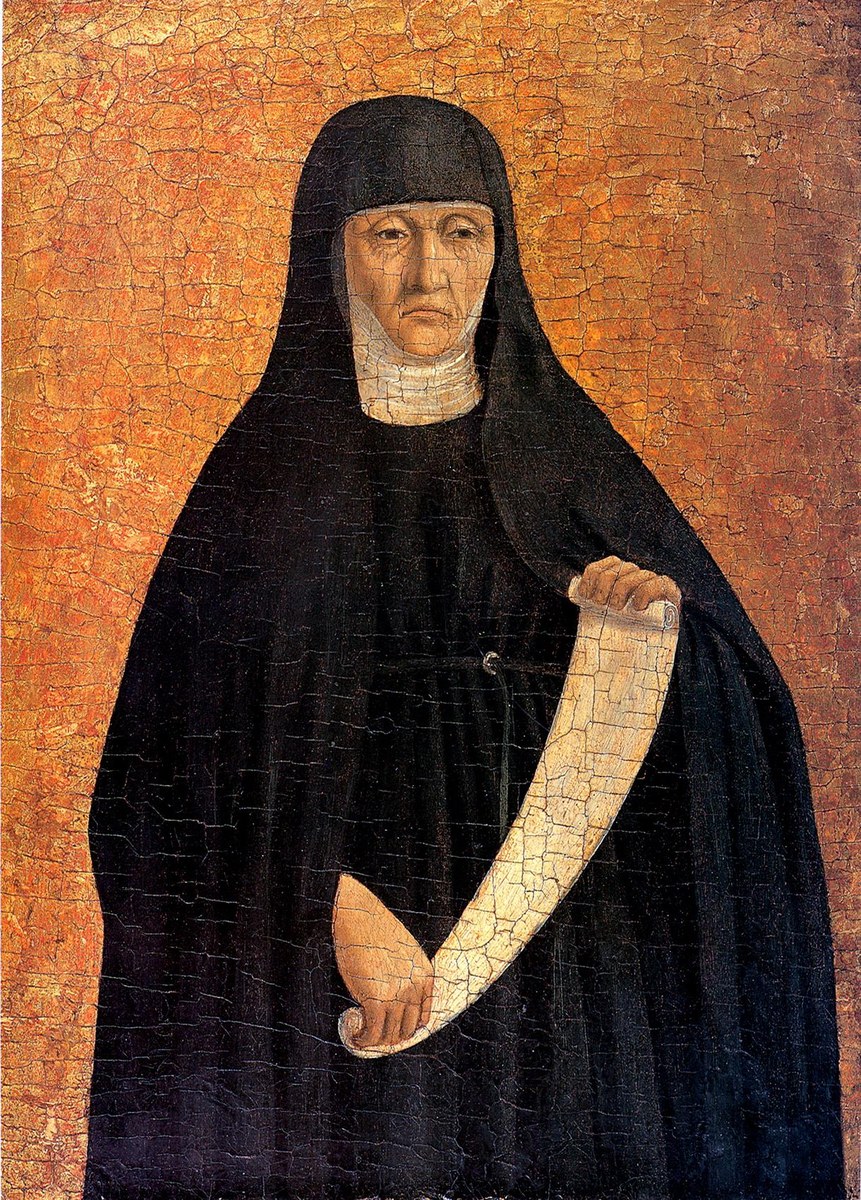
Monica has no ancient Byzantine iconographic type, her commemoration having entered Eastern usage late; the icons of her painted since the twentieth century — chiefly in English-speaking and Greek-American parishes, and in African Orthodox missions, which have taken up the North African saints with enthusiasm — follow the type of the holy matron: a woman of middle age in a dark maphorion and long tunic, without ornament, the hands lifted in prayer or one hand holding a scroll. Two variants are usual. In the first she is shown alone, weeping or in the orans posture, and the scroll bears the bishop's promise about the son of her tears. In the second, and more common, she is shown with Augustine: the two either side by side as a pair, she in the maphorion and he vested as a bishop with the Gospel and the omophorion, or in the scene at the window of Ostia, mother and son seated in conversation with the light of the vision above them. Where she appears with a book it is her son's, not her own.
The Western tradition, by contrast, is very rich, and the pre-1900 devotional paintings of her by Verrocchio, Botticini and others are genuinely out of copyright; they are Latin panel-paintings rather than icons, however, and none has been stored here.
The stored image is a Western work per §34: a mid-15th-century Italian panel of the saint in the dark widow's habit. An Eastern image remains wanted and is listed among the upgrade-wanted icons.
Disputed questions
- Whether Orthodox calendars keep her. They do, and the attestation is not merely Western. The Orthodox Church in America carries a proper entry for "Saint Monica" on May 4 in its Lives of the Saints, explicitly stating that the Orthodox Church commemorates her on that day and naming her as a patron of mothers interceding for wayward children; the Greek synaxarion listings for May 4 likewise include Ἁγία Μόνικα, mother of St Augustine; and OrthodoxWiki gives "St Monica of Tagaste, mother of Augustine (387)" for the day. She is not in the printed Slavic Menaion for the day and does not appear on the azbyka.ru day-page for May 17 civil, so her presence is Greek and American rather than Russian. She was accordingly authored here rather than deferred; but it should be understood that the May 4 date itself is the old Western feast, adopted into Orthodox usage rather than independently transmitted by the Byzantine synaxarion, and that no proper Byzantine service exists for her.
- Her classification. She is righteous — a laywoman of the pre-schism West, neither martyr nor ascetic, honoured for holiness in the married and maternal state. This is the same category under which the Orthodox calendar keeps the righteous men and women of the Old and New Testaments and the holy parents of saints.
- Her son. Augustine of Hippo (†430) is himself commemorated in Orthodox usage on June 15, with the epithet blessed rather than father among the saints in most Greek reckonings — a distinction reflecting the long Eastern reserve about parts of his theology (predestination, the filioque's later appeal to him). None of that reserve touches Monica, whose sanctity no tradition has questioned. His entry, authored at his June 15 feast, links back to this one.
- The spelling of her name. The African inscriptions and the best manuscripts of the Confessions give Monnica, with a double n, a name of probable Libyan or Punic origin possibly connected with the local deity Mon of Thibilis. Monica is the later-standardised Latin form and the one all calendars use.