
Augustine of Hippo
Our Father among the Saints Augustine the Blessed, Bishop of Hippo Regius
Bishop · b. 13 November 354, at Thagaste in Numidia — d. 28 August 430, at Hippo Regius
Commemorated 15 June — The Orthodox commemoration of the Bishop of Hippo
Augustine (354–430), Bishop of Hippo Regius in Roman North Africa, is the most consequential writer of the Latin Church: a provincial rhetorician of great gifts and disordered life who passed through Manichaeism and academic scepticism to Neoplatonism and at last, at Milan under the preaching of Ambrose and the prayers of his mother Monica, to baptism in his thirty-third year. He returned to Africa a monk, was made priest and then bishop of Hippo against his will, and for thirty-five years preached, judged, wrote and fought — against the Manichees, the Donatist schism and the Pelagians — leaving the Confessions, the City of God, On the Trinity, and some hundreds of other works and sermons. The Orthodox Church commemorates him on June 15, with the epithet blessed rather than the fuller style of a father among the saints in most Greek reckonings: a real veneration, and a real reserve about parts of his teaching on grace and predestination, and about the later Western appeal to him for the filioque.
.jpg)
Thagaste: a Numidian boyhood
Augustine was born on 13 November 354 at Thagaste (Souk Ahras in modern Algeria), a small municipality of Numidia in the Latin-speaking African provinces. His father Patricius was a minor town councillor of pagan religion, of some standing and little money, who was received into the Church only at the end of his life and died when his son was about seventeen. His mother Monica was a Christian of the African church, tenacious, formidable, and — as her son's account admits without flattery — capable of a devotion that was sometimes hard to distinguish from possessiveness. He had a brother, Navigius, and a sister who later governed a community of women.
He was educated at Thagaste and at Madauros, and then, on the money of a wealthy patron named Romanianus, at Carthage. The Confessions record the boyhood of an intelligent, idle, frightened child who was beaten at school, who hated Greek and loved Virgil, and who wept for Dido and not for his own soul; the theft of the pears from a neighbour's tree, taken for the sheer pleasure of the transgression, has become the most discussed act of petty crime in Western literature. At Carthage he encountered, in his own phrase, a cauldron of illicit loves; he took a concubine whose name he never gives and who bore him a son, Adeodatus, and he lived with her faithfully for some fifteen years.
Cicero, the Manichees, and the flight to Italy
At nineteen the reading of Cicero's lost dialogue Hortensius turned him toward philosophy and the love of wisdom; but Scripture, when he opened it, repelled him by the crudity of its Latin and the moral squalor of the patriarchs. He fell in instead with the Manichees, and remained a hearer of that sect for nine years. Their appeal was intellectual: they promised reason instead of authority, they explained evil by making it a substance and a rival kingdom, and they released the enquirer from responsibility for his own faults. He taught rhetoric at Thagaste and then at Carthage, and slowly wore out his confidence in the Manichaean cosmology; the meeting with their great teacher Faustus of Mileve, an eloquent man who could not answer an astronomical question, finished it.
About 383 he left Africa for Rome, deceiving his mother at the harbour and sailing without her; the African students at Carthage were riotous and the Roman ones, he found, were worse, in that they did not pay. Through the patronage of the pagan prefect Symmachus he obtained the public chair of rhetoric at Milan — the imperial capital, and the front rank of his profession. He was thirty. Monica followed him. Under family pressure he dismissed his concubine, who returned to Africa vowing never to know another man, and became engaged to an heiress not yet of age; the interval he filled with another mistress, and it is of this period that the famous prayer belongs — give me chastity and continence, but not yet.
Milan: Ambrose, Plotinus, and the garden
Three things converged at Milan. The first was the preaching of the bishop, Ambrose, whose allegorical exposition of the Old Testament showed Augustine that the Scriptures he had despised could be read with intelligence, and whose personal dignity he watched with a professional's eye. The second was the discovery of the Platonists — Plotinus and Porphyry in Latin translation — who taught him to conceive of God and the soul as incorporeal and of evil as a privation rather than a substance, demolishing at a stroke the Manichaean dualism he had never quite escaped. The third was the accumulated pressure of example: the story of the conversion of the rhetor Victorinus; the Life of Antony, brought to him by the African official Ponticianus, and the account of two courtiers at Trier who read it and abandoned the world in an afternoon.
The crisis came in a garden in Milan in the late summer of 386. Torn between the two wills in him, weeping under a fig tree, he heard a child's voice from a neighbouring house repeating tolle lege, take and read; he opened the letters of Paul at Romans 13, not in rioting and drunkenness… but put on the Lord Jesus Christ, and, as he says, the light of certainty poured into his heart and every shadow of doubt was gone. He resigned his chair, withdrew with his mother, his son and his friends to a country house at Cassiciacum, and at Pascha 387 was baptised at Milan by Ambrose, together with Adeodatus and his friend Alypius.
Monica, having seen it, died a few months later at Ostia on the journey home, after the conversation at the window that is the summit of the Confessions; her own entry in this repository gives that scene in full. Adeodatus, a boy of extraordinary promise, died soon afterwards.
Priest and bishop of Hippo
Augustine returned to Africa in 388, sold his patrimony, and established at Thagaste a community of "servants of God" — a lay monastery of study, prayer and shared property, the seed of the Augustinian rule. In 391, visiting Hippo Regius on business and taking care (he says) not to enter any town in need of a bishop, he was seized by the congregation in the church and presented to the aged Greek bishop Valerius for ordination to the priesthood; he wept, and was ordained. In 395 Valerius, contrary to the canons, had him consecrated coadjutor bishop, and on Valerius's death he succeeded to the see. He held it for thirty-five years.
What that meant in practice is easily lost behind the books. A late-Roman bishop was the judge of his city: Augustine sat in the audientia episcopalis hearing property disputes, family quarrels and criminal complaints, sometimes all day; he interceded with governors for prisoners and against torture and the death penalty; he administered the church's land and its charities; he preached constantly, often daily, in a Latin pitched deliberately at dockworkers and farmers — better that they should blame our grammar than that the people should not understand. Some six hundred of his sermons and the vast Expositions of the Psalms survive from that pulpit. He lived with his clergy in community, under rule, and without private property.
The three controversies
The Manichees. His first published battles were against his old sect, and out of them came his lifelong doctrine of evil as privation — no substance, no rival principle, but the wounding and turning-away of a good nature. The Church's tradition has taken this over substantially without reserve.
The Donatists. Africa had been split since the persecution of Diocletian between the Catholic communion and the rigorist Donatists, who held that the sacraments of traitors and their successors were void. Augustine was the intellectual force behind the Catholic case at the Conference of Carthage in 411, and it was in this quarrel that he worked out what became the Western theology of the Church and the sacraments: that the validity of a sacrament rests on Christ and not on the holiness of the minister, that schism is a wound in charity, and that the Church in this world is a mixed body. It is also in this quarrel that he came, with visible reluctance and after long resistance, to accept the use of imperial coercion against schismatics — a position later Christendom used far beyond anything he proposed, and one that Orthodox readers have generally judged his gravest practical error.
The Pelagians. The last twenty years were consumed by the dispute with Pelagius and Julian of Eclanum over grace, freedom and original sin. Against the Pelagian claim that a man may keep the commandments by his own unaided will, Augustine insisted that fallen humanity is a massa damnata incapable of the beginning of good without grace; that grace is not merely offered but effective; and, in his final works, that God's predestination of the elect precedes and does not depend upon any foreseen merit. The Church, East and West, upheld him against Pelagius: the necessity of grace and the reality of the ancestral fall are Orthodox doctrine, and were affirmed at Carthage (418) and Ephesus (431). The further propositions of the late anti-Pelagian works are another matter, and are treated below.
The City of God, and the end
When Rome fell to Alaric in 410 and the pagan remnant blamed the Christians for the abandonment of the old gods, Augustine began the work of thirteen years that is his greatest: the City of God against the Pagans, twenty-two books that dismantle Roman religion and Roman historiography and then set out a theology of history in which two societies, formed by two loves — the love of God to the contempt of self, and the love of self to the contempt of God — are intertwined in every institution and separated only at the end. Its refusal to identify any earthly polity, Christian empire included, with the Kingdom is the element in Augustine that Orthodox political theology has found most useful.
He died on 28 August 430, aged seventy-five, while the Vandals of Genseric were besieging Hippo; he had had the penitential Psalms written up on the walls of his room and read them weeping. His biographer and disciple Possidius, who was with him, records that he left no will, having nothing, and that he had ordered the church's library preserved. The last work of his life was the Retractations, a review of his own writings correcting what he had come to think mistaken — an act of intellectual honesty with few parallels in antiquity. Possidius reckoned his output at some thousand titles.
Relics
The relics were carried from Hippo to Sardinia when the Vandal persecution intensified, and thence, in the early eighth century, to Pavia in Lombardy, where they rest in the basilica of San Pietro in Ciel d'Oro; the OCA notice states this and adds that a portion is kept at the monastery of St Meletios at Villia in Attica, Greece. A relic was returned to Annaba (the modern town at Hippo) in 1842.
Feast and commemoration
June 15 (church date; New Calendar civil June 15, Old Calendar civil June 28) — a synaxarion commemoration without a proper Byzantine office, on the day whose service belongs to the Prophet Amos, and shared with Jerome of Stridon, his correspondent on the translation of the Scriptures from the Hebrew. His mother Monica is kept on May 4, and the two entries are cross-referenced. The West keeps him on 28 August, the day of his death, and the whole Augustinian family of orders with it.
Veneration of Augustine in the East is real but thin on the ground: there are few churches and few icons, and no proper hymnography. Where his feast is kept the propers are the common of a hierarch. The reception of his memory in the Greek-speaking world was helped by the translation of parts of his work by Maximus Planoudes in the thirteenth century, and in the Russian world by the eighteenth-century Slavonic translations; he is read now with increasing seriousness in Orthodox theological schools, and the African Orthodox missions have taken up the North African fathers, Augustine and Monica among them, with particular enthusiasm.
Hymns
Apolytikion — Tone 8 (from the common of a hierarch and teacher)
O guide of Orthodoxy and teacher of piety and holiness, luminary of the Church of Africa and God-inspired ornament of hierarchs, O wise Augustine, by thy teachings thou hast enlightened all: intercede with Christ God that our souls may be saved.
Kontakion — Tone 2
Late didst thou love the Beauty that is ancient and ever new, O father Augustine; and being found by Him whom thou didst seek so long, thou didst give thy tongue and thy pen and thy whole life to His service: entreat Him that our restless hearts also may find their rest in Him.
Original translation from the Greek
Iconography
There is no ancient Byzantine iconographic type of Augustine, his commemoration having entered Eastern usage late and thinly. The modern Greek and Russian icons of him — nearly all of the twentieth and twenty-first centuries — follow the standard type of the Latin-rite father received into the East: an elderly hierarch, dark- or grey-bearded and balding, vested in phelonion and omophorion with the Gospel or a scroll, blessing; sometimes with a flaming heart in the hand, an attribute borrowed frankly from the Western repertory, and occasionally with a model of the two cities. He is very often painted with Monica, either as a pair or in the scene at the window of Ostia; his mother's entry describes that variant.
The Western tradition is enormous and quite different — the bishop in mitre and cope with the flaming heart, the pierced heart, the child at the seashore emptying the sea with a shell (the vision on the Trinity), the study, the disputes with heretics — and the pre-1900 examples of it, from Botticelli and Carpaccio to the Spanish baroque, are genuinely out of copyright, but they are Latin panel-paintings and altarpieces rather than icons and none has been stored here.
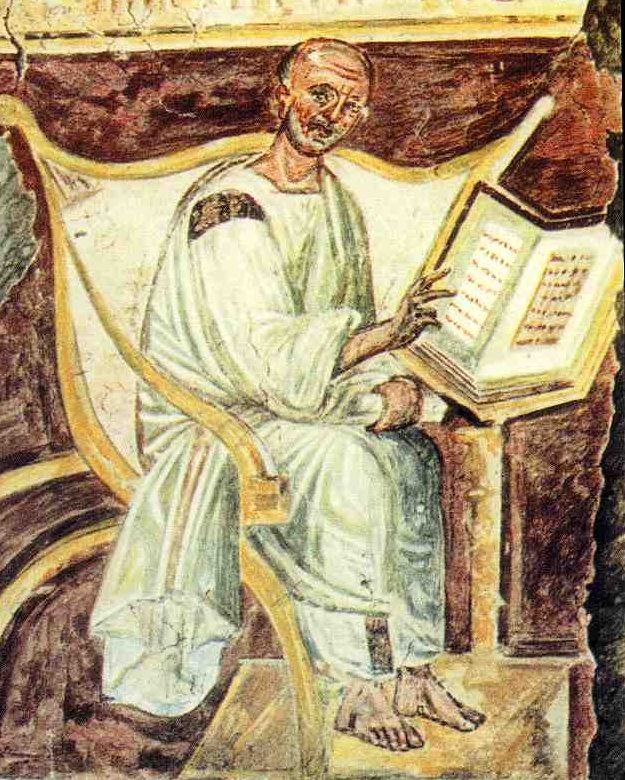
The stored image is the earliest known portrait of Augustine: a fresco of about 550–600 in the chapel of the Sancta Sanctorum at the Lateran in Rome, painted within a century and a half of his death and very possibly transmitting a memory of his appearance. He is shown seated in a high-backed chair in a pale tunic and pallium, tonsured, lightly bearded, one hand turned toward an open book on a lectern, the other holding a scroll — the type of the doctor at his desk in its oldest form, before either the Byzantine hierarch's vesture or the Western mitre existed to be given him. The crop preserves no legible inscription; the identification is that of the standard scholarly literature on the Lateran frescoes and of the Commons file description, and it is on that jurisdiction-independent scholarly attribution, rather than on an epigraph read here, that the image is stored.
Disputed questions
- Why June 15? That the Orthodox Church commemorates Augustine on June 15 is stated plainly by the OCA synaxarion, which contrasts it with the Western 28 August, the day of his death; Greek listings give Αὐγουστῖνος ἐπίσκοπος Ἵππωνος on the same day, and the Slavic books have Августин, епископ Иппонийский. Why the day is June 15 is not explained in any source consulted here. It is not the anniversary of his death, and none of the sources assigns a translation of relics to it — the transfers to Sardinia and to Pavia are not dated to June 15 in the material available, and the Western commemoration of the Pavia translation falls elsewhere. It is recorded here as an open question, and the feast is entered as primary rather than translation-of-relics, since to call it a translation would be to assert what cannot be shown. That June 15 also carries Jerome suggests a deliberate Byzantine pairing of the two Latin doctors on one day, which would explain the placing without an anniversary.
- "Blessed" and not "saint"? Greek usage very generally styles him μακάριος, blessed, rather than ἅγιος or the full hierarchical style, and the Slavic books likewise say блаженный. In Greek and Slavonic that word does not mean a lower grade of sanctity in the Western canonical sense — it is used of undoubted saints, including Blessed Theodoret and Blessed Jerome — but its consistent use of Augustine does register the Eastern reserve about parts of his teaching. His sanctity has never been denied; the Church of Greece confirmed his commemoration explicitly in the twentieth century, and he is named in the Synodikon of Orthodoxy's line of the fathers in some recensions. The classification here is bishop, with the epithet the Blessed carried in official_name.
- Grace, freedom and predestination. This is the substance of the Orthodox reserve. The East holds with Augustine and against Pelagius that no good is begun without grace, and that the fall of Adam wounded the whole race. It does not follow him in the late doctrine of a predestination of a fixed number of the elect anterior to any foreseen response, nor in the reading of the fall as inherited guilt rather than inherited mortality and corruption, nor in the account of concupiscence that follows from it — and it holds, with John Cassian and the fathers of Gaul who first raised the objection, that grace and the created will genuinely co-operate (synergeia), the will neither initiating nor being overridden. Orthodox writers differ sharply in tone about this: some treat it as a father's excess in the heat of controversy, others as the root of the West's later divergences on original sin, merit and justification. What is not in dispute is that the propositions were never received by the East and cannot be cited as Orthodox teaching on Augustine's authority.
- The filioque. Augustine's Trinitarian language in On the Trinity — the Spirit as the mutual love and gift of Father and Son, proceeding principaliter from the Father — was the quarry from which the later Latin defence of the filioque was cut, and this is the second ground of Eastern reserve. In fairness to him: Augustine did not add the word to the Creed, insisted that the Father is the sole principium in the Godhead, and wrote before the question had been posed as one of dogma; the interpolation is Spanish and Frankish and centuries later. But it is not an accident that the appeal was made to him, and Orthodox criticism of the psychological analogy for the Trinity — the mind, its knowledge and its love — as tending to blur the distinction of the Persons into relations within a single essence is a substantive criticism and not merely a polemical one. The honest statement is that the East honours him as a father, does not treat him as a measure of Trinitarian theology, and reads him on this subject through the Cappadocians rather than the reverse.
- Not to be confused with Augustine of Canterbury (†c. 604, May 26), the monk sent by Gregory the Dialogist to the English, a different man of the same name two centuries later.