
Moses the God-seer
The Holy Glorious Prophet and God-seer Moses
Prophet · b. c. 1689 BC (traditional reckoning) — d. c. 1569 BC (traditional reckoning)
Commemorated 4 September — Principal commemoration of the Prophet
Moses, the God-seer and Lawgiver, is the greatest figure of the Old Covenant: the Hebrew child drawn from the Nile who spoke with God in the Burning Bush, led Israel out of Egypt through the Red Sea, received the Law on Sinai, and guided the people forty years in the wilderness before dying within sight of the promised land. The Orthodox Church venerates him as the first and chief of the prophets — the man "whom the Lord knew face to face" — reads his books and sings his odes throughout the liturgical year, sees in the bush that burned unconsumed the great type of the Theotokos, and beholds him standing beside Christ in glory at the Transfiguration. His principal feast is September 4.

Moses's life fills four books of Scripture (Exodus through Deuteronomy), and the account below follows that record, which the Church receives as his own testimony.
Origins and early life
Moses was born in Egypt to Amram and Jochebed, of the tribe of Levi (Exodus 6:20), in the generation when the pharaoh, fearing the increase of the enslaved Hebrews, ordered every male infant drowned in the Nile. Hidden three months by his mother, he was set adrift in a basket of papyrus daubed with pitch among the reeds, watched by his sister Miriam; the daughter of Pharaoh drew him from the water — his name is explained in Scripture from the drawing out (Exodus 2:10) — and raised him at court as her son, with his own mother, unrecognised, for his nurse. Stephen the Protomartyr summarises the tradition: Moses "was learned in all the wisdom of the Egyptians, and was mighty in words and in deeds" (Acts 7:22).
At forty, seeing an Egyptian beating a Hebrew, Moses killed the oppressor and, when the deed became known, fled to the land of Midian. There he defended the daughters of the priest Jethro (Reuel) at the well, married Zipporah, fathered Gershom and Eliezer, and for forty years kept his father-in-law's flocks in the wilderness — the long silence in which, as the Fathers love to observe, the prince of Egypt was unmade into the meekest of men (Numbers 12:3).
The call at the Burning Bush and the Exodus
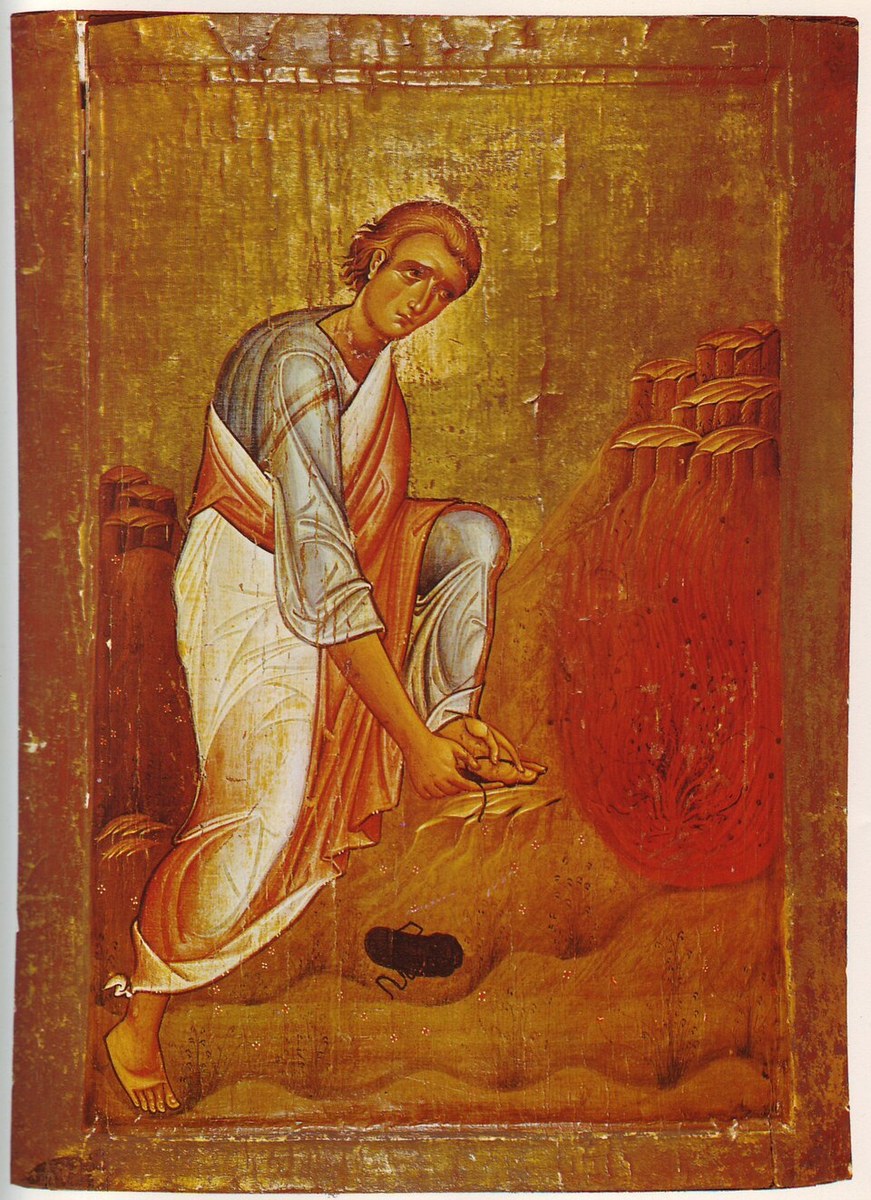
At Horeb, "the mountain of God," the Angel of the Lord appeared to Moses in a bush that burned with fire and was not consumed. Commanded to loose his sandals, for the place was holy ground, Moses heard the God of Abraham, Isaac and Jacob reveal His name — "I AM THAT I AM" (Exodus 3:14) — and send him, against every protest of his slowness of speech, to bring Israel out of Egypt, with Aaron his brother for spokesman and a rod that would work signs.
Before Pharaoh, Moses and Aaron wrought the ten plagues that broke Egypt's obstinacy, culminating in the death of the firstborn on the night of the first Passover, when the destroyer passed over the houses marked with the blood of the lamb — for the Church the primordial type of redemption by the blood of Christ. Israel went out; hemmed between Pharaoh's pursuing army and the sea, Moses stretched out his rod and the Red Sea parted, the people crossing on dry ground while the returning waters overwhelmed the pursuers. On the far shore Moses raised the song "Let us sing unto the Lord, for He hath triumphed gloriously" (Exodus 15) — the First Biblical Ode, sung in the Church's canons to this day.
Sinai and the wilderness
In the third month the people camped before Sinai, and Moses ascended into the darkness where God was. Amid thunder, fire, and the sound of the trumpet, God spoke the Ten Commandments and, in forty days on the mountain, delivered to Moses the Law — moral, liturgical, and civil — and the pattern of the tabernacle, written on two tablets "with the finger of God." Descending to find the people worshipping a golden calf, Moses shattered the tablets, purged the camp, and then ascended again to intercede, offering to be blotted out of God's book rather than see Israel destroyed — for the Fathers the supreme Old Testament image of the pastor's self-offering intercession, a type of Christ's own. He received the tablets anew, and his face so shone from speaking with God that he veiled it before the people (Exodus 34; cf. 2 Corinthians 3).
When Moses prayed "show me Thy glory," God set him in a cleft of the rock, covered him with His hand, and let him see "the back parts" but not the face — the passage on which Gregory of Nyssa built his Life of Moses, the classic patristic account of the soul's endless ascent into the knowledge of God, and from which the Church draws the title God-seer (θεόπτης): the man who saw God as far as man can see and learned thereby that God is beyond all seeing.
Forty years Moses led the murmuring people through the wilderness: manna and quail from heaven, water from the rock struck at his word (the rock which, Paul says, "was Christ" — 1 Corinthians 10:4), victory over Amalek while his arms were held outstretched in the figure of the Cross, the ordination of the seventy elders, the rebellions of Korah and of the spies, the bronze serpent lifted on a pole that those bitten might look and live — the type the Lord Himself applies to His crucifixion (John 3:14). For striking the rock twice at Meribah instead of speaking to it as commanded, Moses and Aaron were told they would not themselves bring the assembly into the land (Numbers 20:12) — a severity over which the Fathers pondered, seeing in it also a mystery: the Law cannot itself bring the people into the inheritance; that belongs to Jesus (Joshua), Moses's successor and the Lord's namesake.
Repose
His work done, Moses proclaimed the covenant anew on the plains of Moab (the book of Deuteronomy), sang his great swan-song "Give ear, O ye heavens" (Deuteronomy 32 — the Second Biblical Ode), blessed the twelve tribes, laid his hands on Joshua son of Nun, and went up from the plains of Moab to Mount Nebo, to the peak of Pisgah over against Jericho. There the Lord showed him all the land promised to the fathers; and there Moses the servant of the Lord died, one hundred and twenty years old, "his eye not dim, nor his natural force abated," and God buried him in a valley in the land of Moab — "and no man knoweth of his sepulchre unto this day" (Deuteronomy 34). The Synaxarion notes simply that the holy prophet Moses was perfected in peace; its verse for September 4 sings that he who once saw God from the rock and from behind now beholds Him whole. The Epistle of Jude (v. 9) preserves the tradition of the archangel Michael contending with the devil over the body of Moses — the hidden grave guarded from becoming an idol.
By the traditional reckoning followed in the synaxaria (and by the OCA life), Moses was born about 1689 BC and died about 1569 BC; on the scholarly dating of the Exodus see Disputed questions.
Veneration and later cultus
Moses towers over the whole of later Scripture: "there arose not a prophet since in Israel like unto Moses, whom the Lord knew face to face" (Deuteronomy 34:10). Deuteronomy 18:15 — "the Lord thy God will raise up unto thee a Prophet from the midst of thee, like unto me" — is read by the apostles as fulfilled in Christ (Acts 3:22; 7:37), and the Gospels present Christ as the new and greater Moses: the infant saved from a slaughtering king, called out of Egypt, giving the law of the Kingdom from the mountain, feeding the people bread in the wilderness.
At the Transfiguration, Moses himself stood on Tabor with Elias beside the Lord in glory, "speaking of His exodus which He should accomplish at Jerusalem" (Luke 9:31): the Law and the Prophets bearing witness to their Giver, the man who on Sinai could not see God's face now seeing it in the incarnate Christ. Orthodox hymnography and iconography of the feast of August 6 give Moses this permanent place at the Lord's left.
The Burning Bush became the Church's cherished type of the Theotokos — the bush that held fire and was not consumed prefiguring the Virgin who contained the fire of the Godhead and remained inviolate. The Menaion's stichera for September 4 dwell on exactly this typology, and the Russian tradition keeps the feast of the icon of the Mother of God "the Unburnt Bush" on this same day. At Sinai itself, the monastery of Saint Catherine encloses the traditional site of the bush in its Chapel of the Burning Bush, where the faithful still remove their shoes; the monastery's church is anciently dedicated to the Transfiguration, binding the two theophanies of Moses together.
In the Orthodox liturgy Moses is omnipresent: the First and Second Biblical Odes, which frame every canon sung at Matins, are his songs at the sea and in Moab; Genesis and Exodus (traditionally received as his books) are read at Vespers through Great Lent and Holy Week; the Paschal Vigil of Holy Saturday reads the Passover institution (Exodus 12) and sings the Ode of the Sea with its refrain "for gloriously hath He been glorified"; and the feasts of the Theotokos return constantly to his types — the bush, the ark, the tablets, the jar of manna, the rod. He is also commemorated among the ancestors and righteous of the Old Covenant on the Sunday of the Holy Forefathers before the Nativity.
Miracles and traditions
Beyond Scripture, the tradition records his continuing care for the holy places of his prophecy. The best-loved story belongs to Sinai: on the day John of the Ladder was installed as abbot of the monastery, a stranger was seen directing the cooks and stewards at the banquet, who could not afterwards be found; John explained that "our lord Moses does nothing strange in serving in the place which belongs to him." Hebrews 11:23–29 canonises his life as a triumph of faith — refusing to be called son of Pharaoh's daughter, "esteeming the reproach of Christ greater riches than the treasures in Egypt."
Hymnographic and literary legacy
Tradition receives Moses as the author of the Pentateuch, of Psalm 89 (90), "Lord, Thou hast been our refuge," and of the two Biblical Odes named above. The patristic literature on him is immense: beyond Gregory of Nyssa's Life of Moses, the Philokalia and ascetic tradition return constantly to the darkness of Sinai as the image of prayer beyond concepts. In the Menaion for September 4 the Prophet has a full canon in Tone 4, its theotokia signed "of Clement" (the Studite hymnographer), together with a cycle of stichera in Tone 4 on the storm, the darkness, and the bush.
Feast and commemoration
September 4 (church date; Old Calendar civil September 17) is the Prophet's principal commemoration in the Byzantine rite, universal to all jurisdictions, sharing the Menaion office of the day with the Hieromartyr Babylas of Antioch. The Russian usage keeps the icon of the Theotokos "the Unburnt Bush" the same day, precisely because of the Prophet's feast. Moses is further remembered among the Forefathers on the pre-Nativity Sunday of the Holy Forefathers, at the Transfiguration (August 6), and pervasively in the Lenten and Paschal lectionary; Eastern and Western martyrologies alike keep September 4 as his day.
Hymns
Troparion — Tone 2
Celebrating the memory of Thy Prophet Moses, O Lord, through him we beseech Thee: save our souls.
Original translation from the Greek
Kontakion — Tone 2
The choir of the Prophets rejoiceth with gladness today with Moses and Aaron, for the fulfilment of their prophecy is accomplished in us: today shineth the Cross, whereby Thou hast saved us. By their prayers, O Christ God, have mercy on us.
Original translation from the Slavonic
Stichera
Loose quickly, O Moses, the sandal from thy feet, for the place whereon thou standest is holy ground; let no token of deadness be borne about upon thee: for in the bush and in the fire the wonders of the Maiden who is God's own child are mystically shown thee; He that spake on Mount Horeb declared them unto Moses.
Iconography
Moses bears two iconographic ages: the young, beardless shepherd of the Burning Bush scenes, and the aged, long-bearded lawgiver holding the tablets (or a scroll), as he appears on festal icons of the Transfiguration opposite Elias and on the prophets' tier of the iconostasis. He is often shown receiving the Law, or before the bush within which the Theotokos of the Sign came to be painted — the composition that grew into the "Unburnt Bush" icon. The stored image is the celebrated loca sancta icon of the twelfth (possibly thirteenth) century from Saint Catherine's Monastery, Sinai: the young Moses, standing on the holy ground of Horeb itself, stoops to loose his sandal before the bush aflame at the right of the panel.
Disputed questions
- Dating. The frontmatter dates (b. c. 1689, d. c. 1569 BC) reproduce the traditional chronology given in the synaxarial tradition (so the OCA life), computed from the long biblical chronologies. Modern scholarship, when it accepts an Exodus at all, generally places it in the thirteenth century BC (the Ramesside period), with a minority defending a fifteenth-century date; the sixteenth-century "century of repose" used for indexing here follows the tradition, not a scholarly consensus.
- Authorship of the Pentateuch. The Church's liturgical and patristic tradition names Moses author of the five books (allowing, already among the Fathers, for the account of his own death being added by another — Joshua, in one common view). Modern critical scholarship regards the Pentateuch as composite and later; this entry records the tradition as tradition without adjudicating the critical question.
- Mount Nebo. The biblical Nebo/Pisgah is generally identified with Jebel Nebā in Jordan, where a Byzantine memorial church of Moses stood from the fourth century; the identification is traditional and probable but not demonstrable, and Scripture itself insists the grave is unknown.
- Distinct commemorations. Not to be confused with the monastic saints Moses the Ethiopian (August 28) and Moses the Hungarian (July 26); see also Joshua son of Nun (September 1), his minister and successor, whose entry treats the conquest that Moses was not given to lead.