
Myrope of Chios
The Holy Martyr Myrope of Chios
Martyr · Virgin · b. early 3rd century — d. c. 251
Commemorated 2 December
Myrope was a young Christian woman of Ephesus who, during the persecution of Decius in the mid-third century, withdrew with her mother to the island of Chios. When the soldier-martyr Isidore was beheaded there and his body set under guard, she secretly took it away by night and buried it; and when the guards were condemned to death for its loss, she gave herself up rather than let innocent men die in her place. Confessing Christ before the governor, she was savagely beaten and cast into prison, where at midnight, as she prayed, the martyr Isidore appeared to her amid a company of angels and she surrendered her soul to God, the whole prison filling with a sweet fragrance. Her name, from the Greek for sweet-smelling myrrh, was joined in life and death to the anointing of the holy dead.

Ephesus and the myrrh of Hermione
Myrope was born at Ephesus at the beginning of the third century. She lost her father while still a child, and her mother, a devout Christian, raised her in the faith. As a girl she was drawn to the shrine of the martyr Hermione — one of the four prophesying daughters of the Apostle Philip (commemorated September 4) — whose relics rested at Ephesus. Myrope would visit the grave, take of the fragrant myrrh that flowed from the holy relics, and with it anoint and heal the sick. The tradition connects her very name — Μυρόπη, from myron, sweet myrrh — with this ministry of anointing, a foreshadowing of the fragrance that would attend her own martyrdom.
Chios and the burial of Isidore
When the persecution of the emperor Decius (249–251) broke out, Myrope and her mother left Ephesus for the island of Chios, where they gave themselves to fasting and prayer. On Chios at that time the governor put to death, with great cruelty, the soldier Isidore — a man of deep faith who had refused to sacrifice, and who is himself venerated as a martyr (commemorated May 14). His body was left exposed under guard, with strict orders that the Christians should not be allowed to take it for burial. Myrope, moved by reverence for the martyr, came by night, secretly removed the body, and buried it with honour.
Martyrdom
When the loss of the body was discovered, the soldiers who had kept the watch were condemned to death for their failure. Myrope, learning that innocent men were to die in her stead, could not bear it: she came forward and told first the soldiers and then the governor what she herself had done. Brought to trial, she openly confessed herself a Christian. For this she was subjected to a fierce and prolonged beating and then thrown into prison, her body broken. At midnight, as she lay praying, a light shone through the cell, and the martyr Isidore appeared to her surrounded by a host of angels; and in that moment Myrope gave up her spirit to God. At once the prison was filled with an ineffable sweetness of fragrance. The pagan soldier set to guard her, trembling at what he had seen, went and told a Christian priest all that had happened; and he too, coming to believe, in time received baptism and himself died a martyr's death for the confession of Christ. Her repose is placed about the year 251.
Feast and commemoration
Myrope is commemorated on December 2 (Old Calendar civil December 15), within the Nativity Fast. Her commemoration is kept throughout the Byzantine rite, and she is held in special honour on Chios, the island of her martyrdom, and at Ephesus, the city of her birth. Her memory is naturally linked with that of the martyr Isidore of Chios, whose body she buried and who appeared to her at her death.
Hymns
Troparion — Tone 4
Thy lamb Myrope, O Jesus, crieth out with a loud voice: Thee, O my Bridegroom, do I love, and seeking thee I endure the contest; I am crucified and buried together with thee in thy baptism, and I suffer for thy sake, that I may reign with thee; I die for thee, that I may live in thee. Accept me as a spotless sacrifice, offered unto thee with love. By her prayers, O merciful Saviour, save our souls.
Original translation from the Greek
Iconography
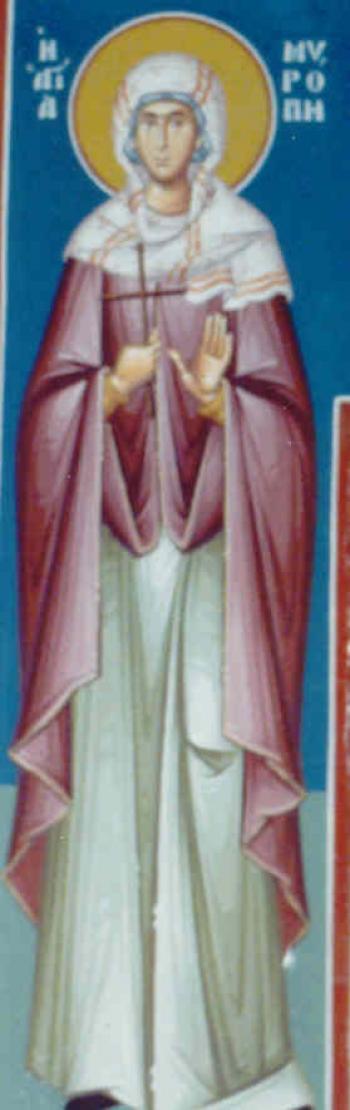
Myrope is depicted as a young woman martyr, veiled in the maphorion, bearing in her right hand the small cross of the martyrs and often holding in her left a vessel of myrrh in token of her name and of the anointing that filled her life and her death. The stored image is a wall-painting showing her standing full-length in a dark-red mantle over a pale undergarment, the martyr's cross in her hand, inscribed in Greek "Saint Myrope."