
Isidore of Chios
The Holy Martyr Isidore, who suffered on the island of Chios
Martyr · d. 251
Commemorated 14 May — Beheading on Chios under Decius
Isidore of Chios (†251) was an Egyptian of Alexandria serving as an officer of the imperial fleet when his squadron put in at Chios in the persecution of Decius. Denounced to his admiral Numerius by the centurion Julius, he confessed Christ, refused to sacrifice, and was scourged, dragged over rock, and had his tongue cut out — yet, the acts relate, he kept speaking, while the admiral who had ordered it was struck dumb. His own father came from Alexandria not to save him but to press for his death. Beheaded and thrown into a well to be devoured, his body was rescued and buried by the virgin Myrope, who paid for it with her own martyrdom. Isidore is the patron of Chios and, across the Mediterranean, of sailors; his well became a healing shrine attested by Gregory of Tours, and local tradition binds his memory to the weeping mastic trees of the island.

An Alexandrian in the fleet
Isidore came from Alexandria in Egypt, and by the synaxarion's account was a sailor of the imperial fleet — most sources make him a man of some rank, an officer or marine rather than a common oarsman. The fleet in which he served was commanded by the admiral (navarchos) Numerius, and in the reign of Decius (249–251) its squadron lay at anchor off the island of Chios, in the eastern Aegean.
Chios at that time was not a place of active persecution, and Isidore appears to have kept his faith without much concealment. The centurion Julius learned of it and denounced him to Numerius. Summoned and questioned, Isidore did not equivocate: he acknowledged that he was a Christian and refused to offer sacrifice to lifeless images. The admiral, who evidently had some regard for him, urged him to comply with the imperial edict and spare himself; the martyr's answer, preserved in the acts, turns on the limits of imperial power — that they might kill his body but had no authority over his soul, in which the living God, Jesus Christ, dwelt, and would dwell after his death; and that he would not cease to confess Him while breath remained.
The passion
He was handed over to the torturers. He was beaten with whips and dragged over rough ground, and through it all praised Christ and mocked the idols as the soulless handiwork of men; then he was thrown into prison. It was at this point, the passion relates, that his father — hearing in Alexandria that his son had abandoned the religion of his ancestors — took ship for Chios. The meeting was tender: Isidore embraced him with reverence and told him that he ought rather to rejoice, since his son had seen the light that Christ gives, and begged him to open the eyes of his own soul. His father petitioned Numerius for custody of the young man, promising to bring him round; failing, he cursed and disowned him and urged the admiral to execute him without delay. The hagiographers see in this the literal fulfilment of the Lord's word that "the father shall deliver up the child to death" (cf. Matt. 10:21) — the persecutor found not only among strangers but within the household.
The final tortures followed. His tongue was cut out; and — the detail on which the acts insist — he went on confessing Christ audibly by grace, while Numerius himself was struck speechless, so that he had to give the order for the execution by a sign. Isidore heard the sentence with joy, and was beheaded, in the year 251. The Greek synaxarion verses mark both the manner and the day: "The hope of the crown caressed Isidore, and urged him towards the sword, from which the crown came… on the fourteenth the blade cut Isidore down."
Myrope and the burial
The martyr's body was flung into a well (some recensions say a ravine) to be devoured by carrion birds, and a few soldiers were set to watch it lest the Christians should carry it off. That night the Christian virgin Myrope, who with her mother had withdrawn from Ephesus to Chios, came with two servant-women while the guards slept, took up the relics, and buried them with honour. When Numerius discovered the loss and condemned the guards to death, Myrope gave herself up rather than let innocent men die in her place; she was scourged and imprisoned, and at midnight, as she prayed, Isidore appeared to her amid a company of angels and told her that her prayer was heard and her crown ready — and she surrendered her soul, the whole prison filling with fragrance. Her feast is December 2, and her memory is inseparable from his. The Slavonic recension used by the Orthodox Church in America adds a second name, Ammonios (commemorated September 4), as sharing in the burial, and says that he too was afterwards martyred, at Cyzicus. Myrope was laid beside Isidore, and a chapel was raised over the two graves.
Relics, the well, and the mastic
In the fifth century the chapel gave way to a church, and Markianos, the oikonomos of the Great Church of Constantinople (commemorated January 10), who built a chapel by the church of Hagia Eirene, translated the martyr's skull and a portion of his relics to Constantinople, placing them in the church of the Most Holy Theotokos at Peran.
The rest remained on Chios, and the shrine there is one of the better-attested healing sites of the sixth century, because a Latin witness describes it. Gregory of Tours, in the Liber in gloria martyrum, reports that Isidore is buried on Chios, that in his church there is the well into which he was thrown, that those who drink its water — the possessed, the fevered, the sick — are frequently cured, and that a light like a burning candle is often seen at the well's mouth; he says he met a priest who had seen it himself. In the same passage Gregory notes the island's peculiar product, the resin gathered from its mastic trees. Local tradition draws the two together: at the place of the martyrdom the mastic trees are said to have wept fragrant tears for the martyr, and the mastic of Chios — the island's wealth for centuries — is held to be gatherable only from the groves near where he suffered.
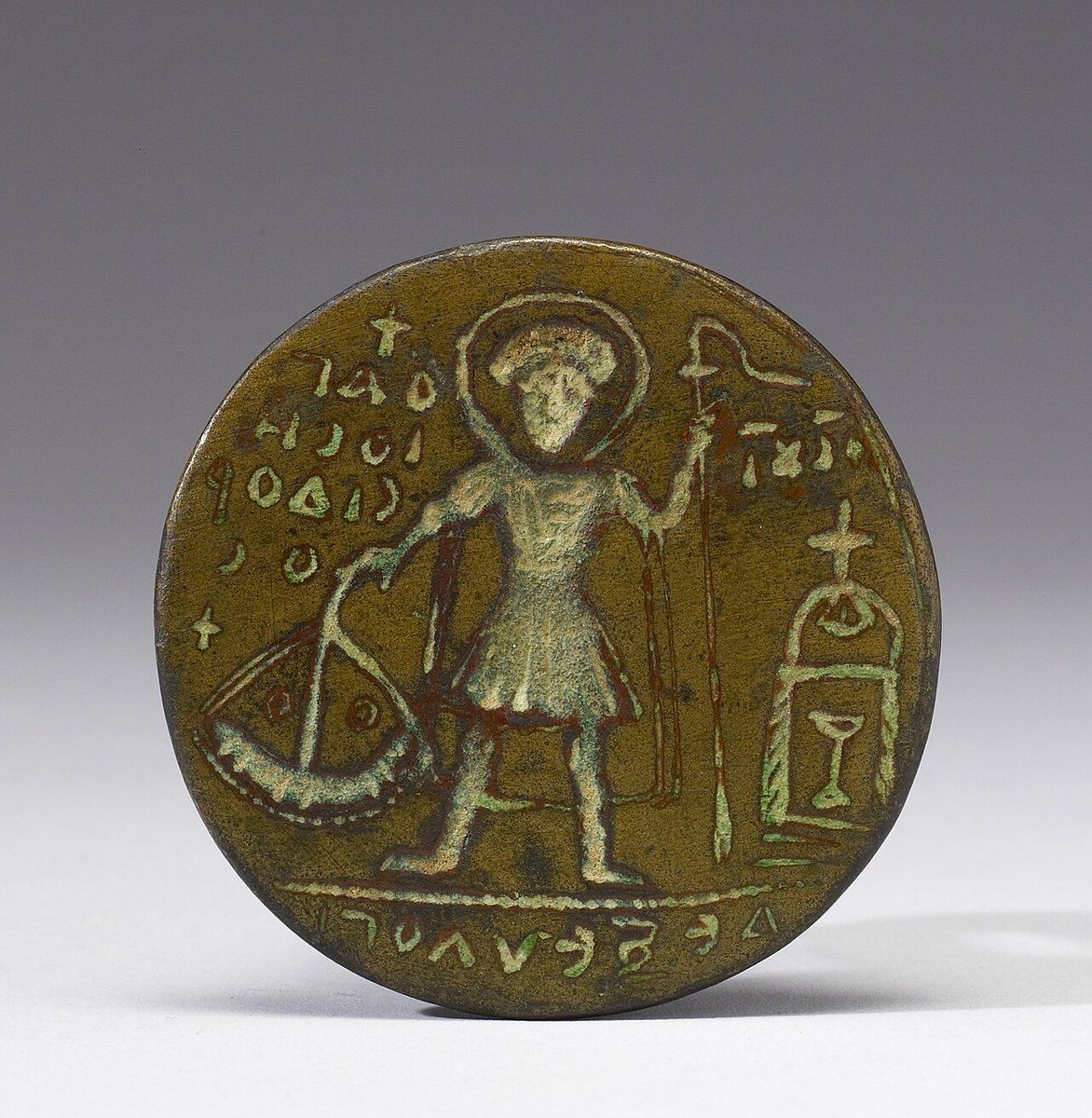
Latin sources record a further translation: in 1125 the Venetians carried the martyr's body from Chios to Venice, where it was laid in the basilica of San Marco; the chapel of San Isidoro, off the north transept, still houses his sarcophagus. The Orthodox synaxaria do not record this removal, and Chios continues to keep him as her own; both traditions agree in making him a protector of seafarers, which his own naval service and the ship stamped on his pilgrim tokens amply explain.
Feast and commemoration
May 14 (church date; Old Calendar civil May 27), kept universally. Depending on the date of Pascha the day falls either late in the Paschal season or after Pentecost, so its liturgical setting varies by year. Isidore leads the day in Greek and Antiochian usage, where the synaxarion pairs him with the hieromartyr Therapon of Cyprus; Slavonic usage keeps him with Isidore of Rostov and Nikitas of Novgorod, and the Orthodox Church in America heads the day "Martyrs Isidore and Myrope of Chios," joining the two whom the passion joins. He is the patron of the island of Chios, honoured also at Ephesus (through Myrope), in Constantinople where his skull was laid, and — in the Latin West — at Venice.
Hymns
Apolytikion — Tone 4
Enlisted as a soldier of the King of the ages, thou didst cast off the warfare of things earthly and didst fearlessly proclaim Christ as God; wherefore, having finished thy good contest, thou wast shown forth as a martyr glorified of God by the Saviour. Entreat Him that we who honour thee may be saved, O all-blessed Isidore.
Kontakion — Tone 4
Thou hast been shown forth, O holy one, as a great steward of the whole world by thy prayers to God; therefore we hymn thee this day, O martyr wise in God, most glorious Isidore.
Original translation from the Slavonic
Iconography
Isidore is painted as a young soldier-martyr: beardless or lightly bearded, in the short military tunic and cloak, holding the martyr's cross, and often with the sword of his beheading. Because he is a mariner-saint, the attributes that distinguish him from the crowd of soldier-martyrs are maritime and topographical rather than military — a ship, and the well of his shrine on Chios. In the menologia he appears in the ranks of the May martyrs, and Russian monthly-menaion icons of May place him at the head of the fourteenth day. Later Greek panels from Chios show him standing before the sea with the island behind him, sometimes with Myrope beside him.
The stored image is exceptional: a sixth-century Byzantine bronze pilgrim stamp from the shrine itself (Walters Art Museum), a die for impressing eulogiai — blessed tokens of clay or bread given to pilgrims. The saint stands haloed in a short belted tunic, a staff or spear in his raised hand; to his left is a ship with its rigging, to his right the well of the shrine surmounted by a cross, with a vessel below to draw its healing water. The inscription is cut in reverse, as a stamp requires. It is thus not an icon in the panel sense but the working instrument of the cult Gregory of Tours describes, and it shows that by the sixth century both the ship and the well were already fixed as Isidore's signs.
Disputed questions
- Rank and status. The Greek synaxarion calls him simply a sailor (ναύτης) of the imperial fleet; the fuller lives make him an officer. Nothing in the acts requires more than that he was a serving man of the fleet whose Christianity was known to his messmates.
- The well and the ravine. The Greek text has the body cast into a pharangi (ravine), the Slavonic and the Constantinopolitan tradition into a well; Gregory of Tours, the earliest independent witness, describes a well inside the church, which suggests the well is the older element and the ravine a later softening.
- Not to be confused with the several other saints of the name: Isidore the Fool-for-Christ of Rostov (†1474), who shares this very day — see Isidore of Rostov; Isidore of Pelusium (February 4), the Egyptian abbot and letter-writer; Isidora of Tabenna (May 1), the fool-for-Christ; Isidore of Yuriev (Dorpat) and the seventy-two martyrs with him (January 8); and the Latin fathers Isidore of Seville and Isidore the Ploughman, who belong to Western usage.