
Nahum the Prophet
The Holy Prophet Nahum
Prophet
Commemorated 1 December
Nahum the Elkoshite, seventh of the Twelve Minor Prophets, prophesied in Judah in the seventh century before Christ, and his short book is a single sustained oracle — "the burden of Nineveh." Where Jonah had seen the Assyrian capital repent and be spared, Nahum, more than a century later, announced its final doom: the great city that had crushed Israel and blasphemed the living God would itself be swept away, and so it was, falling to the Medes and Babylonians in 612 BC. His name means "comfort," and his message of judgment on the oppressor was heard by his own people as consolation. The Church commemorates him on December 1, the first day of the December menaion, keeping his memory within the Nativity Fast. He is not to be confused with Naum of Ohrid, the ninth–tenth-century disciple of Cyril and Methodius and enlightener of the Bulgarians (commemorated December 23), whose name is the same "Naum" in the Slavonic books.
.jpg)
In the Scriptures
Almost nothing of Nahum's life is recorded. The single verse of biography is the superscription of his own book: "The burden of Nineveh. The book of the vision of Nahum the Elkoshite" (Nahum 1:1). His name — נַחוּם, Naḥum — is formed from the root meaning "to comfort," and is understood by the tradition as "God consoles"; the Fathers heard in it the paradox of the book, that the overthrow of the tyrant is the consolation of the tyrant's victims.
Where "the Elkoshite" places him is disputed (see below). His book gives no dates and issues no call to repentance — unlike almost every other prophet, Nahum neither denounces Israel for infidelity nor summons anyone to turn back; his whole vision is fixed on Nineveh. Its historical horizon can nonetheless be fixed within narrow bounds. Nahum speaks of the sack of the Egyptian city of No-Amon, that is Thebes, as a past event (Nahum 3:8–10) — Thebes fell to the Assyrian Ashurbanipal in 663 BC — and he foretells as still to come the fall of Nineveh, which the Medes and Babylonians took and destroyed in 612 BC. His prophecy therefore belongs to the third quarter of the seventh century BC, in the reign of the Assyrian empire's last strength and the beginning of its swift collapse after Ashurbanipal's death (traditionally 632 BC). He was thus a younger contemporary of Zephaniah and an elder of Jeremiah, prophesying in the kingdom of Judah in the generation before the Exile.
The book and its message
The Book of Nahum is three chapters of some of the most vivid poetry in the prophetic corpus. It opens with a theophany — an alphabetic hymn, partly acrostic in the Hebrew, to the God who is "jealous and avenging," "slow to anger and great in power," before whom the mountains quake and the sea is dried up, yet who "is a stronghold in the day of trouble, and knoweth them that trust in him" (Nahum 1:2–7). From this double confession — terror to his enemies, refuge to his own — the prophet turns to Nineveh.
The second and third chapters are a single, headlong description of the city's siege and sack: the scarlet shields and flashing chariots of the attackers, the river-gates opened and the palace dissolved, the plunder of "silver and gold," the empty city — "Nineveh is like a pool of water… Halt, halt! but none looketh back." The prophet names the sin for which she falls: she is "the bloody city, all full of lies and robbery," a harlot and sorceress who "sold nations through her whoredoms," a den of lions that "filled his caves with prey." The Assyrian war-machine that had deported the ten tribes of Israel and boasted against the God of Hezekiah — the blasphemy of Sennacherib is in the prophet's memory — will find no mourners: "all that hear the bruit of thee shall clap the hands over thee: for upon whom hath not thy wickedness passed continually?" (Nahum 3:19). The book that began as "the burden of Nineveh" ends on that unanswered question, a verdict rather than a lament.
Nahum and Jonah
The Church reads Nahum in deliberate counterpoint to Jonah. Both prophets are sent against Nineveh, the one to save it and the other to condemn it. Under Jonah, in the eighth century, the city heard the eight-word sermon of doom, repented in sackcloth from the king to the cattle, and was spared. Under Nahum, in the seventh, the repentance long forgotten and the cruelty resumed, the same city is told there is no reprieve. The Fathers took the pair as a lesson on the patience and the justice of God together: mercy is real and repentance is heard, but a nation that returns to its blood-guilt after being spared stores up a heavier reckoning. So the two books, set a century apart in the record and a few months apart in the calendar (Jonah on September 21, Nahum on December 1), frame the single history of Nineveh between mercy and judgment.
Traditions and tomb claims
The para-biblical Lives of the Prophets, attributed to Epiphanius, supplies the only ancient "biography": Nahum was of Elkesh beyond Bethabara, of the tribe of Simeon; after his prophecy against Nineveh he died in peace and was buried in his own land. The Greek synaxaria and the Menologion of Basil II repeat this in brief; a later notice, reflected in the OCA's synaxarion, gives his age at death as forty-five.
His tomb has been claimed, like those of most prophets, in more than one place. The most famous claim is at Alqosh, a town on the plain north of Mosul in northern Iraq, where a shrine of "Nahum the prophet" was for centuries the centre of a pilgrimage kept by the Jews of Kurdistan and revered by the Assyrian Christians around it; the derelict shrine, in the care of the Chaldean Church, survived the twentieth century and has been the object of recent restoration. A rival tradition, following the Lives of the Prophets, sets Elkosh in Galilee — some have connected the name with Capernaum, Kefar-Naḥum, "the village of Nahum" — while other ancient authorities placed the Elkoshite in the territory of Judah or of Simeon in the south. No claim can be verified; the disagreement over "the Elkoshite" is as old as the earliest commentators.
Feast and commemoration
December 1 on the church calendar (Old Calendar civil December 14), the first commemoration of the December menaion, kept within the Nativity Fast. The Greek Menaion appoints Nahum a full service — proper stichera in Tone 3 on "Great is thy cross," the common apolytikion of a prophet in Tone 2, and a canon by Theophanes the Branded acrostic on the prophet's name — sung together with the service of the righteous Philaret the Merciful, who shares the day. The Slavic books keep the same commemoration with their own troparion and kontakion.
Hymns
Troparion — Tone 2
Celebrating the memory of thy prophet Nahum, O Lord, through him we entreat thee: save our souls.
Original translation from the Greek
Kontakion — Tone 4
Thy pure heart, illumined by the Spirit, became the dwelling-place of most radiant prophecy, for thou dost behold things far off as though they were present. Therefore we honour thee, O blessed prophet, glorious Nahum.
Original translation from the Slavonic
Iconography
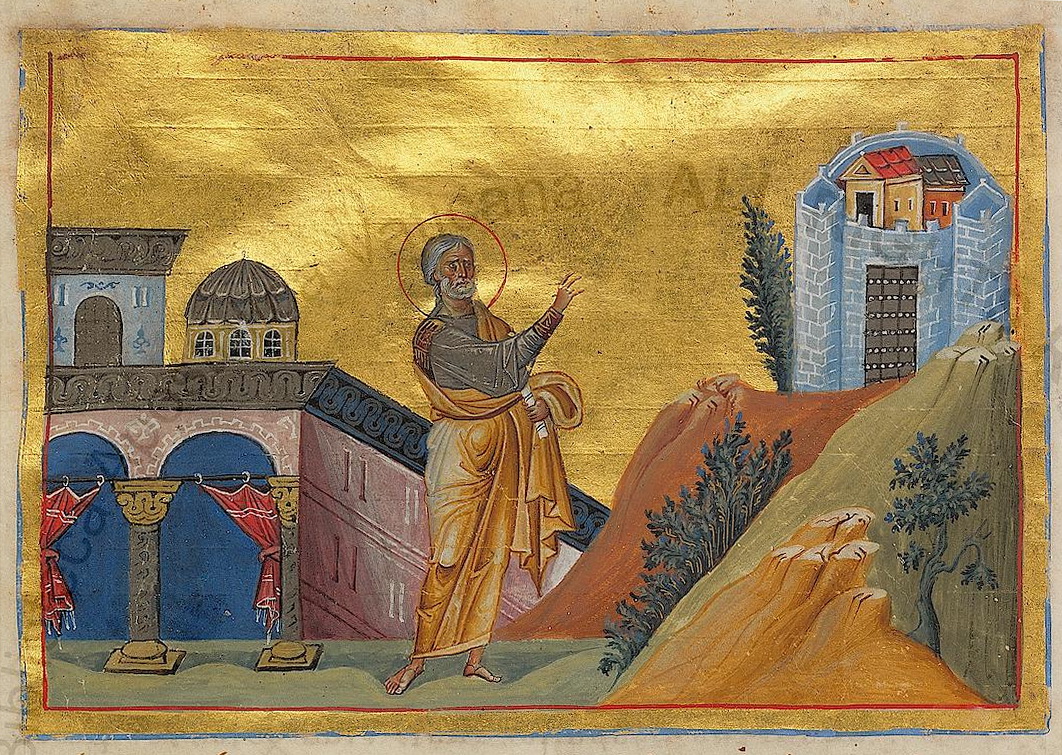
Nahum is depicted in the manner of the minor prophets: an older man, bearded, in the mantle of a prophet, holding a scroll — sometimes inscribed with the opening of his oracle. He appears in the prophet rows of church programmes and in the illustrated prophet-books and menologia. The stored image is the miniature of the Menologion of Basil II (Constantinople, c. 985), where the prophet stands full-length with his scroll, captioned as Nahum, for his feast of December 1.
Disputed questions
- Where was Elkosh? The three ancient locations — Alqosh near Nineveh (Assyrian tradition), a Galilean Elkesh/Capernaum, and a site in southern Judah — cannot be reconciled, and each has champions from antiquity onward. The calendar commemorates the prophet without settling the question.
- A prophet of vengeance? Nahum's unrelieved oracle of destruction, with no call to repentance, has troubled some readers as sub-evangelical. The Church reads it rather as the necessary complement to Jonah: a witness that God's long patience is not indifference, and that the cry of the oppressed against a blood-guilty empire is heard and answered in his justice.
- Not to be confused with Nahum of Ohrid, the disciple of Cyril and Methodius and enlightener of the Slavs (†910, commemorated December 23) — a wholly distinct saint who happens to share the prophet's name; by a curious convergence of Russian piety both Nahums are invoked for the relief of those afflicted with disorders of the mind.