
Naum of Ohrid
Our Venerable Father Naum of Ohrid, the Wonderworker, Enlightener of the Bulgarians
Equal to the Apostles · Venerable · Wonderworker · b. c. 830 — d. 910
Commemorated 20 June — Summer commemoration, kept at the Monastery of St Naum, 23 December — Repose at the Monastery of St Naum on Lake Ohrid
Naum of Ohrid (c. 830–910) was one of the seven Apostles of the Slavs — the Sedmochislenitsi — a direct disciple and co-worker of Cyril and Methodius who, after their mission in Great Moravia was broken up by the Latin clergy, carried the Slavonic letters and liturgy south into Bulgaria. There, with his companion Clement of Ohrid, he became a founder of Slavonic learning: a teacher at Pliska and Preslav under the princes Boris and Symeon, and then head of the school at Ohrid, where he built a monastery on the southern shore of the lake and reposed in 910. Venerated across the Bulgarian, Macedonian and Serbian lands as an enlightener and wonderworker, he is commemorated on December 23, and his monastery and relics at the springs of Lake Ohrid remain one of the great pilgrimage shrines of the Balkans.
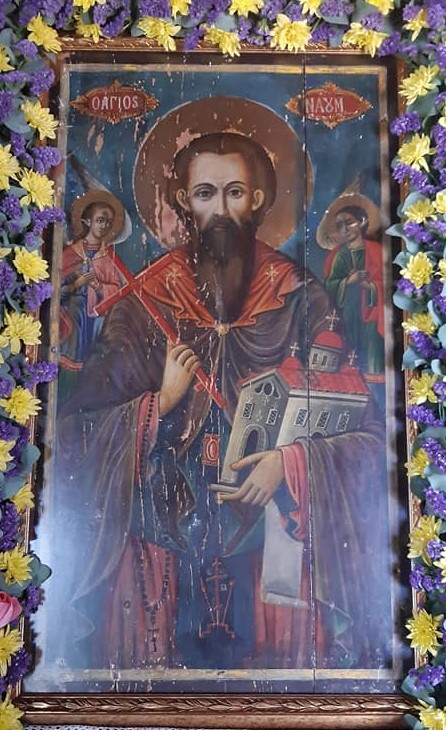

Disciple of Cyril and Methodius
Naum was born about 830, of Slavic (or, in one tradition, mixed) parentage, somewhere in the region of the Byzantine Balkans; the sources are silent on his origins, and he enters history already as a companion of the brothers Constantine (in monasticism Cyril) and Methodius. He was among the closest of their disciples during the great mission to the Slavs, and one of the small band of "the Five" — Clement, Naum, Gorazd, Sava and Angelar — who continued the work after the founders. Learned and, the tradition says, master of several tongues, he shared in the labour of translating the Scriptures and the service books into Slavonic and of teaching the new alphabet.
He accompanied Cyril and Methodius on their journey to Rome (about 867–868), where Pope Adrian II blessed the Slavonic books and liturgy against the objections of those who held that only Hebrew, Greek and Latin were fit for worship. In Rome, Cyril died (869); Naum remained among Methodius's helpers through the years of his Moravian archbishopric, amid the mounting opposition of the German missionary clergy who resented the Slavonic rite.
Expulsion from Moravia and the coming to Bulgaria
When Methodius died in 885, the Frankish party in Great Moravia moved at once against his disciples. The Slavonic clergy were seized, imprisoned, and finally driven out — some sold into slavery. Naum, with Clement and Angelar, was expelled and made the hard journey down to the Danube and across into Bulgaria, where the prince Boris I, newly baptised and eager to give his people a Church in their own language, received the exiles as a gift from heaven and set them to work.
Naum laboured first in the north, at the old capital Pliska and then at the new one, Preslav, where under Boris and his son Symeon the Great a brilliant school of Slavonic letters grew up. There Naum was among the teachers and scholars who shaped the Preslav literary school — the milieu in which, in these very decades, the Cyrillic alphabet took form out of the earlier Glagolitic, and a whole Christian literature was translated and composed in Slavonic. Naum's own hand is traditionally seen in hymnographic and translation work of the period.
Ohrid and the monastery
About 893, when Clement was raised to be bishop in the south-western region of Kutmichevitsa, Naum was sent to take up and continue his educational work at Ohrid, the second great centre of Slavonic learning in Bulgaria. For some seven years he taught there, forming clergy and copyists and consolidating what became known as the Ohrid Literary School.
Around 905, having withdrawn toward the monastic life, Naum built a monastery on the southern shore of Lake Ohrid, at the place where the springs of the Black Drin rise — dedicating its church to the Holy Archangels Michael and Gabriel. He passed his last years there in asceticism, and reposed on December 23, 910. He was buried in the monastery church, and the house has borne his name ever since: the Monastery of Sveti Naum, one of the most venerated and most visited holy places of the region, its foundation among the oldest surviving in the Slavic Orthodox world.
Veneration and wonders
Naum was numbered among the saints soon after his death, his relics at the monastery quickly becoming a source of healing. He is especially invoked for the cure of mental and nervous illness, and a long-standing popular practice has pilgrims lay an ear to his tomb, where the faithful say a sound may be heard. The Greek Menaion styles him "Naum the Wonderworker, the enlightener and holy preacher of Bulgaria," and his cult spread through the Bulgarian, Macedonian and Serbian Churches and to Athos. With Cyril, Methodius, Clement, Gorazd, Sava and Angelar he is honoured among the Seven Enlighteners of the Slavs (the Sedmochislenitsi), whose common synaxis is kept on July 27 — a company whose work gave the Slavic peoples the Scriptures, the Liturgy and the beginnings of their letters in their own tongue.
Feast and commemoration
December 23 (church date; Old Calendar civil January 5) is his principal feast, the day of his repose, kept in the Bulgarian, Macedonian and Serbian Churches and in the Greek Menaion, and falling within the Forefeast of the Nativity. A summer commemoration is kept on June 20, chiefly at the Monastery of St Naum on Lake Ohrid, where the day draws great pilgrimage. He is also commemorated within the joint feast of the Seven Enlighteners of the Slavs on July 27.
Iconography
Naum is depicted as a monastic saint — in the tunic, mantle and often the great schema of a venerable father — bearded, holding a scroll or a Gospel book, and frequently shown alongside Clement of Ohrid or within the group of the Seven Enlighteners. In the churches of the Ohrid region his image is ancient and common. The stored icon is a panel of the last quarter of the fourteenth century from the Church of St Mary Perivleptos in Ohrid (now in the Ohrid Icon Gallery), showing the saint at prayer.
Disputed questions
- Not to be confused with Nahum the Prophet, the Old Testament minor prophet (commemorated December 1), whose name is transliterated identically as "Naum" in the Slavonic books: two entirely distinct saints, of different ages and feasts.