
Nectarius of Aegina
Our Father among the Saints Nectarius the Wonderworker, Metropolitan of Pentapolis
Bishop · Wonderworker · b. October 1, 1846 — d. November 8/9, 1920
Commemorated 9 November — Repose (night of November 8–9, 1920)
Nectarius of Aegina (1846–1920), born Anastasios Kephalas in Silivri (Selybria) in Thrace, is among the most beloved saints of the modern Orthodox world. A learned and gentle hierarch, he was consecrated Metropolitan of Pentapolis in the Patriarchate of Alexandria, then driven from Egypt by the envy and slander of fellow clergy and left, uncomplaining, to years of obscurity and poverty in Greece. He served humbly as a preacher and for fourteen years as director of the Rizarios Ecclesiastical School in Athens, and at last founded the Holy Trinity convent on the island of Aegina, where he reposed in 1920. His grave proved a source of healings and his relics streamed myrrh; glorified by the Ecumenical Patriarchate in 1961, he is invoked across the world, especially by the sick and by cancer patients, and more churches are dedicated to him than to any other modern saint.
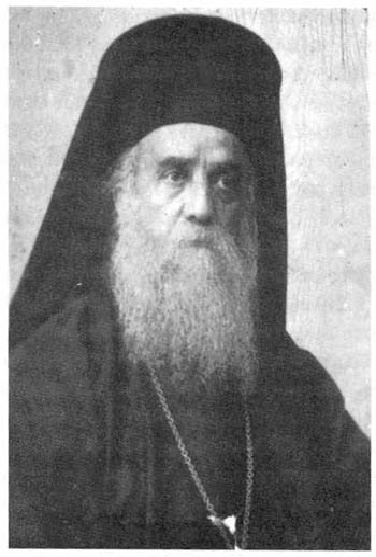

Origins and early life
The saint was born on October 1, 1846, in the town of Silivri (Greek Selybria, Σηλυβρία) on the Sea of Marmara in Eastern Thrace, and given the name Anastasios Kephalas. His family was pious and poor. At about the age of fourteen he made his way to Constantinople to find work, arriving with nothing; tradition tells that the boat's engines would not start until the captain, moved to pity, let the penniless boy aboard. In the great city he found employment with a tobacco merchant, went about barefoot and in patched clothing, and copied maxims from spiritual books onto the shop's paper bags so that the customers might read and profit from them. He longed above all to teach and to serve God. The stories of his boyhood faith — the letter he addressed simply "To the Lord Jesus Christ in Heaven," asking for shoes and an apron, which a passing shopkeeper opened and answered with an anonymous gift — are told of him as signs of the childlike trust that marked his whole life.
He became a schoolteacher, first on the island of Chios at the town of Lithi, where his teaching was joined to catechesis and preaching and where his reputation for holiness began. On November 7, 1875, he received the monastic tonsure at the Nea Moni monastery of Chios and was given the name Lazarus; two years later he was ordained deacon and renamed Nectarius.
Ministry in Egypt and the See of Pentapolis
A wealthy benefactor and later the Patriarch of Alexandria, Sophronios IV, recognised his gifts and provided for his education: Nectarius studied at the University of Athens, graduating in theology in 1885, and then entered the service of the Patriarchate of Alexandria. Ordained priest, he served with great distinction in Cairo, was made preacher, patriarchal secretary and warden of the church of Saint Nicholas, and on January 15, 1889, was consecrated Metropolitan of Pentapolis — an ancient titular see of the Alexandrian Church.
His learning, his eloquence in the pulpit, and above all the transparent holiness and humility of his life won him the love of the people of Cairo and Alexandria, and, with it, the jealousy of others around the aged patriarch. Slander was carried to Sophronios that the Metropolitan of Pentapolis was ambitious for the patriarchal throne itself and that his piety was a pretence to court popularity. In 1890 the patriarch and synod removed him from his functions and required him to leave Egypt. He was never canonically tried, never deposed from his episcopal rank, and never told plainly what he was accused of: the letter of suspension spoke only of removal "for reasons known to the Patriarchate." Nectarius bore the injustice in silence and without retaliation — a meekness that his admirers came to regard as the very heart of his sanctity.
Poverty and hidden service in Greece
He came to Athens to find that the rumours had preceded him and that the ambiguous letter had left every slander believed. Neither Church nor state would give him a post; for a time he was destitute, calling day after day at the Ministry of Religion and being turned away. Through a friend from Egypt he was at last appointed a humble preacher in the diocese of Euboea — a station a simple monk might have filled, which the former metropolitan accepted gladly — and preached through its churches, though even there the whispers followed him. On March 8, 1894, with the help of those who had come to see that the charges against him were empty, he was appointed director of the Rizarios Ecclesiastical School in Athens, a seminary for the training of priests, and he governed it until December 1908. There he celebrated the services, taught and formed a generation of clergy, and wrote a stream of theological, moral and devotional works — on the councils, on prayer, on Christian ethics, together with sermons and hymns; he is remembered also as a hymnographer, and the beloved hymn to the Theotokos Agni Parthene ("O Pure Virgin") is his.
The convent on Aegina and repose
Longing for stillness, Nectarius sought out on the island of Aegina an abandoned and ruined monastery of the Holy Trinity, and from about 1904 began to rebuild it with his own hands. He gathered a community of nuns, appointing the blind nun Xenia as abbess and himself serving as their father-confessor; sought out for his gift of spiritual direction, he drew many to the island for confession, and the community grew to some thirty sisters. Retiring there fully from 1908, he lived his last years in prayer, poverty and the guidance of his nuns, still under the shadow of the old calumny. "I am building a lighthouse for you," he told the sisters, "and God shall put a light in it that will shine to the world" — words they understood only later.
In the autumn of 1920 he was taken, gravely ill with a disease of the bladder, to the Aretaieion, a state hospital for the poor in Athens, where the staff at first would not believe that the old man in plain black robes, without pectoral cross or money, was a bishop. After two months of suffering he surrendered his soul to God late on the night of November 8, 1920, at the age of seventy-four. As the nurse and the attending nun removed his sweater to prepare his body, they laid it on the next bed, where a paralysed man lay; at its touch the paralytic rose up healed and glorified God — the first of the wonders that would make his name.
Relics and glorification
He was buried at the Holy Trinity convent on Aegina. When, some years later, his grave was opened according to Greek custom to gather the bones, his body was found whole and incorrupt, as though newly buried, and it exhaled a sweet fragrance; the relics were reported to stream myrrh, and cloths laid on them worked cures. Twice reburied — once, it is said, at the direction of the Archbishop of Athens, to let nature take its course — the body was each time found undecayed, until in God's time it dissolved and left the bones, the skull being placed in a bishop's mitre for veneration. The reputation of his holiness and of the miracles wrought at his tomb grew unceasingly, and on April 20, 1961, the Ecumenical Patriarchate formally numbered him among the saints. His principal shrine on Aegina became one of the great pilgrimage sites of modern Greece.
Miracles and veneration
Both in his lifetime — the stilled storm at sea, the healed paralytic — and in the century since his repose, Nectarius has been credited with an immense multitude of miracles, so that the calendars style him simply "the Wonderworker." He is invoked above all by the sick, and has become especially the patron of those suffering from cancer, countless of whom attribute their cure to his intercession. His veneration spread with extraordinary speed far beyond Greece — through the Slavic Churches, the Middle East, and the Orthodox diaspora — and it is often observed that more churches and chapels have been dedicated to him than to any other saint of the modern era.
Feast and commemoration
November 9 (church date; Old Calendar civil November 22) — his repose, kept universally in the Orthodox Church. Because he reposed late in the night of November 8, some notices give the date of death as November 8 (so the civil record and Wikidata), while the liturgical commemoration is kept on November 9. His memory is observed with particular solemnity on Aegina, where his relics rest, and in the many parishes bearing his name; a number of places also keep a summer commemoration of the translation and enshrining of his relics.
Iconography
Nectarius is depicted as an elderly bishop of the modern age: bald with a long white beard, in episcopal vesture — sakkos and omophorion, or a black monastic mantle and klobuk — usually holding the Gospel or blessing, and frequently shown with the Holy Trinity convent of Aegina in the background. Because he lived into the age of photography, his icons descend directly from lifetime and near-contemporary photographs, and his likeness is therefore unusually fixed and recognisable. Modern painted and printed icons of the saint are the copyrighted work of living iconographers and are not stored here; the image reproduced is instead an early photograph of the saint himself, taken in Greece before 1908 (during his years at the Rizarios School), which is in the public domain by age.