
Nestor of Thessalonica
The Holy Martyr Nestor of Thessalonica
Martyr · d. c. 306
Commemorated 27 October — Martyrdom at Thessalonica
Nestor (†c. 306) was a young Christian of Thessalonica who, blessed and emboldened in his prison cell by the great-martyr Demetrius, went up against the emperor's champion gladiator Lyaeus in the arena and overthrew him, crying "O God of Demetrius, help me!" For this public humiliation of the imperial spectacle he was beheaded, and Demetrius, who had strengthened him, was speared to death — the two deaths bound together in the passion of Thessalonica's patron. Nestor is commemorated on 27 October, the day after Demetrius, whose feast his own scarcely leaves; the Church remembers him as the type of the believer who ventures all in the confidence that "the Lord is my helper, and I will not fear what man shall do to me."
.jpg)
The contest with Lyaeus
Nestor's whole story is told within the passion of Demetrius of Thessalonica, and the two cannot be told apart. The tradition remembers him as a young man of the city — very young in years and comely in appearance — whom Demetrius, then holding high office in Thessalonica, had instructed in the faith. When the emperor (named Maximian in the received account, in the tetrarchic years when Galerius ruled the Balkan provinces) came to the city after a campaign, he set up in its midst a high platform on which his champion, a barbarian of prodigious strength named Lyaeus, wrestled and threw all comers down onto a bed of upright spears fixed beneath, so that the defeated died as they fell. Lyaeus had killed many, Christians among them forced to fight him, and the crowd's blood-lust and the emperor's pride in his gladiator had become a public exaltation of paganism.
Grieved at this and moved by the miracles of Demetrius, Nestor went secretly to the baths beside the hippodrome where the confessor was held prisoner, fell at his feet, and begged his blessing to face the giant: "Pray for me, O servant of God, that God may help me to bring down Lyaeus and put an end to him who brings reproach upon the Christians." Demetrius sealed him with the sign of the Cross upon the forehead and foretold two things together — that he would both overthrow Lyaeus and suffer for Christ. Nestor climbed the platform without fear, cried aloud before the whole assembly, "O God of Demetrius, help me!", and threw the great gladiator down upon the very spears he had prepared for his victims, so that Lyaeus died as he had made others die.
Martyrdom
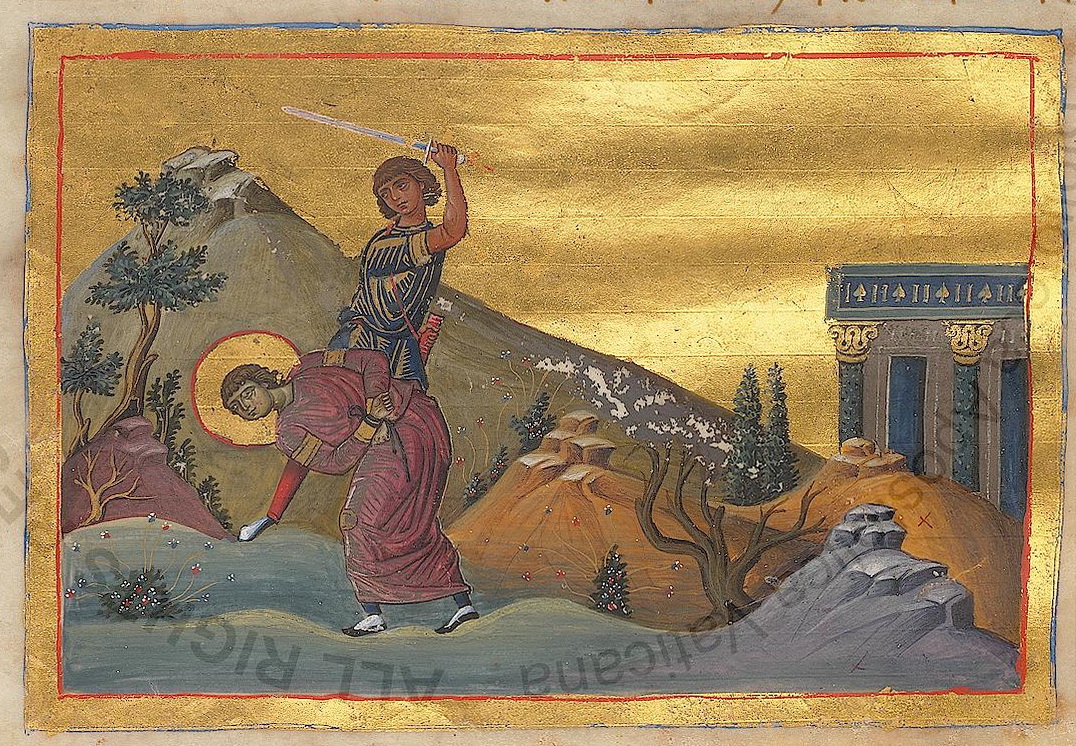
The emperor's triumph was turned to public humiliation, and his fury fell upon the youth and upon the man who had strengthened him. Learning that it was the imprisoned Demetrius who had blessed and emboldened Nestor, he sent soldiers to run Demetrius through with their spears in the baths; and he ordered Nestor beheaded. So Nestor suffered by the sword, a distinct martyr, commemorated the day after the patron whose blessing had made him victor. His death is placed, with Demetrius's, about the year 306, in the last and fiercest of the pagan persecutions before the peace of the Church.
The Church draws from his contest a lesson repeated in his hymns: that the Christian who ventures himself upon God, and not upon his own strength, is made a victor; the words the tradition sets in his mouth in the arena are read as an enacted confession of Psalm 117 (118):6, "The Lord is my helper, and I will not fear what man shall do to me."
Feast and commemoration
27 October (church date; Old Calendar civil 9 November), a universal commemoration of the Byzantine rite, kept everywhere the day after the feast of Demetrius (26 October) and understood as its sequel — Demetrius's own apolytikion in Tone 3 names both "the arrogance of Lyaeus" that was brought down and "Nestor in the stadium" to whom courage was given, so that the two feasts are liturgically inseparable. The Greek Menaion appoints Nestor a proper kontakion of his own (see Hymnography) while giving him the common apolytikion of a single martyr; the fuller festal propers of the day are those of Demetrius, with which Nestor's memory is joined.
Hymns
Troparion — Tone 4 (from the common of a martyr)
Thy martyr, O Lord, in his courageous contest for Thee received as a prize the crown of incorruption and life from Thee, our immortal God. For since he possessed Thy strength, he cast down the tyrants and wholly destroyed the demons' strengthless presumption. By his intercessions, O Christ our God, save our souls.
Original translation from the Greek
Kontakion — Tone 2
Having contested well, thou hast now inherited immortal glory, and hast become a most excellent soldier of the Master through the prayers of Demetrius the martyr; therefore, O wise Nestor, together with him cease not to intercede for us all.
Original translation from the Greek
Iconography
Nestor is depicted as a beardless young man, often in the short tunic of a youth or the chlamys, sometimes bearing the martyr's cross; where the scene of his contest is shown, he is the small figure overthrowing the great gladiator Lyaeus, who falls upon the spears — a composition that regularly accompanies the martyrdom cycle of Demetrius, the elder martyr blessing the younger from his prison. In the surviving fresco cycles of the reliquary-chapel of Hagios Demetrios the two episodes are shown in sequence: Demetrius blessing Nestor, and Nestor triumphing over Lyaeus.
The stored image is the miniature of the Menologion of Basil II (c. 1000, now in the Vatican Library), captioned "the Martyr Nestor of Thessalonica," which gives the young martyr frontally in the manner of that great imperial menologion — one of the hundreds of public domain portraits by which the minor saints of the fixed year are known.