
Nestor the Chronicler
Our Venerable Father Nestor the Chronicler of the Kiev Caves
Venerable · b. c. 1050 — d. c. 1114
Commemorated 27 October — Repose at the Kiev Caves
Nestor the Chronicler (c. 1050 – c. 1114) was a monk and hierodeacon of the Kiev Caves monastery, the first great historian of the Christian East Slavs and, by tradition, the compiler of the Russian Primary Chronicle (the Tale of Bygone Years), which opens "Whence came the Russian land." A disciple of the successors of Theodosius of the Caves, he wrote the earliest lives of the passion-bearers Boris and Gleb and of Theodosius himself, helped uncover Theodosius's relics, and gathered the memory of the young Rus' into a theological history of its baptism and salvation. He reposed in the monastery about 1114 and rests incorrupt in the Near Caves; the Russian Church honours him as the father of its written history and the patron of chroniclers and scholars.
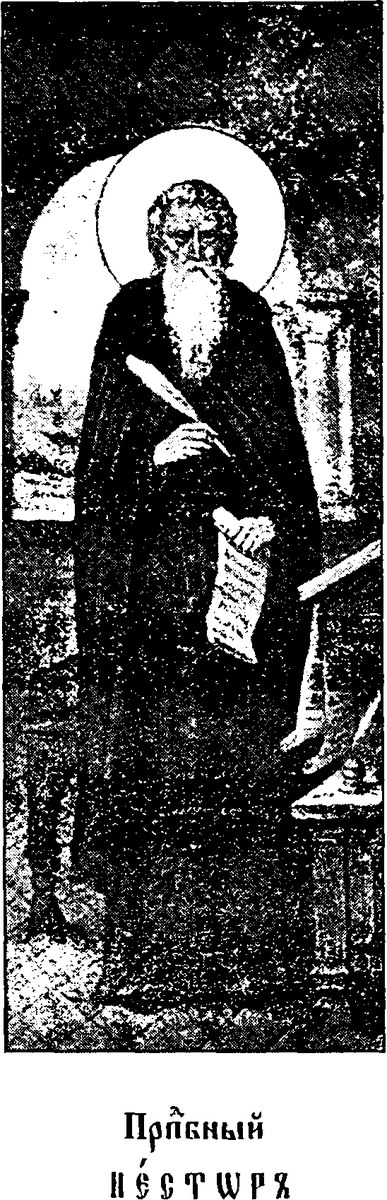
_-_%D0%B8%D0%BA%D0%BE%D0%BD%D0%B0_02272_%D0%9D%D0%B5%D1%81%D1%82%D0%BE%D1%80_%D0%BB%D0%B5%D1%82%D0%BE%D0%BF%D0%B8%D1%81%D0%B5%D1%86.png)
Origins and monastic tonsure
Nestor was born at Kiev about the year 1050, in the generation that saw the young Christian Rus' come to maturity two lifetimes after the baptism of Vladimir. As a young man he came to the Kiev Caves monastery — the Pechersk Lavra, cradle of Russian monasticism — while its founder Theodosius of the Caves was still alive or newly reposed; he received the monastic tonsure under Theodosius's successor, the igumen Stephen, and under him was ordained hierodeacon (a deacon in monastic orders). Of his inner life the tradition records that, with other fathers of the monastery, he took part in delivering the recluse Nikḗtas (later bishop of Novgorod) from a spirit of delusion that had seized him through an overweening study of the Old Testament — Nestor, who prized true learning joined to humility and repentance, standing among those whose prayers restored him.
His own praise of learning is preserved in the Chronicle and became a maxim of Russian monastic culture: "Great is the profit of book-learning, for books point out and teach us the way to repentance… they are a river watering the whole world, and in them is a boundless depth; the one who reads books converses with God or with the saints."
The historian of the Caves
Within the monastery Nestor was given the obedience of chronicler, and to this labour his sanctity is chiefly bound. In the 1080s he wrote the Account of the Life and Martyrdom of the Blessed Passion-Bearers Boris and Gleb, occasioned by the translation of their relics to Vyshgorod in 1072, and the Life of our Venerable Father Theodosius of the Caves — foundational texts of Russian hagiography. In 1091, on the eve of the monastery's patronal feast, he was among those entrusted by the igumen John to disinter the relics of Theodosius for their translation into the great church, and the tradition remembers him as the first eyewitness of those relics — the memory enshrined in his proper kontakion.
His chief work was the compilation, about the years 1112–1113, of the Russian Primary Chronicle, the Tale of Bygone Years (Повѣсть временныхъ лѣтъ). Its opening line declares its purpose — "These are the narratives of bygone years concerning the origin of the land of Rus', who first ruled at Kiev, and how the land of Rus' came to be." To it Nestor brought an extraordinarily wide range of sources: earlier Rus' chronicle material, monastery records and oral testimony (among his informants the aged boyar Jan Vyshatich), the Byzantine world-chronicles of John Malalas and George Hamartolos, treaty texts, and historical miscellanies. From these he composed not a bare annal but a theological history: the story of the Rus' set within the history of the whole world and of the salvation of the human race — the first mention of the Rus' in 866 under Patriarch Photius, the invention of the Slavonic letters by Cyril and Methodius, the baptism of Olga at Constantinople, the first church of Kiev (945), the Varangian martyrs (983), Vladimir's "testing of the faiths" (986) and the Baptism of Rus' (988). He wrote in a time of trial — the land torn by the feuds of the princes and wasted by the raids of the Polovtsian nomads, and he was himself an eyewitness to the sack of the Caves monastery in 1096 — yet shaped it all into a patriotic and ecclesial vision of his people's calling.
Repose and legacy
Nestor reposed at the Kiev Caves about the year 1114, leaving to the monastery's later chroniclers the continuation of his work; his successors — the igumen Sylvester (who gave the Primary Chronicle its surviving redaction in 1116), the igumen Moses of Vydubychi, and at last the monk Laurence, whose manuscript of 1377 preserves the oldest surviving text — carried the great chronicle forward. His relics rest incorrupt in the Near (Anthony's) Caves of the Lavra. For the depth, historical fidelity and spiritual seriousness of the Primary Chronicle, which stands among the significant works of medieval world literature, the Church venerates Nestor as the first Russian church historian and the patron of those who write and study; he is regularly depicted in Russian art with pen and scroll, the founder of the national memory.
Feast and commemoration
27 October (church date; Old Calendar civil 9 November), his principal feast, the day of his repose — a commemoration of the Russian Church and the Churches descended from it (the Orthodox Church in America among them), not part of the older universal calendar. Nestor is also commemorated with the whole company of the Caves fathers on two further occasions kept in the same tradition: the Synaxis of the Venerable Fathers of the Kiev Caves who rest in the Near Caves (28 September), and the Synaxis of All the Venerable Fathers of the Kiev Caves on the second Sunday of Great Lent — the latter a movable commemoration. He is to be distinguished from a second, later ascetic of the monastery, Nestor "the Unlettered" (not the Chronicler) of the Far Caves, whom the same calendars keep on this day (see Disputed questions).
Hymns
Troparion — Tone 4
Having written the deeds of the great princes of Rus' and the lives and miracles of the venerable Fathers of the Caves, and having thyself, O God-wise Nestor, gained through thy many virtues a name written in heaven, pray that we too may be inscribed in the Books of Life.
Original translation from the Slavonic
Kontakion — Tone 2
As a disciple of the God-bearing Theodosius and a true imitator of his life, thou wast counted worthy to be the first to behold his precious relics, which with the others thou didst reverently translate, and so didst inherit with them the Kingdom of Heaven; pray to the Lord that we who honour thee may obtain it also.
Original translation from the Slavonic
Iconography
Nestor is depicted as an aged monk of the Caves, hooded or bare-headed with a long grey beard, in the schema, most often seated at his writing with a quill and an open scroll or book — the "chronicler" type, sometimes shown against the caves or the monastery — the visual emblem of the scribe-historian. He appears among the ranked fathers in the great composite icons of the Synaxis of the Kiev Caves saints, placed among the Near Caves. Later Russian art gave him a fixed and famous portrait in this scholarly guise, and it is the type reproduced in the stored image, an engraved icon of Nestor as the seated chronicler from the illustrated Lives of the Saints published at Moscow in 1903–1911.
Disputed questions
- Authorship of the Primary Chronicle. The attribution of the Tale of Bygone Years to Nestor is the received tradition of the Church and of much older scholarship, but the chronicle is a composite work with several redactions, and modern textual critics debate how much of the surviving text is Nestor's own and how much belongs to his continuators (notably Sylvester of the 1116 redaction) and to earlier chronicle compilations he drew upon. The Church venerates him as its compiler; the precise editorial history is a question of philology.
- Not to be confused with Nestor "the Unlettered" (not the Chronicler) of the Far Caves, a later monk of the same monastery commemorated on the same day (27 October) — so kept, the tradition holds, because he bore the name of Nestor of Thessalonica — who rests in the Far (Theodosius's) Caves and is a distinct person from the chronicler of the Near Caves.