
Theodosius of the Kiev Caves
Our Venerable and God-bearing Father Theodosius, Abbot of the Kiev Caves, Founder of Cenobitic Monasticism in the Land of Rus'
Venerable · b. c. 1008–1036, at Vasilev near Kiev — d. 3 May 1074, at the Kiev Caves monastery
Commemorated 3 May — Repose at the Caves monastery, 1074, 14 August — Uncovering and translation of the relics into the Great Church of the Dormition, 1091, 28 August — Synaxis of the Fathers of the Kiev Far Caves
Theodosius (Feodosy Pechersky, †3 May 1074) is the father of Russian monasticism: the second founder, with Antony, of the Kiev Caves monastery, and the man who turned a company of hermits in a hillside burrow into a cenobium governed by a written rule. Born at Vasilev near Kiev and raised at Kursk, he baked the prosphora for his village church as a boy against his mother's violent opposition, escaped to Kiev in his twenties, and was received by Antony into the cave above the Dnieper and tonsured by Nicon. As abbot he procured a copy of the typikon of the Studion monastery at Constantinople and imposed it on the brotherhood — common table, common property, unbroken obedience — so that the Caves became the mother and model of every monastery in the land of Rus'. He raised the community from a handful to a hundred, built the wooden and then began the great stone church of the Dormition, gave a tenth of the monastery's income to the poor and maintained a hospice for the sick and the mutilated, sent a cartload of bread each week to the prisoners, and rebuked the Grand Prince Svyatoslav to his face for usurping his brother's throne. His Life, written by Nestor the Chronicler, is one of the founding works of Slavonic literature; his relics were uncovered on 14 August 1091, and in 1108 he became the first monastic saint of Rus' to be formally canonised.
Not to be confused with any of the six other saints named Theodosius already in this corpus, and above all not with Theodosius the Cenobiarch (†529), the founder of the coenobia of the Judaean desert. See Disputed questions below.

Vasilev and Kursk
Theodosius was born at Vasilev (Vasilkov), a small town on the Stugna south of Kiev, to parents of the middling servant class of the princes; the transmitted dates of his birth range from about 1008 to the 1030s, and none is secure (see Disputed questions). While he was still a child the family was moved to Kursk, on the far north-eastern frontier of the Rus' lands, when his father was transferred there in the prince's service.
The Life draws the boy with a set of details that are unusual in Slavonic hagiography for being awkward rather than edifying. He would not play with the children of his own rank; he went to church every day, and asked to be taught letters, and learned quickly. He refused good clothes and wore what a peasant would wear, and — this is the detail Nestor makes central — he went out to work in the fields with the household slaves, which in the society of eleventh-century Kursk was not humility but scandal. His father died when he was about fourteen, and thereafter his mother, a woman of formidable will whom the Life describes as strong as a man, took his upbringing wholly upon herself.
The prosphora, the chains, and the flight
Learning that the village church went short of the prosphora — the loaves offered at the Liturgy — because no one would trouble to bake them, Theodosius bought wheat, ground it, baked the bread with his own hands and sold what was left over, buying more wheat with the proceeds and giving the rest away. He did this for years. The other boys mocked him for it, and his mother beat him for it: for a son of a princely servant to work as a baker was, in her eyes, a disgrace to the family.
The conflict escalated in the way the Life records without softening. When a fellow townsman, seeing his devotion, gave him iron chains to wear beneath his clothes as an ascetic discipline, he wore them until they cut into his flesh and the blood showed through his shirt; his mother discovered them at a feast, tore them off him and beat him again. When a company of pilgrims passed through Kursk on the way to the Holy Land he attached himself to them and slipped away; his mother pursued him for three days, overtook him, dragged him home by the hair, beat him, and kept him in fetters until he promised not to run away again.
At about twenty-three or twenty-four, hearing at the Liturgy the words He that loveth father or mother more than me is not worthy of me, he went out of Kursk secretly and made for Kiev, walking behind a caravan of merchants for three weeks so as not to be seen.
The cave of Antony
At Kiev the monasteries would not take him. The Life is candid about the reason: he came in the clothes of a labourer, without money and without a patron, and the abbots judged by appearances. At last he was directed to the hillside above Berestovo, where the hieromonk Antony, back from Athos, was living in a cave he had dug himself with a few companions.
Antony put to him the question that has become the most quoted sentence of the Caves tradition — "Dost thou see, child, that my cave is a poor thing, and narrow?" — and Theodosius answered that God had brought him there and he would do whatever he was commanded. He was received, and tonsured at Antony's direction by Nicon the Great, the priest of the little community.
The labours of a monk
In the cave Theodosius outdid the brethren in the plainest possible ways. He carried the water, chopped and carried the wood, ground the grain by hand and brought the flour to each monk's cell — the offices that no one wanted. On summer nights he would bare his body to the swarms of gnats and flies of the Dnieper marshes and sit spinning wool for the brethren's shoes and chanting the Psalter, unmoving until matins. He was never absent from the services, and never last to arrive at them.
Four years after his flight his mother found where he was. She came, wept, threatened, and demanded that he come home. Theodosius would not see her until she had agreed to hear him; and the outcome of their meeting is the resolution of the whole first half of his Life: she stayed in Kiev and was tonsured a nun at the convent of St Nicholas on Askold's grave, and there she died. The son who had been dragged home by the hair brought his mother to the monastic habit.
Abbot: the Studite rule
Ordained hieromonk — the received date is 1054 — Theodosius was chosen abbot (igumen) when Varlaam, the first superior appointed by Antony, was taken away by Prince Izyaslav to head the new monastery of St Demetrius in the city. The year is variously given as 1057 and 1062 (see Disputed questions). Antony, who never governed, withdrew further into his cave; from this point the two founders divide the tradition between them as the hesychast and the cenobiarch of Rus'.
Theodosius's decisive act was to give the community a written rule. The Caves brotherhood had been living as a loose colony of ascetics, each after his own measure; Theodosius obtained the typikon of the monastery of Studion at Constantinople, the great cenobitic rule of St Theodore the Studite, having it copied out and brought to Kiev. The Life and the Paterikon credit the transmission to the Studite monk Michael, who had come to Rus' in the suite of Metropolitan George, and the Caves tradition also attributes the copying of the typikon at Constantinople and its carriage home to Ephraim, later bishop of Pereyaslavl, who went there at Theodosius's own request. He then imposed the rule in full: common refectory, common possessions, no private property whatever, fixed hours, and unqualified obedience to the abbot. He himself went through the cells and took away anything a monk had kept back for himself, and burnt it.
This is the act on which his whole significance rests. The Studite rule as received and enforced at the Caves became the rule of the Caves' daughter houses, and through them the constitution of Russian monasticism for centuries; and the office of abbot as Theodosius exercised it — teaching, correcting, refusing to be served — became the Russian ideal of the starets-superior. The brotherhood grew in his lifetime from a handful, twenty at the most, to about a hundred monks.
The abbot's own life
He kept, on his own person, a discipline harder than he laid on the brethren. He ate dry bread and cooked greens without oil; he drank water; he slept sitting and never lay down; he wore a hair-shirt under his habit and the same patched outer garment for years, so that visitors took him for the monastery cook. Every Great Lent, from Cheesefare Sunday until the Friday before Palm Sunday, he shut himself alone in a cave and returned to the brethren only for the feast of the Entry into Jerusalem. He went about the cells at night listening — not for gossip, but to know whether the brethren were praying — and if he heard idle talk he knocked at the door and rebuked the monk the next day, gently, by parable.
Mercy, and the money
The Life and the Paterikon are full of Theodosius's almsgiving, and it was organised rather than impulsive. He built beside the monastery a court with a church of St Stephen where the poor, the blind, the lame and the leprous were housed and fed at the monastery's charge; he assigned a tenth of all the monastery's income to their keeping; and every Saturday he sent a cartload of bread to the prisoners in the city gaols.
The most famous of the Caves stories belong to this side of his life: the cellarer who reported that there was nothing to set before the brethren, and the bread that was found in the ovens; the flour that did not fail in a famine; the gold left on the abbot's table by a visitor no one could identify; the robbers who came by night to plunder the monastery's stores and were held off by the sound of singing in the empty church. Nestor tells them plainly, as the community's own memory of the years when it had nothing and was never short.
Theodosius and the princes
Theodosius stood in a relation to the princes of Kiev that no Russian churchman had occupied before him, and which he largely created. Izyaslav Yaroslavich, the Grand Prince, came often to the monastery, ate the monks' bread and preferred it to his own kitchen's, and took the abbot's counsel; Theodosius spoke to him as a father and never flattered him.
When in 1073 Izyaslav was driven from Kiev by his brothers and Svyatoslav took the throne, Theodosius refused to recognise the usurpation. He would not commemorate Svyatoslav in the diptychs of the monastery, refused his invitations, denounced the seizure of a brother's throne in writing and to the prince's face, and told the messengers who threatened him with exile that nothing in this world could frighten a man who had left it. The brethren, fearing for the monastery, begged him to moderate; he ceased his public denunciations but never withdrew the substance, and never asked anything of Svyatoslav for himself. Svyatoslav, for his part, gave the monastery the ground for the new church and a hundred grivnas of gold toward its building — the odd fruit of a quarrel neither man won.
The Life of Theodosius is thus also the first Russian document of the freedom of the Church's word before the state, and it was read as such by every later generation of Russian monks.
Building the Dormition
Theodosius moved the community out of the caves. About 1062 he built a wooden church of the Dormition of the Most Holy Theotokos and a range of cells on the hill above the cave complex, and transferred the brotherhood to them, leaving the caves for burial and for those called to reclusion. In 1073 he laid the foundations of the great stone church of the Dormition — the Great Church of the Lavra, whose building was completed under his successor Stephen and which became the model for church architecture throughout the Rus' lands. He did not live to see it finished.
Repose
Theodosius foretold the day of his death. He gathered the brethren, took leave of them, and when they asked him to name a successor he asked whom they would have; and at their request — "He grew up under thy instruction, and he has served thee; give him to us" — he appointed Stephen, the domesticus of the monastery, laying on him three charges: to keep the typikon exactly, to receive pilgrims and strangers, and to pray for the monastery's benefactors.
He gave instructions about his own burial that are as characteristic as anything in his Life: he was to be laid in the cave in which he used to keep Lent, in the clothes he was wearing, not washed, and buried at night, with no one gathered and no ceremony. He died on 3 May 1074 — the year 6582 of the Byzantine reckoning. The brethren, in the event, could not keep the injunction to silence: the Life says the whole city knew before the burial was done.
Relics and canonisation
On 14 August 1091, on the eve of the Dormition, the relics were uncovered at the direction of Abbot John and the whole brotherhood and translated from the cave into the new Great Church of the Dormition; they were found incorrupt. Bishop Stephen, his own former disciple, and Ephraim of Pereyaslavl were among the hierarchs present. Tradition holds that the relics were later concealed beneath the Great Church in the face of invasion, and that, unlike the ranks of Caves fathers whose bodies lie open to veneration in the Near and Far Caves, the relics of both founders — Antony's in his cave and Theodosius's under the Dormition — have remained hidden ever since.
In 1108, at the petition of Abbot Theoctistus and the Grand Prince Svyatopolk, Metropolitan Nicephorus of Kiev directed that Theodosius's name be entered in the synaxaria of all the churches of Rus' — a formal canonisation, the first of a Russian monastic saint, and one of the earliest acts of the kind in Slavonic Christianity. His memory has been kept universally in the Russian and Ukrainian Churches ever since, and the Greek synaxaria receive him as "Ὅσιος Θεοδόσιος, καθηγούμενος τῆς Λαύρας τῶν Σπηλαίων τοῦ Κιέβου."
Writings
Eleven short works are transmitted under Theodosius's name, and they are among the earliest original compositions in Church Slavonic from Rus': instructions to the brethren (on patience, on love, on humility, on the Christian's endurance of adversity, on the danger of drunkenness), two prayers, and letters to Prince Izyaslav — one on the keeping of Wednesday and Friday and the eating of meat, and one, best known, on the Latin faith, warning the prince against the customs of the Western Church. The attribution of this last is contested (see Disputed questions). Whatever the resolution, the instructions to the brethren are securely his, and they show the abbot the Life describes: concrete, unliterary, and preoccupied with obedience and mutual forbearance rather than with speculation.
Hagiographic and literary legacy
The Life of our Venerable Father Theodosius of the Caves, written at the monastery by Nestor the Chronicler some years after 1080, is the first full-scale Slavonic monastic biography and the model for the genre in Rus'. It is unusually rich in domestic detail, unusually free with the failings of the great — including the saint's mother and the reigning prince — and it is the principal source for everything in this entry. Around it grew the Kiev Caves Paterikon, the collection of tales of the monastery's fathers, in which Theodosius is the fixed point: nearly every one of the Caves saints is characterised by his relation to him. Through the Life, the Paterikon and the Primary Chronicle, Theodosius became for Russian monasticism what Benedict is for the Latin West — not the first monk, but the lawgiver.
Feast and commemoration
May 3 (church date; Old Calendar civil May 16) — the day of his repose in 1074, and his principal feast in the Russian, Ukrainian and OCA calendars and in the Greek synaxaria, which have received him as an Ὅσιος of the universal calendar. In the Slavonic Menaion the day is his with a full office; he shares it with the martyrs Timothy and Maura, whose office holds the day in Greek usage, and in the Greek books with Peter of Argos.
August 14 (Old Calendar civil August 27) is the translation of his relics into the Great Church of the Dormition in 1091, kept on the eve of the Dormition — in Russian usage a feast of the Caves Lavra and in the OCA calendar a commemoration of the universal year. (That feast day has not yet been authored in this corpus; the August sweep will add the calendar listing there and no separate entry is needed, since this file is the single source of truth for both feasts.)
He is further commemorated with all the fathers of the Caves on the Second Sunday of Great Lent (a movable commemoration belonging to the movable sweep, not to any fixed day), and in Russian usage he is named together with Antony in the dedication of a great number of churches, the two founders being invoked as a pair — "our venerable fathers Antony and Theodosius of the Caves" — in the dismissals of the Lavra and in the Russian proskomedia commemorations. Because May 3 falls near the boundary of the Paschal cycle its position in the year is not fixed: in most years the office is sung within the Pentecostarion, but where Pascha falls late the day may still lie in Great Lent or Holy Week.
Hymns
Troparion — Tone 8
Raised up unto virtue, and loving the monastic life from thy childhood, thou didst valiantly attain unto thy desire and didst make thy dwelling in a cave, adorning thy life with fasting and with purity; and abiding in prayer as one without a body, thou didst shine forth in the land of Rus' as a radiant beacon, O venerable father Theodosius. Pray thou unto Christ God that our souls may be saved.
Original translation from the Slavonic
Kontakion — Tone 3
Let us honour today the star of Rus', which rose in the east and came unto the west, enriching all this land with miracles and with good things, and founding for us the rule and the order of the monastic life: the blessed Theodosius. Him the monastery of the Caves honoureth, and with the brethren we cry aloud: Rejoice, O father, boast of the monks!
Original translation from the Slavonic
Iconography
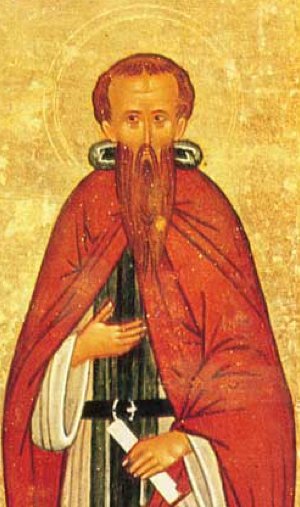
Theodosius is painted as a venerable father in the monastic habit — dark mandyas or, in Russian usage, a russet-brown mantle over the black paraman and the analavos of the great schema, its bands crossed on the breast — with a long, narrow, pointed beard, often reddish-brown rather than white, and a high bare forehead. He blesses with the right hand and holds in the left an unrolled scroll bearing a text of monastic instruction, or a folded scroll; the scroll rather than a book is his fixed attribute, marking him as a lawgiver of the monastic life. He is not vested as a priest, though he was a hieromonk, and he is never given a bishop's omophorion.
He appears above all in pairs and in companies. The commonest composition in Rus' shows Antony and Theodosius flanking the Kiev Caves Icon of the Mother of God, or standing on either side of a model of the Lavra, holding it up between them — the founders' composition, of which there are hundreds of examples from the sixteenth century onward, and which appears on the Caves Lavra's own antimensia and seals. In the great group icons of the Fathers of the Kiev Caves he stands at the head of the abbots, and in Russian menologion icons for May he is the principal figure of the third day.
The stored image is a detail from a two-sided Novgorod icon tablet of the late fifteenth century (24 × 19.5 cm; State Tretyakov Gallery, inv. 22031; the reverse bears the Entry into Jerusalem), on which Theodosius is painted with the Metropolitan Peter of Moscow and Leontius of Rostov. The identification of the figure reproduced here rests on the composition of the tablet — Theodosius is the one monastic among the three, and the other two are hierarchs in phelonion and omophorion — rather than on a legible inscription within the crop, and it is recorded that way rather than asserted more strongly. The figure shows the type exactly: the red-brown mantle, the schema-bands down the breast, the long tapering beard, and the scroll in the hand.
Disputed questions
- The year of his birth. The sources permit anything from c. 1008 to the 1030s. The traditional reckoning, which makes him about sixty-five at his death, yields c. 1009; the internal chronology of the Life — the flight to Kiev at twenty-three or twenty-four to a cave community that cannot be much older than 1051 — pushes the birth toward c. 1029 or later. Modern Russian scholarship generally prefers the later range; the calendars assert nothing. This entry records the span rather than choosing.
- The year he became abbot. The OCA's life gives ordination to the priesthood in 1054 and the abbacy in 1057; Russian scholarship generally places the abbacy in 1062, when Izyaslav founded the monastery of St Demetrius and removed Varlaam to head it. The disagreement is recorded here and not resolved.
- "Of the Far Caves." The OCA styles him "Abbot of the Kiev Far Caves," and the Far Caves complex is called Theodosius's Caves because he dug and inhabited it while Antony kept to the Near Caves. But his body was translated in 1091 into the Great Church, not into either cave; the epithet marks the caves he made, not a burial. Whether he is to be numbered in the Synaxis of the Fathers of the Far Caves (August 28) is answered inconsistently by the calendars, and this entry therefore records only the two feasts that are securely his. He is certainly commemorated with all the Caves fathers on the Second Sunday of Great Lent, a movable commemoration.
- The treatise on the Latins. The letter On the Christian and the Latin Faith, addressed to a Prince Izyaslav, is ascribed in the manuscripts to "Theodosius of the Caves," but many scholars assign it instead to Theodosius the Greek, a twelfth-century abbot of the same monastery who wrote for Izyaslav Mstislavich (d. 1154) rather than Izyaslav Yaroslavich. The question is genuinely open, and it matters: the treatise is one of the sharpest anti-Latin texts of early Rus', and its date determines whether such polemic was current in Kiev before or only after 1054's rupture had hardened.
- Not to be confused with — the Theodosii of this corpus are easily conflated, and this
one is the only monastic founder among them:
- Theodosius the Cenobiarch (†529, January 11), the father of the coenobia of the Judaean desert and, in Slavonic usage, likewise called "the Great." The confusion is the most natural of all, since both are titled founders of the common life; they are separated by five centuries and by a continent.
- Theodosius of Antioch (†c. 412, January 11), the Syrian hermit of Rhosus.
- Theodosius of Trebizond (†1392, January 11), metropolitan of Trebizond.
- Theodosius of Trnovo (†1363, February 17), the Bulgarian hesychast of Kilifarevo.
- Theodosius of Chernigov (†1696, February 5 and September 9), the Ukrainian archbishop — the Theodosius most often confused with this one in Russian usage, since both are Kievan and both are wonderworkers of the Ukrainian lands.
- Theodosius the Great, the emperor (†395, January 17).
- And, outside this corpus, Theodosius the Greek, the twelfth-century abbot of the same Caves monastery, translator and probable author of the anti-Latin letter discussed above.