
Nicetas the Goth
The Holy Great Martyr Nicetas the Goth
Great Martyr · d. 372
Commemorated 15 September — Martyrdom by fire under Athanaric
Nicetas the Goth (†372) was a Christian of the Gothic lands on the lower Danube, converted and formed in the young Gothic church of the fourth century, who laboured to spread the faith among his own people. When the pagan Gothic ruler Athanaric renewed his persecution of the Christians among the Goths, Nicetas denounced him, was seized, tortured, and burned; his body, preserved unconsumed, was carried by his friend Marianus to Mopsuestia in Cilicia, from which his cultus spread through the whole Church. Venerated as a great-martyr, he became one of the most beloved warrior-saints of the Slavic world. His feast is September 15.
.jpg)
The Gothic church of the fourth century
Nicetas belongs to one of the most remarkable and least-remembered chapters of the early Church: the Christianity of the Goths beyond the Danube, in the lands the Romans called Gothia (roughly modern Wallachia and Moldavia). The faith had reached the Goths in the third century, partly through Roman captives carried off in the raids of the 250s, among whose descendants was Ulfilas himself. By 325 the community had a bishop: Theophilus, "bishop of Gothia," subscribed the acts of the First Ecumenical Council at Nicaea. The tradition makes Nicetas a Goth born and raised on the banks of the Danube, baptised by this Theophilus and formed in his circle.
Theophilus's successor in the Gothic mission was Ulfilas (Wulfila), a descendant of Cappadocian captives, consecrated bishop "for the Christians in the Gothic land" about 341. Ulfilas devised an alphabet for the Gothic tongue and translated the Scriptures into it — the first Bible in a Germanic language, of which the surviving Codex Argenteus is a descendant — omitting, as Philostorgius reports, the books of Kings, lest their wars inflame a war-loving people. Ulfilas's doctrinal allegiance was to the Homoian ("Arian") party dominant at the imperial court of his day, and through his mission Arianism became the historic form of Gothic Christianity; the hagiographic tradition of Nicetas, however, remembers the saint simply as an orthodox confessor of Christ formed by Theophilus and labouring for the conversion of his countrymen. Nicetas is said to have worked tirelessly among the Goths, drawing many to the faith by his example and his words.
The persecution of Athanaric
Within the Gothic confederation of the Tervingi, Christianity provoked a pagan reaction. The iudex (chief magistrate) Athanaric, seeing in the new faith a Roman infiltration dissolving ancestral custom, raised two persecutions against the Christians among his people, the second and fiercer falling in the years 369–372. This persecution is solidly historical, attested by contemporary witnesses far beyond the hagiography of Nicetas: on April 12, 372 the martyr Sabas the Goth was drowned in the river Mousaios (the modern Buzău in Romania), and the letter of the Gothic church which accompanied his relics to Cappadocia — together with the correspondence of Basil the Great, who received them through Junius Soranus, the dux of Scythia — is among the treasures of early hagiography. The church historians Socrates and Sozomen record the persecution and the many Gothic martyrs; a Gothic liturgical calendar fragment preserves commemorations of martyrs "burned in Gothia."
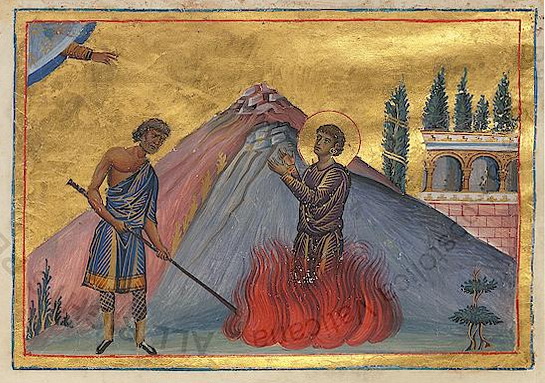
The Passion of Nicetas sets his martyrdom against the civil strife within the Gothic nation: the chieftain Fritigern, at the head of a party increasingly aligned with the empire and open to Christianity, clashed with Athanaric; after Fritigern's victory (with Roman support) the faith spread the more freely, but Athanaric regathered his strength, regained power in his own territory, and turned upon the Christians in vengeance for his humiliation. Nicetas, filled with zeal, openly denounced Athanaric's cruelty and impiety and strengthened the faithful for martyrdom. Seized by the persecutor, he endured many tortures and was finally cast into fire, in which he surrendered his soul on September 15, 372. The tradition insists that his body remained unburnt, radiant in the fire — the synaxarion's epigram plays on his name: "Thou art burned, Nicetas, and becomest a victory-bearer; or rather to say, a fire-bearing victory-bearer" (Νικήτας, "the victorious").
Relics and translations
A friend of the martyr, Marianus, a Christian of Mopsuestia in Cilicia who had known Nicetas in Gothia, took up the body by night — the Passion says he was guided by a star-like light — and carried it home to Mopsuestia, where it was enshrined and quickly became a fountain of healings. Mopsuestia was the historic centre of the cultus: the Passion itself was almost certainly composed there, and the city kept the martyr as its patron. Portions of the relics were later translated to Constantinople; the Serbian royal monastery of Visoki Dečani preserves a portion of the relics to this day, and the monastery of St Nicetas near Skopje (a foundation of the Serbian king Milutin) carried his name into the medieval Balkans.
Veneration and later cultus
From Mopsuestia and Constantinople the veneration of Nicetas spread through the whole Byzantine world and passed with special warmth into the Slavic lands. In Russia "Nikita" became one of the most popular of all baptismal names, and churches of the great-martyr multiplied (the church of Nicetas the Martyr on Staraya Basmannaya in Moscow and the Nikitsky monastery which gave its name to Nikitskaya street are examples; the Yaroslavl church of Nikita the Martyr preserved a great sixteenth-century vita icon of the saint). Russian popular devotion invokes him as a protector of children — the OCA notes the custom of praying to him for the preservation of infants — and as a mighty vanquisher of demons: a whole class of medieval Russian images, amulets and pilgrim crosses shows "Nikita Besogon," Nikita the demon-beater, thrashing a small black devil. That image, however, descends from an apocryphal Life of a different, unhistorical "Nikita son of the emperor Maximian," which church tradition and popular piety merged with the Gothic martyr; the Besogon iconography was eventually discouraged by the Russian church authorities, but its association with the name of the great-martyr persists in the material record (see Disputed questions).
Feast and commemoration
September 15 (church date; Old Calendar civil September 28), within the afterfeast of the Elevation of the Cross, whose hymns frame the whole service; Nicetas is the chief saint of the day in every tradition, with a full service in the Greek and Slavic Menaia. The commemoration is universal. The Russian tradition also keeps on the same day the Novonikitskaya icon of the Mother of God, which the pious tradition links to a vision granted to Nicetas before his baptism.
Hymns
Troparion — Tone 4
Thy Martyr, O Lord, Nicetas, in his contest received an incorruptible crown from Thee our God; for possessing Thy strength he cast down the tormentors and broke the feeble insolence of the demons: at his intercessions save our souls.
Original translation from the Greek
Troparion — Tone 4 (Slavic Menaion)
Taking up the Cross of Christ eagerly as a weapon, thou didst hasten to the battle against the enemies, and having suffered for Christ, thou didst at the last give up thy hallowed soul to the Lord in the fire; wherefore thou wast counted worthy to receive from Him the gifts of healing, O Great-martyr Nicetas: pray to Christ God that our souls may be saved.
Original translation from the Greek
Kontakion — Tone 2
Thou didst cut down the dominion of error by thy withstanding, and didst receive the crown of victory by thy contest; with the Angels, O glorious one, thou rejoicest, Nicetas, namesake of victory, with them interceding unceasingly to Christ God for us all.
Original translation from the Greek
Appointed readings
Epistle — 2 Timothy 2:1–10
1Thou therefore, my son, be strong in the grace that is in Christ Jesus. 2And the things that thou hast heard of me among many witnesses, the same commit thou to faithful men, who shall be able to teach others also. 3Thou therefore endure hardness, as a good soldier of Jesus Christ. 4No man that warreth entangleth himself with the affairs of this life; that he may please him who hath chosen him to be a soldier. 5And if a man also strive for masteries, yet is he not crowned, except he strive lawfully. 6The husbandman that laboureth must be first partaker of the fruits. 7Consider what I say; and the Lord give thee understanding in all things. 8Remember that Jesus Christ of the seed of David was raised from the dead according to my gospel: 9Wherein I suffer trouble, as an evil doer, even unto bonds; but the word of God is not bound. 10Therefore I endure all things for the elect’s sakes, that they may also obtain the salvation which is in Christ Jesus with eternal glory.
Gospel — Matthew 10:16–22
16Behold, I send you forth as sheep in the midst of wolves: be ye therefore wise as serpents, and harmless as doves. 17But beware of men: for they will deliver you up to the councils, and they will scourge you in their synagogues; 18And ye shall be brought before governors and kings for my sake, for a testimony against them and the Gentiles. 19But when they deliver you up, take no thought how or what ye shall speak: for it shall be given you in that same hour what ye shall speak. 20For it is not ye that speak, but the Spirit of your Father which speaketh in you. 21And the brother shall deliver up the brother to death, and the father the child: and the children shall rise up against their parents, and cause them to be put to death. 22And ye shall be hated of all men for my name’s sake: but he that endureth to the end shall be saved.
Iconography
Two iconographic streams serve the saint. The Byzantine tradition shows the martyrdom: the Menologion of Basil II (c. 985) illustrates its September 15 notice with Nicetas standing at prayer amid the flames, the executioner stoking the fire, and the hand of God blessing from heaven — the miniature stored here (the hosting Commons file carries a mistaken description naming Euphrosyne of Alexandria; the identification with Nicetas is verified against the Vatican digitisation of the manuscript, Vat. gr. 1613 p. 37, where the miniature stands under the heading of the great-martyr's memory). Later Byzantine and Slavic icons show him as a young warrior with lance, sword and shield, often paired with the other soldier-martyrs; the stored variant is the great vita icon of the second half of the sixteenth century from the church of Nikita the Martyr in Yaroslavl (Yaroslavl Museum), with twenty border scenes of his life and passion. The distinct "Nikita Besogon" type — the saint beating a demon with his fetters — belongs to the apocryphal Life discussed above.
Disputed questions
- History and legend. The persecution, the year 372, and the burning of Gothic Christians are historically secure from contemporary sources (the Passion of Sabas, Basil's letters, Socrates, Sozomen, the Gothic calendar). The Passion of Nicetas itself (BHG 1339–1340) is a later, legendary composition, written at Mopsuestia to serve the shrine there; the Bollandist Hippolyte Delehaye, who studied the Thracian and Moesian martyrs, treated its narrative framework — the wars of Fritigern and Athanaric, the star-led recovery of the body — as literary construction around an authentic martyr of the Gothic persecution. This entry presents the traditional account while marking its historical core.
- "Nikita Besogon." The demon-beating episode does not belong to the Gothic martyr's Passion at all but to the apocryphal acts of "Nikita son of Maximian," a text condemned in Slavic indices of forbidden books; the two figures are thoroughly conflated in medieval Russian iconography and popular devotion. Modern calendars commemorate only the Gothic great-martyr.
- Confession of the martyr. The Gothic church of his day was evangelised largely by the Homoian (Arian) mission of Ulfilas; the synaxaria remember Nicetas as taught by the Nicene bishop Theophilus and therefore orthodox. The sources do not allow a confident reconstruction of party allegiances among the martyrs of 369–372, and the Church has never doubted his confession of Christ, for which he died.
- Not to be confused with Nicetas the Stylite of Pereyaslavl (May 24), Nicetas of Medikion the Confessor (April 3), Nicetas the Hidden of Constantinople (September 9), Nicetas of Apollonias (the ninth-century iconodule confessor-bishop, March 20), or Nikitas of Novgorod (the recluse of the Kiev Caves and bishop of Novgorod, †1108, January 31) — later saints of the same name. Nor with Nicetas of Remesiana (June 22), the bishop of Dacia Mediterranea and apostle of the Bessi (†c. 414), whom the calendars style a martyr although nothing in his record supports a violent death: the stray title most likely reached him from this Gothic martyr, with whom he shares both the name and the Danubian region.