
Nikitas of Novgorod
Our Father among the Saints Nikitas the Recluse, Bishop of Novgorod, Wonderworker of the Kiev Caves
Venerable · Bishop · Wonderworker · b. mid-11th century — d. 1108
Commemorated 31 January — Repose at Novgorod, 1108, 30 April — Uncovering of his incorrupt relics, 1558, 14 May — Commemoration of the uncovering of the relics
Nikitas of Novgorod (†1108) was a monk of the Kiev Caves who became one of the most instructive figures in the Russian ascetic tradition: a young hermit who, shutting himself into reclusion against his abbot's warning and before he was ready, fell into spiritual delusion (prelest) — visited by a demon in the guise of an angel, given a false gift of prophecy, and turned wholly to the Old Testament while unable so much as to bear the name of Christ or the Gospels. The elders of the Caves, discerning the deception, drove out the demon by their prayers, and Nikitas was restored — humbled, unlettered again, and set on the sure path of obedience. He rose to sanctity, was made Bishop of Novgorod about 1096, and governed that see for some thirteen years, remembered for the two miracles by which he saved his city: he brought rain in a drought and quenched a great fire by his prayer. He reposed in 1108; his incorrupt relics were uncovered in 1558.
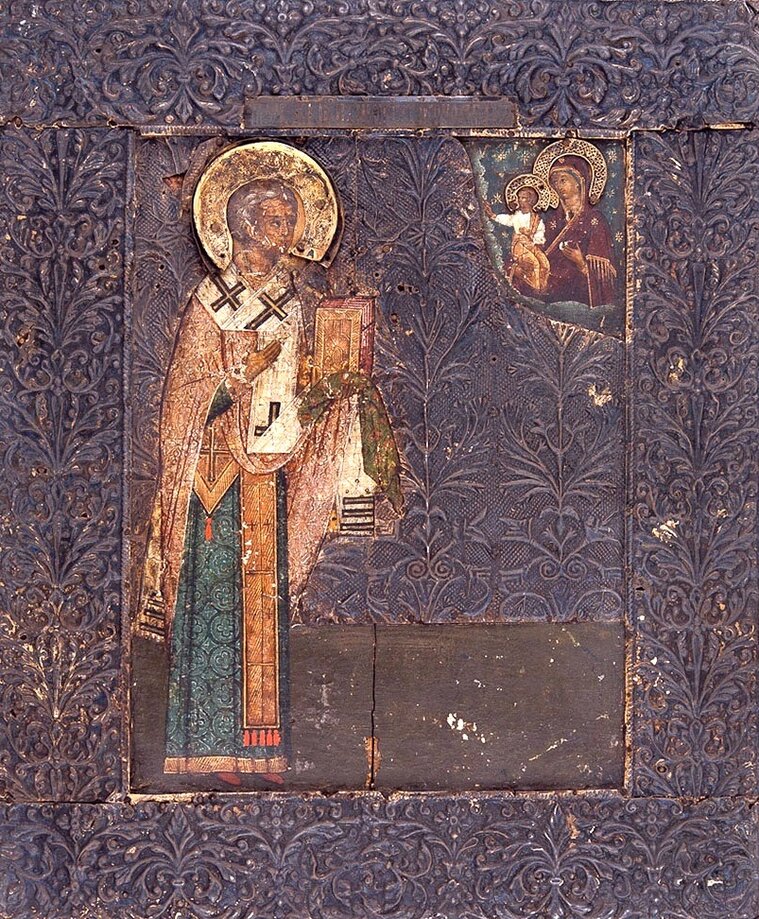

The young recluse and his fall
Nikitas entered the Kiev Caves Monastery — the cradle of Russian monasticism, under the abbacy of the venerable Nikon (abbot c. 1078–1088) — while still a young monk, in the generation after its founders Anthony and Theodosius. Burning with zeal, he begged the abbot's blessing to shut himself into reclusion (the zatvor), the severest of monastic labours, in which the monk seals himself alone in his cell. The wise Nikon refused, warning the youth that he was not ready: such solitude, he said, was perilous for one so untried, who might be overcome by the enemy. But Nikitas would not be dissuaded, and against the abbot's counsel he enclosed himself.
For a time all seemed well; then the young recluse was deceived. A spirit came to him — the tradition is unusually vivid — as an angel of light, filling the cell with fragrance; it bade Nikitas cease from prayer, promising to pray in his stead while he gave himself to reading, and set him to the Old Testament, which he memorised entire. Soon he astonished visitors by seeming to prophesy — telling of things happening at a distance, of a prince's death, of hidden matters — so that his fame spread and even the great came to him for counsel; and his words, drawn (the demon's craft) from what the spirit revealed, proved true. But a sure sign betrayed the delusion: Nikitas would speak only of the Old Testament and could not endure the New — he would not hear the name of the Gospel, nor of Christ, and turned away from any word of the Saviour.
Restoration by the fathers of the Caves
The holy fathers of the Caves — the tradition names a company of them, among them the future bishops and saints of that house — discerned in this the mark not of God but of the deceiver, for the Holy Spirit does not turn a soul from Christ. They came to Nikitas and prayed over him, and by their prayer the demon was driven out and the recluse delivered. When he was brought forth he was found to have forgotten all that the spirit had taught him — he could no longer even read, and had to be taught his letters again like a child — and, chastened by the memory of his fall, he set himself to the true monastic life of humility and obedience, and so came, this time rightly, to holiness. His story became in the Russian tradition the classic cautionary tale of prelest — spiritual self-deception — and of the danger of seeking the heights of solitary prayer before the soul is grounded in obedience.
Bishop of Novgorod
Grown to sanctity, Nikitas was called from the Caves to the episcopate: about the year 1096 he was consecrated Bishop of Novgorod, the great northern city and its wide territories. He governed the see for some thirteen years, and the memory of Novgorod preserved two deliverances wrought by his prayers. When a drought parched the land and fire threatened, he prayed and rain fell; and when a great conflagration broke out in the city — Novgorod, built of wood, dreaded fire above all — the bishop's prayer quenched the flames. These are the miracles for which his people remembered him, and which passed into his office and iconography.
Repose and relics
Nikitas reposed on the 31st of January, 1108, having been bishop for about thirteen years, and was buried in the cathedral of Holy Wisdom (Saint Sophia) in Novgorod. Four and a half centuries later, in 1558, in the reign of Tsar Ivan Vasilievich (Ivan the Terrible), his relics were uncovered incorrupt, and his glorification as a saint followed; the uncovering is kept on April 30 and May 14. His relics remained a treasure of Novgorod, drawing the veneration of the city and of the Russian Church, which numbers him both among the Wonderworkers of the Kiev Caves (he is reckoned of the Far Caves) and among the Hierarchs of Novgorod.
Feast and commemoration
Nikitas is kept on January 31 (church date; Old Calendar civil February 13), the day of his repose — the principal feast, though his cult is Russian and local rather than universal. The uncovering of his relics (1558) is commemorated on April 30 (Old Calendar civil May 13) and May 14 (Old Calendar civil May 27). He is also commemorated within the Synaxis of the Saints of the Kiev Caves and the Synaxis of the Hierarchs of Novgorod.
He is not to be confused with the other saints named Nicetas/Nikitas of the calendar: Nicetas the Goth (the great-martyr burned by the Goths, †372, kept September 15); Nicetas the Patrician (the confessor of the iconoclast persecution, †c. 838, kept October 13); Nicetas the Confessor of Medikion (April 3); and Nicetas the Stylite of Pereyaslav (the penitent tax-collector turned pillar-ascetic, May 24). Nikitas of Novgorod is the recluse of the Kiev Caves who became bishop of Novgorod — himself a Caves-saint, and so to be distinguished from the several other Caves ascetics of the same common name.
Hymns
Troparion — Tone 4
Rejoicing, thou didst enter upon the ascetic life from thy youth, O blessed Nikitas, and manfully overcoming the assaults of the enemy, thou wast shown forth a chosen vessel of God and a shepherd of the Church of Novgorod. Pray thou to Christ our God that our souls be saved.
Original translation from the Slavonic
Kontakion — Tone 6
Having cleansed thyself by humility from the deceit of the enemy that once ensnared thee, thou wast made a lamp of the Church of Novgorod, and by thy prayers thou didst bring down rain in the drought and quench the fire of the city; wherefore we cry to thee: Rejoice, O holy hierarch and father Nikitas.
Original translation from the Slavonic
Iconography
Nikitas is depicted as a bishop — vested in the cross-figured sakkos or the phelonion and the omophorion, the mitre or bare grey head, holding the Gospel-book and blessing — in the type of the Russian hierarch-saint, but marked as a monk of the Caves by his ascetic, wasted features. The stored image is a mid-17th-century Russian icon set within a chased-metal ground: Nikitas stands full-length as a hierarch, in the crossed omophorion, holding a jewelled Gospel and raising his hand in blessing, while in the upper corner appears the Mother of God "of the Sign" (Znamenie) — the palladium-icon of Novgorod, his own city — a fitting attribute for the bishop who saved Novgorod by his prayers (source, public domain, pd-old-work).