
Nicodemus of Serbia
Our Father among the Saints Nicodemus, Archbishop of Peć and of all the Serbian Lands
Bishop · Venerable · b. second half of the 13th century, in Raška — d. 11 May 1324 (some sources 1325), at Peć
Commemorated 11 May — Repose of the Archbishop of Serbia at Peć, 30 August — Commemorated with the Synaxis of the Serbian Hierarchs and Teachers
Nicodemus (†1324) was Archbishop of Peć and of all the Serbian lands from 1317 to his death, an Athonite monk of Hilandar before his elevation and one of the most learned Serbian churchmen of the fourteenth century. He translated the Jerusalem Typikon into Serbian, giving the Serbian Church the liturgical order it has kept ever since; he compiled a synaxarion-calendar recording the death-days of the Serbian kings and archbishops so that their memorials might be kept correctly; he twice acted as peacemaker in the murderous quarrels of the Nemanjić house; he crowned Stephen Uroš III Dečanski at Epiphany 1321; and he built and restored churches at Peć, at Žiča and on Athos. He is honoured with the Serbian hierarchs, and his relics rest in the church of St Demetrius at the Patriarchate of Peć.

Athos and Hilandar
Nicodemus was born, the Serbian tradition says, in Raška, the old heartland of the Serbian state, in the later thirteenth century. He went as a young man to the Holy Mountain and was tonsured there, entering the Serbian house of Hilandar — the monastery founded by St Symeon (Stephen Nemanja) and his son St Sabbas of Serbia, and in that generation the school of almost every Serbian hierarch of consequence. He was a man of books: the sources call him a theologian and an ecclesiastical writer, at home in Greek, and it was this competence that shaped everything he later did.
He became igoumen of Hilandar about 1312, holding the office until 1316. The abbacy of Hilandar was in that period a political as well as a monastic charge, since the house stood at the point of contact between the Serbian court and the Byzantine world. In it Nicodemus was sent by King Milutin and his brother Dragutin — whose long fratricidal war over the succession had torn the kingdom for two decades — as an envoy to Constantinople, to seek a settlement and reconciliation between the brothers. He also kept in repair the cell of St Sabbas at Karyes, the Serbian hesychastic foundation on the Mountain, of which Hilandar was the guardian.
Archbishop of Serbia
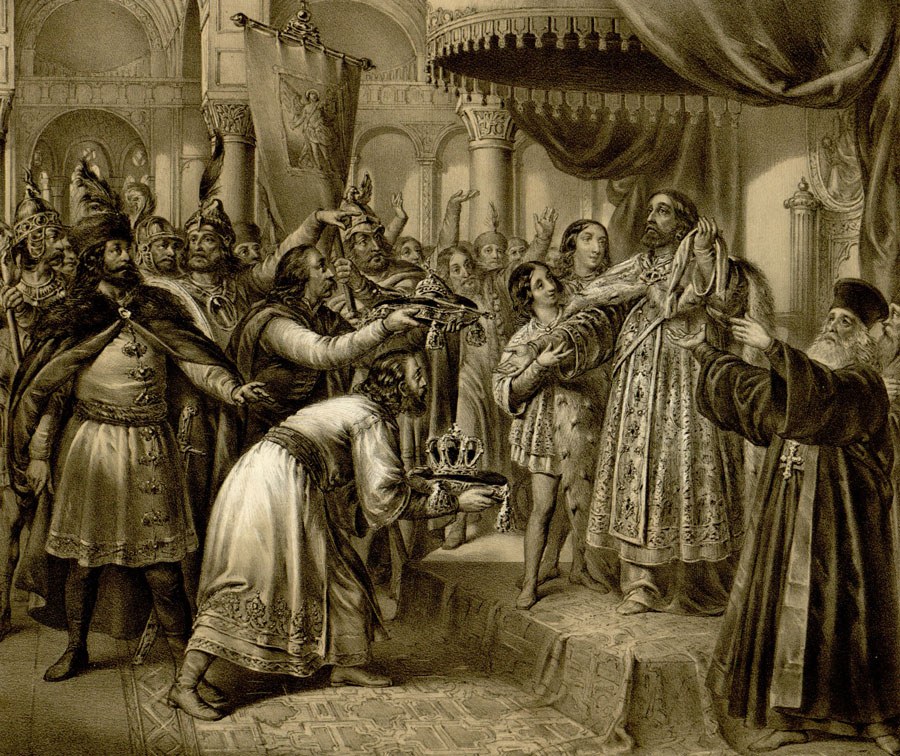
On the death of Archbishop Sava III in 1316, Nicodemus was elected Archbishop of Peć and of all the Serbian lands in 1317. The eight years of his episcopate fell in the most dangerous phase of the Nemanjić succession. Milutin had blinded and exiled his son Stephen (the future Uroš III, called Dečanski) after a rebellion; Nicodemus led the embassy that obtained the king's forgiveness and the return of the exiled prince from Constantinople — an act the Serbian tradition remembers as the saving of the dynasty and, since Stephen's sight was restored, as a miracle of St Nicholas obtained by the Church's prayer. When Milutin died in 1321 and the succession was again disputed, it was Nicodemus who resolved it liturgically: on 6 January 1321, the feast of the Theophany, he crowned Stephen Uroš III at Peć "with great joy and royal honour," and crowned with him the boy Dušan as young king — the future Stephen Dušan, under whom the archbishopric would become a patriarchate.
Against heresy he was, in the phrase of his own tradition, "an axe laid to the designs of the heretics": his targets were the Bogomils, still strong in the Serbian and Bosnian lands, and the Latin pressure exerted through the coastal cities and the Angevin claims. He preached, he legislated in synod, and he set about the more permanent remedy, which was to give the Serbian Church a stable and unambiguous liturgical order.
The Typikon and the Serbian calendar
Nicodemus's most consequential work was scholarly. He translated from Greek into Serbian the Typikon of St Sabbas the Sanctified — the Jerusalem Typikon, the ordo of the Palestinian monastic tradition which had by then displaced the older Constantinopolitan usage throughout the Byzantine world. His translation, made in 1319 and preserved in a manuscript with his own preface, is the foundation of Serbian liturgical practice from that day to this; every later Serbian Typikon descends from it. The preface, in which he describes going to Constantinople for a good exemplar and the labour of rendering it, is a rare personal document of a medieval Serbian hierarch.
To this he joined a synaxarion-calendar into which he entered the dates of repose of the Serbian kings and archbishops, so that their memorials should be served on the right days and their names commemorated at the proskomedia. It is the beginning of the Serbian national synaxarion and one of the main sources for the chronology of the Nemanjić dynasty and of the archbishops of Peć. He is also credited with a translation of the Life of St Sabbas material and with supervising the copying of service-books.
Builder
He built at Peć the church of St Demetrius, which stands still as one of the churches of the Patriarchate complex and in which he was himself buried; and a church of St Sabbas of Serbia at Lizica. He restored Žiča, the coronation church of the Serbian kings, which had been sacked by the Cumans and Tatars in 1291–1292, bringing it back into use as a royal and archiepiscopal sanctuary. And he maintained the Serbian foundations on Athos.
Repose and veneration
Nicodemus reposed at Peć on 11 May 1324, after some eight years as archbishop, and was buried in the church of St Demetrius he had built. His relics were enshrined there and are venerated at the Patriarchate of Peć to this day. He is commemorated in his own right on May 11, and again with the great company of the Serbian hierarchs and teachers — Sabbas, Arsenius, Sabbas II, Eustathius, Nicodemus, Danilo and the rest — on August 30, the collective feast of the archbishops of Peć instituted in the Serbian Church.
Feast and commemoration
May 11 (church date; Old Calendar civil May 24). Nicodemus is a Serbian commemoration received into the wider Slavic calendars: the Serbian Church keeps him on this day at Peć, and the Russian Church and the OCA list him for May 11 among the day's saints, after the hieromartyr Mocius and the Slav-apostles. In Serbian usage he is also commemorated on August 30 with the Synaxis of the Serbian Hierarchs. The propers used for him where a full service is served are modern compositions of the Serbian Church; the common of a hierarch is otherwise sung.
Hymns
Troparion — Tone 8 (common of a hierarch)
Guide of Orthodoxy, teacher of piety and holiness, lamp of the Serbian land, divinely inspired adornment of hierarchs, O most wise Nicodemus: by thy teaching thou hast enlightened all, thou harp of the Spirit; intercede with Christ God that our souls may be saved.
Original translation from the Slavonic
Kontakion — Tone 2
Having laboured on the Holy Mountain and been set as a shepherd over the Serbian flock, thou didst give thy people the order of the divine services and the memory of their fathers, O hierarch Nicodemus; and now, standing before the throne of glory, remember those who honour thy repose.
Original translation from the Slavonic
Iconography
Nicodemus is painted as a Serbian hierarch of the Nemanjić age: elderly, with a long grey beard, in phelonion (often the cross-patterned polystavrion) and white omophorion, wearing no mitre in the older work, holding the Gospel-book in his left hand and blessing with his right; a scroll bearing the opening of his Typikon preface is sometimes substituted for the Gospel, marking him as the translator and lawgiver of the Serbian services. He appears in the great composition of the archbishops of Peć in the churches of the Patriarchate, in which the whole succession from St Sabbas is ranged in a single row, and in the donor-portrait tradition of Dečani and Peć. The best-known medieval likeness is the fresco of 1322–1324 in his own church of St Demetrius at Peć, in which he is shown together with King Stephen Uroš III Dečanski, the young king Dušan and St Sabbas — a composition of the highest historical interest, since it is a contemporary portrait. The stored image is the 1852 lithograph of Stefan Dečanski receiving his sight at his coronation — the crowning archbishop being Nicodemus, whose place in the scene is his place in the history.
Disputed questions
- Year of repose. The Serbian tradition and most calendars give 1324; a substantial body of sources, including the OCA synaxarion and much of the Russian literature, gives 1325. The day, May 11, is not in dispute. The discrepancy probably arises from the reckoning of the Byzantine year, which began on September 1.
- Numbering. He is "Nikodim I," to distinguish him from Nikodim II, a fifteenth-century Serbian bishop; the two are unrelated.
- Not to be confused with Nicodemus of the Kiev Caves, the prosphora-baker (October 31), nor with Nicodemus the Hagiorite (†1809), the compiler of the Great Synaxaristes and of the Philokalia, nor with the Righteous Nicodemus of the Gospel.