
Sabbas of Serbia
Our Father among the Saints Sava, First Archbishop and Enlightener of Serbia
Bishop · Venerable · b. c. 1174, as Rastko Nemanjić — d. 1236, at Tarnovo in Bulgaria (some sources 1235)
Commemorated 14 January — Repose at Tarnovo; his principal commemoration, kept on the leavetaking of the Theophany, 27 April — Burning of his relics on Vračar at Belgrade by Sinan Pasha, 1594, 6 May — Translation of his relics from Tarnovo to the monastery of Mileševa (1237); Serbian usage
Sabbas (Sava, c. 1174 – 1236), born Rastko Nemanjić, youngest son of the Serbian Grand Prince Stefan Nemanja, is the father of the Serbian Church and the most beloved of Serbian saints. As a youth he fled the court for Mount Athos and was tonsured a monk; there, joined by his abdicated father — the monk Symeon — he refounded the ruined monastery of Hilandar as the great Serbian house of the Holy Mountain. Returning home with his father's relics, he reconciled his warring brothers, reformed the monastic life of Serbia from Studenica, and in 1219 obtained from the exiled Patriarch of Constantinople at Nicaea the autocephaly of the Serbian Church and his own consecration as its first archbishop. He gave his people their law in the Zakonopravilo, its churches their order and hymnody, and its national memory its shape, writing the Life of his father the founder-saint. He died on pilgrimage at Tarnovo in Bulgaria in 1236; his relics, translated to Mileševa, worked wonders until the Turks, to break the Serbs, burned them at Belgrade in 1594 — the act that made him more than ever the symbol of the nation. He is commemorated on January 14, the leavetaking of the Theophany.

Origins: the youngest son of Nemanja
Rastko was born about 1174, the third and youngest son of Stefan Nemanja, the Grand Prince (veliki župan) who gathered the Serbian lands into a single state and founded the Nemanjić dynasty, and of his wife Anna. His elder brothers were Vukan and Stefan (the future "First-Crowned" king). Raised for rule, the boy was given at about fifteen an appanage to govern — the province of Hum (Zahumlje, roughly modern Herzegovina). But Rastko was drawn from childhood to the Church rather than the court, grave and devout beyond his years, and the governance of a province did not hold him.
Flight to Mount Athos and monastic tonsure
About the year 1192, while a party of Athonite monks was visiting his father's court, Rastko slipped away and fled with a Russian monk to the Holy Mountain, entering the Russian monastery of Saint Panteleimon and afterwards the Greek house of Vatopedi. When his father's horsemen overtook him and demanded his return, the youth — the story runs — had himself tonsured in the night, and let down his shorn hair and his princely clothes from the tower to the pursuers to carry home to Nemanja, keeping only the monk's habit and the new name Sava (Sabbas, after Sabbas the Sanctified). The father, the account says, received the sign not with anger but with tears of joy and prayer, and it turned his own heart toward the same path.
Symeon and Sava: the founding of Hilandar
In 1196 Stefan Nemanja abdicated in favour of his middle son Stefan, took monastic vows himself under the name Symeon, and the next year came to Mount Athos to end his days beside his son — an old founder-prince become a novice under the guidance of the child he had begotten. Father and son together obtained from the Emperor Alexios III Angelos and the Protaton the ruined monastery of Hilandar, and rebuilt it (1198) as an autonomous Serbian monastery on the Holy Mountain, endowed by the Serbian crown — the cradle of Serbian literacy, translation, and monastic culture, and to this day the Serbian house of Athos. There Symeon reposed on 13 February 1199; from his tomb there flowed a fragrant myrrh, and he is venerated as Symeon the Myrrh-gusher (Simeon of Serbia, February 13), the first canonised saint of the dynasty. Sava wrote for Hilandar its typikon (rule), modelled on that of the Evergetis monastery of Constantinople, and composed for his father the first work of Serbian biography, the Life of Saint Symeon — so that the son who had drawn the father to the monastic life now enrolled him among the saints. Sava himself, ordained deacon and priest and later raised to the honorary rank of archimandrite by the Patriarch, would gladly have remained a monk of the Mountain; but the needs of his country called him home.
Return to Serbia: peacemaker and reformer
After Symeon's death Serbia fell into civil war between the brothers Stefan and Vukan. About 1206–1207 Sava returned home, bearing his father's relics, and laid them in the monastery of Studenica, Nemanja's own foundation; there, as hegumen (abbot) of Studenica, he made the shrine of the Myrrh-gusher the centre of a reconciliation, reconciling his brothers over their father's incorrupt and myrrh-streaming body. From Studenica he set about the reform of the whole Serbian Church — founding and restoring monasteries, translating Greek liturgical and canonical books into Slavonic, ordering the services, and forming a native clergy. The translation of his father's relics and the peace of the realm are among the acts by which the tradition remembers him as the healer of his nation's divisions.
1219: the autocephaly of the Serbian Church
Sava's greatest work was the securing of an independent Serbian Church. The Serbian lands lay under the ecclesiastical claims of the Greek archbishopric of Ohrid and, from the west, of Rome; a Church of their own would set the seal on the kingdom his brother Stefan had lately gained (Stefan was crowned "the First-Crowned," in one account by a papal legate, in 1217). In 1219 Sava travelled to Nicaea, the seat of the Byzantine emperor and the Ecumenical Patriarch in exile after the Latin seizure of Constantinople, and obtained from the Emperor Theodore I Laskaris and the Patriarch Manuel I Sarantenos the grant of autocephaly — self-government — to the Church of Serbia, and his own consecration as its first Archbishop. Returning, he fixed his see at Žiča, the new royal monastery, and at a great assembly there consecrated bishops from among his own disciples and organised the Serbian Church into its bishoprics, setting them so as to hold the frontiers against Latin and Bogomil influence. He is thus at once the first hierarch, the chief lawgiver, and the organiser of the Serbian Church — the founder in the fullest sense.
The Zakonopravilo and the ordering of Church and realm
To his young Church and kingdom Sava gave a body of law: the Zakonopravilo (the "Nomocanon of Saint Sava"), a great compilation of Byzantine canon law and civil law translated and adapted into Slavonic — the first Serbian constitution, the foundation of both Church order and the law of the land, and a legal monument that shaped the Orthodox Slavs for centuries (it passed into Bulgaria and Rus'). He composed and translated hymnody and services, gave the coronation office to the Serbian crown, and by his writings, translations, and foundations became the father of Serbian literature and learning as well as of its Church — so that in the Serbian memory he is the teacher of the whole people, and the patron of its schools to this day.
Pilgrimages, repose at Tarnovo, and abdication
Twice in his later years Sava made the long pilgrimage to the Holy Land, to Jerusalem, Sinai, and the monasteries of Palestine and Egypt, founding hospices and purchasing cells for Serbian monks in the holy places, and (the tradition says) receiving at the Great Lavra of Saint Sabbas the wonderworking "Three-handed" icon of the Mother of God (the Trojeručica, later the treasure of Hilandar). He had already resigned the archbishopric into the hands of his disciple Arsenije, that the succession might be secured while he lived. Returning from his second pilgrimage, he fell ill and reposed at Tarnovo (Trnovo), the capital of the Bulgarian Tsar, on 14 January 1236 (some reckonings 1235), and was buried there with honour in the church of the Holy Forty Martyrs.
Relics: Mileševa, and the burning of 1594
His nephew, King Vladislav, obtained the return of the relics to Serbia, and in 1237 (the tradition keeps May 6) they were translated to the monastery of Mileševa, Vladislav's foundation, where they rested and worked wonders, drawing pilgrims of every faith of the Balkans — Orthodox, Catholic, and Muslim alike — for over three centuries. In 1594, when the Serbs of the Banat rose against Ottoman rule under a banner bearing Sava's image, the Grand Vizier Sinan Pasha, to break the spirit of the nation at its root, ordered the relics carried from Mileševa to Belgrade and there publicly burned upon the hill of Vračar (the traditional date, 27 April 1594). The burning did not extinguish but rather inflamed his veneration: the martyred relics of the founder-saint made him more than ever the symbol of Serbian identity and endurance, and the great Cathedral of Saint Sava that now crowns Vračar in Belgrade — among the largest Orthodox churches in the world — stands on the place of the burning, in his memory.
Feast and commemoration
Sabbas is commemorated on January 14 (church date; New Calendar civil January 14, Old Calendar civil January 27), the day of his repose, which falls on the leavetaking of the Theophany. He is the foremost saint of the Serbian Orthodox Church, where his day (kept on the Old Calendar, so civil January 27) is the patronal feast of Serbian schools and learning, observed throughout Serbia and the Serbian diaspora with a proper slava. His veneration is universal in the Byzantine churches; the Antiochian, Greek, Russian, and OCA calendars keep him on January 14 as the first Archbishop of Serbia (the OCA article is filed at January 12, but the commemoration is the 14th). The Serbian Church also keeps the memory of his father Symeon the Myrrh-gusher (Simeon Nemanja, †1199, February 13) and the translation of Sava's own relics to Mileševa; the burning of the relics in 1594 is remembered at the Vračar shrine. Because his missionary and organising labour founded a national Church, the Serbian tradition styles him, like the apostles of nations, "Enlightener of the Serbs," and his hymns set him among the companions of the Apostles.
Hymns
Troparion — Tone 3
A guide and first-hierarch and teacher of the way that leadeth unto life wast thou; for coming first, O holy Sava, thou didst enlighten thy fatherland, and, giving it new birth by the Holy Spirit, thou didst plant thy all-hallowed children like olive trees in the noetic paradise. Wherefore, honouring thee as sharing the throne of the Apostles and hierarchs, we pray: intercede with Christ God to grant us great mercy.
Original translation from the Slavonic
Kontakion — Tone 8
As a great first-hierarch and companion of the Apostles, the Church glorifieth thee, O venerable one, thy own people's boast; but as thou hast boldness before Christ God, save us by thy prayers from every affliction, that we may cry to thee: Rejoice, O God-wise father Sava.
Original translation from the Slavonic
Iconography
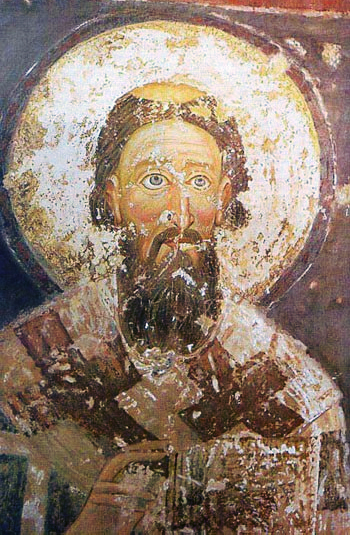
Sabbas is depicted as an archbishop in the prime of life or as an elder: vested in the sakkos or phelonion and the omophorion, wearing the mitre or bare-headed, holding the Gospel-book and blessing, often paired with his father Symeon the monk-king, the two founder-saints of the Nemanjić house shown together. In the great fresco cycles of the medieval Serbian monasteries — Mileševa, Studenica, Žiča, Sopoćani, Peć, Gračanica — he appears both in portrait and in narrative scenes of his Life: the tonsure on Athos, the founding of Hilandar, the reconciliation of his brothers, the assembly at Žiča. His image on the rebels' banner in 1594 — the occasion of the burning of his relics — shows how completely he had become the face of the Serbian nation.
The stored image is one of the earliest and most venerable of his portraits: a thirteenth-century fresco from the Mileševa monastery — the very church that received his relics — painted about the time of his repose, showing the first archbishop haloed and vested, in the grave and luminous manner of the Mileševa masters (the house of the famed "White Angel").
Disputed questions
- The year of repose, 1235 or 1236. The Serbian and Byzantine sources and the received liturgical tradition give 1236; a strand of modern scholarship, reckoning from the Bulgarian and other evidence, dates the death to the night of 14 January 1235. The day, January 14, is fixed; the year is given with the variant noted.
- The name in the world. Serbian sources give his baptismal name as Rastko (Rastislav); the OCA and some Greek notices render it Rostislav. He is the same saint under either form.
- Not to be confused with his great-nephew and namesake Sava II of Serbia (†1271, kept February 8), the third Archbishop of Serbia, a son of Sava I's brother King Stefan the First-Crowned. Nor with Sabbas the Sanctified (December 5), whose name he took in religion, nor with the two Gothic martyr-Sabbases, Sabbas Stratelates (April 24, †272) and Sabbas the Goth (April 12, †372).