
Nikolai of Zhicha
Our Father among the Saints Nikolai (Velimirović), Bishop of Ohrid and Žiča
Bishop · Confessor · b. 1880 (December 23 O.S.; January 5, 1881 N.S.), at Lelić near Valjevo, Serbia — d. 1956, at South Canaan, Pennsylvania (March 18)
Commemorated 18 March — Repose at St Tikhon's Monastery, South Canaan, Pennsylvania
Nikolai Velimirović (1880/81 – 1956), Bishop of Ohrid and of Žiča, was the most celebrated Serbian churchman of the twentieth century — preacher, poet, theologian, and missionary, called in his own lifetime "the Serbian Chrysostom" for his golden eloquence. Rising from a peasant family of western Serbia through the seminaries of Belgrade and the universities of Europe, he became a monk and bishop, the tireless renewer of Serbian Orthodox piety, and the author of the Prologue of Ohrid, a synaxarion and daily devotional read across the Orthodox world, and of the lyrical Prayers by the Lake. Interned by the Nazis and in 1944 imprisoned in the Dachau concentration camp, he survived to emigrate to America, where he taught in the Orthodox seminaries and reposed at South Canaan, Pennsylvania, on March 18, 1956. His relics were translated to his native Lelić in 1991, and he was glorified by the Serbian Orthodox Church in 2003. He is commemorated on March 18.

Origins and formation
Nikolai was born in 1880 (December 23 on the old calendar; January 5, 1881 by the new) in the mountain village of Lelić, near Valjevo in western Serbia, the eldest child of the peasant farmers Dragomir and Katarina Velimirović. Taught first at the nearby monastery of Ćelije, he went on to the seminary at Belgrade and then, his gifts marking him out, to study in the West — taking a doctorate in theology at Bern (his dissertation on the faith of the Church in the Resurrection of Christ), studying further at Geneva and Oxford, and mastering several languages and the whole range of European letters. After a grave illness he embraced the monastic life, was ordained, and quickly became known as a preacher of rare power, the pulpit orator whom Serbia would name after John Chrysostom.
Bishop of Žiča and of Ohrid
Consecrated bishop in 1919, Nikolai served briefly at Žiča and was then translated to the ancient see of Ohrid (1920), the see of Saints Clement and Naum in Macedonia, where he spent the most fruitful years of his life. At Ohrid, among the simple faithful and the monuments of the Slavic enlighteners, he wrote the works for which he is best loved: the Prologue of Ohrid (Ohridski prolog), a great synaxarion giving for every day of the year the lives of the saints, a homily, a reflection, and a hymn — a book that became, and remains, a daily companion of Orthodox devotion far beyond Serbia; and Prayers by the Lake (Molitve na jezeru), a cycle of prose-poems of mystical prayer composed on the shore of Lake Ohrid. He fostered the popular spiritual revival known as the Bogomoljci ("God-worshippers"), a movement of lay piety, Scripture, and hymn-singing that renewed the faith of the Serbian countryside. Returned to Žiča in the 1930s, he governed that historic see — the coronation-church of the medieval Serbian kings — until the war.
Dachau and exile
When the Axis powers overran Yugoslavia in 1941, Nikolai, a national and spiritual leader too dangerous to leave free, was placed under arrest and confinement in a succession of monasteries, and at last, in 1944, was deported with the Serbian Patriarch Gavrilo to the concentration camp at Dachau. There the bishop endured the sufferings of the camp, a confessor of the faith under the Nazi tyranny, until his liberation at the war's end. Unwilling to return to a Serbia now under Communist rule, which reviled and would have destroyed him, he made his way to the United States in 1946.
America and repose
Nikolai spent his last decade as a teacher in the Orthodox seminaries of America — at St Sava's (Libertyville), St Vladimir's, and above all St Tikhon's Seminary at South Canaan, Pennsylvania — writing, preaching, and forming a new generation, honoured by Serbs and by the wider Orthodox alike. He reposed at St Tikhon's on March 18, 1956, and was buried at the Serbian monastery of St Sava at Libertyville, Illinois. In 1991, as Serbia emerged from Communism, his relics were translated home to Lelić, to the church he had built near his birthplace, and became a place of pilgrimage. On May 24, 2003 the Serbian Orthodox Church numbered him among the saints, and his veneration has spread quickly through the whole Orthodox world.
Feast and commemoration
Nikolai is kept on March 18 (church date; Old Calendar civil March 31), the day of his repose. The Serbian Orthodox Church, which keeps the old calendar, commemorates him on that church date (civil March 31), and the Orthodox Church in America and other new-calendar Churches on March 18; his memory is also kept on the day of the translation of his relics to Lelić. As a recently glorified saint (2003) his feast is a modern addition to the calendar, and he is among the principal Serbian commemorations of the day, kept together with the ancient saints of March 18 — Cyril of Jerusalem and the martyrs of the day.
Iconography
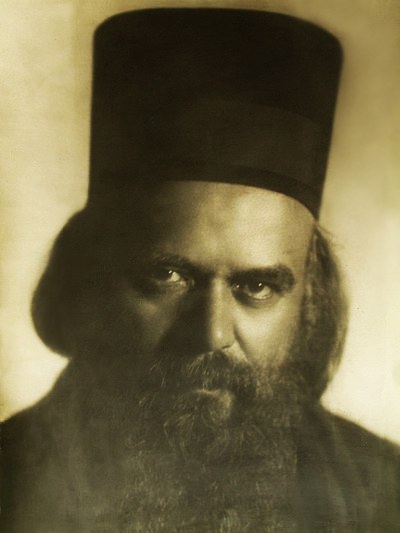
Nikolai is depicted as an Orthodox bishop of the modern type: vested in sakkos, omophorion, and mitre, or in the monastic mantiya and klobuk, holding the Gospel or a scroll and blessing; his features — the strong brow, the grey beard, the piercing eyes familiar from photographs — are kept close to life, as with the other recently glorified saints. His scroll is often inscribed with a line from the Prayers by the Lake or the Prologue. He is frequently shown with the book, the emblem of the great writer and teacher, and sometimes against the lake and mountains of Ohrid.
As a saint glorified in 2003, Nikolai is represented only by modern (copyrighted) icons and by photographs; no public-domain image is available, and an icon is wanting.
The stored image is a 1930s photograph of the bishop, stored per the §50 ruling as a labelled portrait. A free-licensed painted icon remains the eventual want and is listed among the upgrade-wanted icons.
Disputed questions
- The wartime controversy. Nikolai's vast body of writing includes wartime and post-war reflections — above all Words to the Serbian People through the Dungeon Window, composed in confinement — some passages of which have been read by critics as coloured by the nationalism and the anti-modern, and in places anti-Jewish, currents of their time and place. His defenders answer that he wrote as a prisoner of the Nazis and a lifelong opponent of their ideology, that his theme is the spiritual judgement of a Europe that had abandoned Christ, and that the charge mistakes a preacher's rhetoric for a programme. The Serbian Church, weighing his life and his witness at Dachau, glorified him; the controversy is noted here, as the sources require, and not resolved.