
Cyril of Jerusalem
Our Father among the Saints Cyril, Archbishop of Jerusalem, Catechist and Teacher of the Church
Bishop · b. c. 313, at or near Jerusalem — d. 386, at Jerusalem
Commemorated 18 March — Repose at Jerusalem
Cyril of Jerusalem (c. 313 – 386) was Archbishop of Jerusalem for some thirty-five years and one of the great catechists and teachers of the early Church. His Catechetical Lectures — a set of instructions delivered in the Church of the Holy Sepulchre to those preparing for baptism at Pascha, together with the five Mystagogical Catecheses given to the newly baptised in Bright Week — are the fullest surviving witness to how the fourth-century Church initiated her members: the renunciation of Satan, the threefold immersion, the anointing with holy myron, and above all the celebration of the Eucharist, with the earliest clear description of the invocation of the Holy Spirit upon the gifts. Ordained in the years of the Arian storm, Cyril was thrice driven from his see by the Arians and their allies and spent some sixteen years in exile, yet at the last he stood vindicated as a confessor of the Nicene faith and took his seat among the fathers of the Second Ecumenical Council at Constantinople in 381. He reposed at Jerusalem in 386 and is kept on March 18. He is not to be confused with Cyril of Alexandria, the Christological doctor.
.jpg)
Origins and formation
Cyril was born about the year 313 — the very year of the Edict of Milan, in which the persecuted Church passed into peace — at or near Jerusalem, and was reared in the Holy City in the first generation of Christians free to build and to teach openly. Of his family little is known, though he speaks in his lectures with the ease of a man bred to the Scriptures, which he had by heart and expounds at every turn. He grew up under the shadow of the great buildings that the emperor Constantine and his mother Helen were raising over the holy places — the Martyrion basilica and the rotunda of the Anastasis (the Holy Sepulchre), dedicated in 335 — and the discovery of the relics of the Cross and the sacred topography of the Passion and Resurrection are everywhere in his preaching, for he taught, quite literally, on the ground where the things he proclaimed had come to pass. "Others merely hear," he tells his catechumens, "but we see and touch."
He was ordained deacon, the tradition holds, by Macarius of Jerusalem, and priest about the year 343 by Bishop Maximus, Macarius's successor; and to him Maximus entrusted the instruction of the catechumens — the office in which Cyril's genius lay and by which the Church remembers him. On the death of Maximus, about 350 or 351, Cyril was consecrated Archbishop of Jerusalem.
The see of Jerusalem and the quarrel with Caesarea
Cyril inherited a see of unique dignity and awkward standing. Jerusalem was the mother of all the churches, the place of the Lord's death and rising, and its bishop's honour was rising fast with the flood of pilgrims to the newly adorned holy places; yet in the ordinary order of the province Jerusalem (Aelia) was subject to the metropolitan see of Caesarea in Palestine. The metropolitan at Cyril's accession was Acacius, the learned and formidable leader of the court party that would soon fill the Arian councils — and between the two men there opened a feud that was at once jurisdictional and doctrinal. Cyril upheld the ancient apostolic dignity of Jerusalem against the metropolitan claims of Caesarea; Acacius, for his part, saw in the archbishop of Jerusalem a rival to be put down and a suspect of the Nicene faith to be broken. Out of this collision came Cyril's three exiles.
The Catechetical Lectures
Before the storms broke, and probably early in his episcopate (about 350), Cyril delivered in the Martyrion at Jerusalem the course of instruction that is his enduring monument. It survives as a Procatechesis — an opening address to those enrolling for baptism — followed by eighteen Catechetical Lectures given through the weeks of Lent to the photizomenoi, "those about to be enlightened," who would be baptised at the paschal vigil. In them Cyril leads the candidates step by step through repentance and the meaning of baptism, then through the articles of the Creed of the Jerusalem church — the one God and Father, the Son "true God of true God," the Holy Spirit, the Virgin Birth, the Cross and burial and Resurrection, the Ascension, the judgement to come, the holy catholic Church, and the resurrection of the flesh — expounding each with a wealth of Scripture and a plain, warm, memorable eloquence aimed not at the schools but at ordinary men and women on the threshold of the font.
To these he added, for the newly baptised in the week after Pascha, the five Mystagogical Catecheses — "instructions in the mysteries" — in which, now that the initiated might be told what before had been veiled, he unfolds the rites of initiation themselves. Here is the earliest full description we possess of the baptismal liturgy of a great church: the candidates in the outer chamber facing West, the region of darkness, to renounce Satan and all his works and pomp; their turning to the East to make covenant with Christ; the stripping and the anointing with exorcised oil; the threefold immersion in the font, image of the three days in the tomb; the coming up into the light; the anointing with holy myron (chrism) on brow and senses, the seal of the Holy Spirit; and then the leading of the new-illumined, robed in white and bearing lights, into the church for their first Eucharist. The last two catecheses describe the Liturgy: the washing of hands, the kiss of peace, the Sursum corda ("Lift up your hearts"), the Sanctus, and — of capital importance to the history of doctrine — the epiclesis, the calling down of the Holy Spirit upon the bread and wine "to make the bread the Body of Christ and the wine the Blood of Christ; for whatsoever the Holy Spirit has touched is sanctified and changed." Cyril teaches the reality of the Body and Blood without reserve — "with fullest assurance let us partake as of the Body and Blood of Christ" — describes the Lord's Prayer and the communion of the faithful, and gives the famous direction for receiving: to make of the left hand a throne for the right, which is to bear the King, and so to receive the holy Body. No other document opens so wide a window onto the sacramental life of the Church in the age of the Fathers, and the Mystagogical Catecheses remain a first source for the study of baptism and the Eucharist in the ancient Church.
The cross of light
In the year 351, early in Cyril's episcopate, there appeared over Jerusalem — the tradition and Cyril's own account agree — a great cross of light, stretching from Golgotha (Calvary) to the Mount of Olives, shining in the sky in the daylight hours of the feast of Pentecost and seen by the whole city. Cyril wrote of it to the emperor Constantius, reading the sign as a token of divine favour surpassing even the finding of the Cross under Constantine, and calling the city to thanksgiving. The Letter to Constantius is among his few surviving works beside the catecheses, and the apparition of the luminous cross entered the memory of the Church as one of the wonders of the Holy City. The Church keeps its memory on 7 May as the Sign of the Cross which appeared over Jerusalem, where the letter's own particulars — the nones of May, the third hour, the extension of the sign from Golgotha to the Mount of Olives — are set out.
The three exiles
Cyril's episcopate of thirty-five years was broken by three periods of exile, in which the Arian ascendancy under the emperor Constantius and later Valens fell upon him again and again.
The first exile came about 357, when Acacius of Caesarea, using his power as metropolitan and the favour of the court, procured Cyril's deposition. The pretext was that in a time of famine Cyril had sold ornaments and hangings of the church to feed the starving poor — even, it was said, a precious robe given by Constantine — and this was charged against him as squandering church goods; behind it lay the jurisdictional quarrel and Acacius's suspicion of Cyril's orthodoxy. Cyril withdrew to Tarsus, and appealed against his sentence to a wider council.
He was restored by the Council of Seleucia in 359, a great assembly of the East at which the Homoiousian majority deposed Acacius himself; but the turn of events at court soon reversed this, and under the pro-Arian settlement of Constantinople (360) Cyril was exiled a second time. With the death of Constantius and the accession of Julian the Apostate in 361 came a general recall of exiled bishops, and Cyril returned to Jerusalem — living to see Julian's notorious attempt to rebuild the Jewish Temple, which (the Christian historians relate, and Cyril is said to have foretold its failure) was broken off amid fire and earthquake, a sign read by the faithful as the vindication of the Lord's word that not one stone should be left upon another.
The third and longest exile fell under the Arian emperor Valens (from about 367), who renewed the persecution of the Nicene bishops; Cyril was driven out once more and remained in banishment until Valens perished at the battle of Adrianople in 378 and the accession of the orthodox Theodosius opened the way home. In all, Cyril passed some sixteen of his years as bishop in exile — a confessor's portion, though he was never called to shed his blood.
Vindication and the Second Ecumenical Council
In 381 the emperor Theodosius summoned to Constantinople the council that the Church honours as the Second Ecumenical Council, which completed the Creed of Nicaea, above all in its confession of the divinity of the Holy Spirit, and gave the Church the Symbol of faith recited to this day. Cyril of Jerusalem sat among its fathers, and the council's vindication of him was explicit: in a synodal letter of the following year the assembled bishops declared that Cyril had been canonically ordained and had "in various places contended much against the Arians." The old suspicion — fed by his early avoidance of the disputed word homoousios — was thus laid to rest by the authority of an ecumenical council, and Cyril stands vindicated as a teacher of the Nicene faith. Whatever the caution of his earlier language, his catecheses confess the Son "true God of true God, begotten before all ages," of one being with the Father in all things but the name, and the whole undivided Trinity; and the Church numbers him among the Fathers of the Second Council.
Repose
Cyril returned to govern his church in peace in his last years and reposed at Jerusalem in 386, having been its bishop for about thirty-five years and its catechist for longer. He left the see he had defended secure in the Nicene faith, and left the Church the incomparable record of her own worship in the age of the Fathers. The West, which keeps him with the East, declared him a Doctor of the Church (by Pope Leo XIII in 1883), a recognition of the same teaching office in which the Christian East had always honoured him.
Feast and commemoration
Cyril is kept on March 18 (church date; Old Calendar civil March 31), the day of his repose, by the Byzantine calendars — Antiochian, Greek, and Slavic in agreement — and on the same day by the Roman calendar, which keeps him as a Doctor of the Church. Because March 18 falls always within Great Lent, his office is sung with the Lenten services, and on a weekday of the Fast (when there is no full Liturgy) his commemoration is kept at Vespers, Matins, and, on Wednesday or Friday, the Presanctified. On March 18 the Greek Menaion joins to Cyril two ancient martyr-commemorations of the day — the Ten Thousand Martyrs and the martyrs Trophimus and Eucarpion of Nicomedia.
Hymns
Troparion — Tone 4
A rule of faith and an image of meekness, a teacher of temperance did the truth of things reveal thee to thy flock; therefore thou hast gained by lowliness the things that are exalted, and by poverty the things that are rich. O Father and Hierarch Cyril, intercede with Christ our God that our souls may be saved.
Original translation from the Greek
Kontakion — Tone 1
By thy God-inspired tongue, O wise one, thou didst enlighten thy people to honour the one Trinity, undivided in nature yet divided in Persons. Therefore, rejoicing, we keep thine all-holy memory, setting thee forth as our intercessor before God.
Original translation from the Slavonic
Iconography
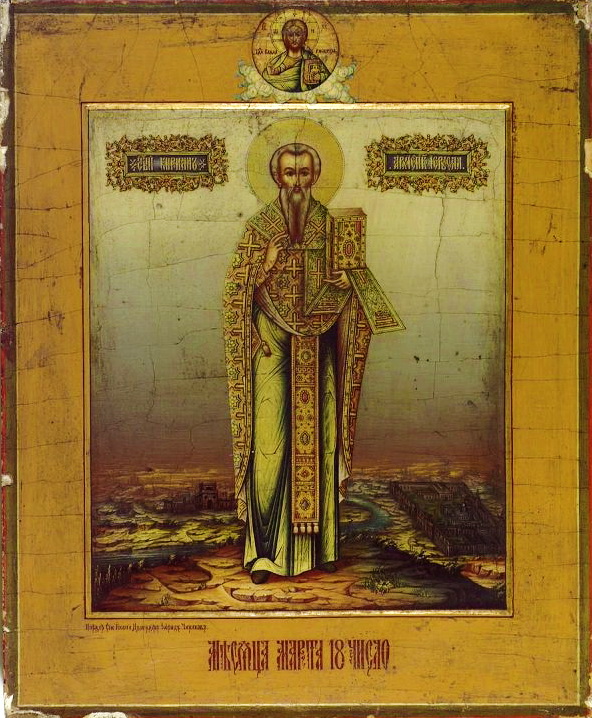
Cyril is depicted as an archbishop in the settled type of a teaching hierarch: vested in the phelonion (or the cross-figured polystavrion) and the omophorion, the Gospel-book held in the left hand and the right raised in blessing, his hair and beard grey or brown and of middle length, the face grave and gentle. His scroll, where shown, is inscribed with a line of his catechesis or of the Creed he expounded. He is distinguished from Cyril of Alexandria, who is characteristically shown in the domed white koukoulion of the Alexandrian patriarchs; Cyril of Jerusalem is bare-headed in the ordinary manner of a Greek or Palestinian hierarch, and his identity in the icons rests on the inscription "of Jerusalem."
The stored image is a 19th-century Russian panel icon by the noted Moscow iconographer Osip S. Chirikov (now in the Museum of the History of Religion, St Petersburg), inscribed "St Cyril, Archbishop of Jerusalem" — the saint vested and blessing, holding the Gospel — a faithful reproduction of a pre-modern work.
Disputed questions
- His orthodoxy and the word homoousios. Cyril's Catechetical Lectures nowhere use the Nicene term homoousios ("of one being"), and speak instead of the Son as "like the Father in all things"; on this ground his enemies charged him with semi-Arianism, and Jerome, in his Chronicle, wrote slightingly of him as one who had wavered. The judgement of the Church is otherwise. Cyril confesses without reserve the full and true Godhead of the Son and the Holy Spirit and the one undivided Trinity; his reticence over a single contested word belongs to the confused middle years of the controversy, when homoousios itself was suspected in many quarters, and not to any denial of the faith it guards. The Second Ecumenical Council received him as canonically ordained and as a stout opponent of the Arians, and the Church keeps him as a saint and a teacher of orthodoxy.
- The authorship of the Mystagogical Catecheses. The five lectures on the mysteries are transmitted in the manuscripts under varying ascriptions — to Cyril, to his successor John II of Jerusalem, or to "Cyril and John" — and scholars have long debated whether they are Cyril's own or were delivered (or revised) by John a generation later. The weight of tradition and much scholarship keep them Cyril's, or at least substantially his; whoever gave them their final form, they describe the Jerusalem rite that Cyril himself served, and the entry treats them, with the Church, as his.
- Not to be confused with Cyril of Alexandria (†444, kept January 18 and June 9), the Christological doctor and "Seal of the Fathers" who presided at the Third Council; with Cyril the Philosopher (Constantine), Equal-to-the-Apostles and apostle to the Slavs (†869, kept February 14 and, with Methodius, May 11); or with the Russian venerable Cyril of Novoezersk (†1532) and the other later Cyrils of the calendar (of White Lake, of Turov). "Of Jerusalem," "the Catechist," and the Catechetical and Mystagogical Lectures belong to this Cyril alone.