
Nine Martyrs of Cyzicus
The Holy Nine Martyrs of Cyzicus — Theognis, Rufus, Antipater, Theostichus, Artemas, Magnus, Theodotus, Thaumasius and Philemon
Martyr · d. c. 286–299
Commemorated 29 April — Beheading at Cyzicus in Mysia
Nine Christians of differing rank and trade — Theognis, Rufus, Antipater, Theostichus, Artemas, Magnus, Theodotus, Thaumasius and Philemon — were arrested together at Cyzicus in Mysia, on the southern shore of the Propontis, in the persecutions of the later third century, and after imprisonment and torture were beheaded with a single sentence when none of them would consent to sacrifice. Their bodies, buried outside the walls, were taken up when the Church gained peace under Constantine and laid in a church built for them in the city, where the healing of the sick and of the mentally afflicted made the martyrs' company famous. In Russia they became the patrons invoked against fever and pestilence, and a monastery was raised in their honour near Kazan to house particles of their relics.
.jpg)
Cyzicus and the coming of the faith
Cyzicus (Greek Κύζικος) was one of the great cities of Mysia in north-western Asia Minor, set where the peninsula of Arctonnesus — the modern Kapıdağ, in the Balıkesir region of Turkey — joins the mainland on the southern shore of the Propontis, the Sea of Marmara. (Synaxarion notices and their modern renderings sometimes place it loosely "on the Hellespont"; the city in fact commanded the Propontine coast a little east of the straits.) It was rich, populous, proud of its temple of Hadrian and its games, and it was thoroughly pagan. The faith reached it early, in the wake of the Apostolic preaching through the province of Asia, and Cyzicus in time gave the Church a whole company of martyrs and confessors — among them the virgin-martyr Tryphaena (January 31), the martyr Emilian (August 8), and later the iconodule confessor-bishop Sisinius (November 23). But through the third century the Christians of Cyzicus were a minority under pressure, and at intervals the imperial edicts, or simply the zeal of a local governor, turned pressure into blood.
The nine and their confession
The nine were not a family, a household, or a military unit; the synaxarion is careful to say that they came from different places and from different walks of life. Among them were soldiers, men of the countryside, townsmen of Cyzicus, and men who served the Church as clergy. This is the striking feature of their passion: what bound them together was neither kinship nor profession but the confession of Christ, and it is as a single company — an ἐννεάριθμος δῆμος, a "nine-numbered band," as the Greek hymn calls them — that they entered the calendar and have never since been separated.
Seeing the city given over to idols and the Christians intimidated into silence, the nine did the opposite of hiding. They came together, confessed Christ openly and rebuked the impiety of the sacrifices publicly and by name. They were arrested, as they must have expected to be, and brought before the ruler of the city.
Their examination followed the ordinary pattern of the third-century trials: an offer of honour and safety in exchange for a gesture of incense, then threats, then torture. The martyrs answered together. They were flogged and racked, and then shut up in prison — according to the account without food or water, so that hunger and thirst might finish what the instruments had begun — where they spent their confinement in prayer and psalmody and grew more resolute rather than less. Brought out again and offered their freedom on the single condition that they renounce Christ, they replied with one voice that they had come to that city and to that hour precisely in order not to deny Him, and that they preferred death to the least dissembling.
Beheading
The judge, finding that neither promises nor pain would move them, and unwilling to let their constancy be seen any longer by the crowds, condemned all nine to the sword. They were beheaded together outside the city, in the years usually given as c. 286–299, in the reign of Diocletian. The Christians of Cyzicus recovered the bodies and buried them near the city, where the graves were quietly honoured through the years of danger that followed.
Relics and the church at Cyzicus
When the persecutions ended and Constantine the Great gave the Church peace, the Christians of Cyzicus took up the relics of the nine — the synaxarion tradition puts this about the year 324, the year of Constantine's final victory and of his mastery of the East — and laid them together in a church built for them within the city. From that translation the account of their veneration becomes concrete: at their shrine the sick were healed, and, in a detail every version of the story preserves, those out of their right mind were restored to reason. The healings did in peace what the martyrs' words had done under trial: many of the pagans of Cyzicus were converted, and the faith took hold in the city where the nine had been silenced.
Veneration and later cultus
The company passed into the Byzantine calendar and into the April Menaion, and from there into every Orthodox synaxarion; their nine names, recited together, became one of the better-known martyrological formulae of the spring.
Their most remarkable later cultus, however, is Russian, and it grew out of the association of the martyrs with healing from fever and infectious disease. Particles of their relics had been brought into Russia in the middle of the seventeenth century. When, towards 1687, an epidemic ravaged the region of Kazan, Metropolitan Adrian of Kazan — who in 1690 became the last Patriarch of Moscow of the pre-Synodal period — founded a monastery in the martyrs' honour outside the city, remembering that the nine of Cyzicus were invoked precisely against such sickness. The Kizichesky (Kizicheskii) Monastery of the Entrance of the Theotokos was established between 1687 and 1691, and in July 1693 the relics of the nine martyrs were brought into it. It became a place of pilgrimage against fever, plague and the diseases of children, and the memory of the nine acquired in Russia the character of a public intercession in time of epidemic. A church of the Nine Martyrs of Cyzicus was likewise built in Moscow, near the Novinsky monastery, and preserves their dedication to this day.
Feast and commemoration
April 29 (church date; Old Calendar civil May 12) in the Slavonic and Russian usage followed here, together with the venerable Memnon the Wonderworker; April 28 in Greek usage, where the Menaion places them and where the Apostles Jason and Sosipater are kept on the 29th. Their rank is that of a simple commemoration with the service of the Menaion — six stichera and a canon — and in years when the day falls in the Paschal season the Paschal hymns take precedence, as with all fixed commemorations of late April. In Russian practice the martyrs are invoked with a special moleben in time of fever, epidemic and childhood sickness, and their feast is kept with particular solemnity at the Kizichesky monastery near Kazan.
Hymns
Troparion — Tone 4 (common of several martyrs)
Thy martyrs, O Lord, in their contest received from Thee, our God, the crowns of incorruption; for armed with Thy might they overthrew the tyrants and broke the feeble insolence of the demons. At their supplications, O Christ God, save our souls.
Original translation from the Greek
Iconography
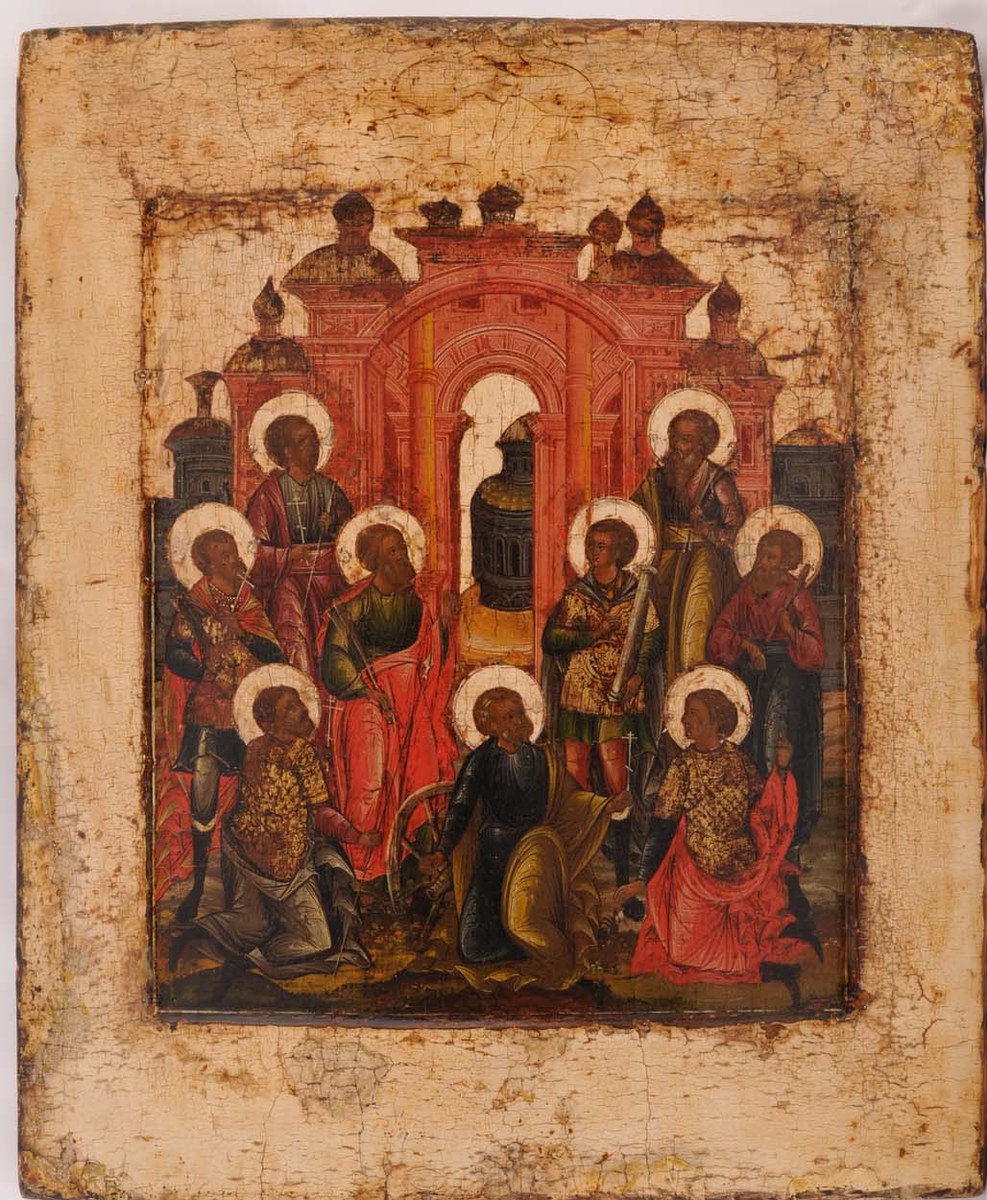
The nine are painted as a company, never singly: a close-packed group of nine haloed figures, each holding the martyr's cross, arranged in two or three tiers so that all nine faces are visible. Because the tradition insists on their diversity of station, good examples of the icon differentiate them — a young soldier in cuirass and cloak with the sword, an elder in the long tunic of a countryman, a cleric in the sticharion holding a cross, a beardless youth beside a grey-bearded old man — and the martyrdom itself may be shown in the lower register, the martyrs kneeling with bared necks before the executioners. Russian icons very often set the group before a church, an allusion to the shrine at Cyzicus in which their relics were laid, and sometimes add a small icon of the Mother of God above the group.
The stored image is a Russian icon of about 1800, of the Vladimir icon-painting villages (catalogued as Mstera, possibly Palekh): the nine martyrs stand and kneel in three tiers before a red-walled, many-domed church, the ciborium of their shrine visible in the open arch behind them; the two elders of the upper tier hold crosses, three soldiers in gilded cuirasses stand with sheathed and drawn swords, and the three martyrs of the front row kneel on the ground at the moment of beheading — the compressed "company and passion" composition typical of the Russian recension of this feast.
Disputed questions
- April 28 or April 29. The day of the commemoration divides the traditions. The Greek Menaion and the Synaxaristes of Nikodemos place the nine on April 28 — the printed Greek text opens the day's synaxarion notice, "On the twenty-eighth of the same month, the memory of the holy nine martyrs of Cyzicus, Theognis, Rufus, Antipater, Theostichus, Artemas, Magnus, Theodotus, Thaumasius and Philemon" — and Greek usage keeps the Apostles Jason and Sosipater on April 29. The Slavonic tradition, followed by the Russian Church and by the Orthodox Church in America, reverses the pair: Jason and Sosipater on April 28, the nine martyrs of Cyzicus (with Memnon the Wonderworker) on April 29. This entry follows the April 29 placement; the divergence is one of calendar order only, and nothing in the two traditions' accounts of the martyrs differs.
- The roll of names. The nine names are transmitted with the ordinary variation of manuscript lists. Theognis appears also as Theognes; Theostichus as Theostichos or Theosticus; and Theodotus is given in a number of Greek witnesses and modern Greek synaxaria as Theodulus. The order of the names is unstable — some lists open with Thaumasius rather than Theognis — which is what one expects of a company whose members were remembered collectively rather than individually. No separate passion of any one of the nine survives.
- The date of the martyrdom. The received notices place the passion under Diocletian, and the years c. 286–299 are the usual estimate; some accounts prefer the great persecution of 303–305. Since no consular date is transmitted, the martyrdom can only be located within the reign, and the third-century dating rests on the general character of the account rather than on documentary evidence.
- Individual identity. Because their veneration has always been collective, no member of the nine has an independent feast, proper hymns, or a separate synaxarion entry; they are one commemoration, and are kept in this corpus as one entry.