
Memnon the Wonderworker
Our Venerable Father Memnon the Wonderworker, Abbot in the Egyptian desert
Venerable · Wonderworker
Commemorated 29 April — Repose of the venerable abbot, 19 May — Second commemoration in the Greek Menaion
Memnon was an ascetic of the Egyptian desert who from his youth gave himself to the monastic life, was set over one of the Egyptian monasteries as abbot, and became famous for the gifts that followed his labours: clairvoyance, and a wonderworking power over the calamities of the countryside. The synaxarion remembers three of his miracles in particular — a spring of water opened in the waterless wilderness at his prayer, a plague of locusts destroyed as it stripped the harvest, and shipwrecked men saved who called on his name at sea — and adds that after his death the mere invocation of his name drove away locusts and broke the deceits of the demons. He is commemorated as "Memnon the Wonderworker," and no fuller Life of him has come down.

The desert and the ascetic struggle
The synaxarion notices are brief and agree in their outline. Memnon left the world while still young and went into the desert of Egypt, the classic school of the monastic life, where he took up the ordinary ascetic warfare of that country: fasting, vigil, manual labour, unbroken prayer. The notices sum up his progress in the language proper to the fathers of the desert — that by "arduous struggles" he brought the flesh under the spirit and won the victory of the inner man over the passions. Nothing is transmitted of his birthplace, his family, his teacher, or the name of the monastery in which he began.
Abbot
In time the brethren of one of the Egyptian monasteries made him their hegumen. What the tradition preserves of his abbacy is a temperament rather than a chronicle: he governed wisely and gently, carrying the brethren by prayer and by counsel rather than by severity, and — the detail the synaxarion is careful to make — his elevation did not slacken his own asceticism. He continued in the struggle against temptation as one of the brethren while directing them, which is exactly the praise the desert tradition reserves for a superior who has not been spoiled by office.
Out of that unbroken labour and prayer, the notices say, he received the gift of clairvoyance — diorasis, the discernment of hearts and of things at a distance — the gift by which the great abbots of Egypt were able to read a novice's thought and answer the question he had not yet asked.
Miracles and traditions
Three wonders are attached to his name in his lifetime, and they are of a kind that belongs to a monastery serving the poor of the surrounding country rather than to a solitary's cell:
- At his prayer a spring of water gushed out in the wilderness — the miracle told of many of the desert fathers, and the most practically consequential of them, since a spring is the condition of a monastery's existence.
- When locusts came down upon the crops, they perished at his word, and the harvest was saved. This is the miracle most firmly attached to his memory: the Greek notice makes the deliverance of a whole district from "the ruinous swarms" the centre of his fame, and records that as abbot he opened the monastery's stores to the farmers of the region.
- Men in shipwreck who called upon his name were brought safe to land — an invocation at a distance, which presupposes that his reputation as a wonderworker had already spread well beyond his monastery and out to the sailors of the coast.
After his repose the same two powers continued to be attributed to him: the mention of his name dispelled a plague of locusts, and undid, as the notice puts it, the cunning devices of evil spirits. Between the locusts and the demons the tradition draws no sharp line; both are ravagers, and in both the invocation of the saint is the remedy.
Feast and commemoration
April 29 (church date; Old Calendar civil May 12) in the Slavonic and Russian usage, where he is kept together with the Nine Martyrs of Cyzicus; Greek synaxaria place him, with the same nine martyrs, on April 28. He has no proper service: the Menaion supplies a kathisma for him — it begins "As a star of light…" — and he is otherwise honoured with the common of a venerable father. Where the day falls within the Paschal season the Paschal hymns govern the service, as with all fixed commemorations of late April. He is invoked, on the strength of the two miracles most firmly attached to him, against locusts and crop pests and for those in peril at sea.
Hymns
Troparion — Tone 8 (common of a venerable father)
With the streams of thy tears thou didst make the barren wilderness bring forth, and by thy sighing from the depths thou didst bear fruit an hundredfold in thy labours; thou becamest a light shining upon the world with miracles, O Memnon our father. Intercede with Christ God that our souls may be saved.
Original translation from the Greek
Iconography
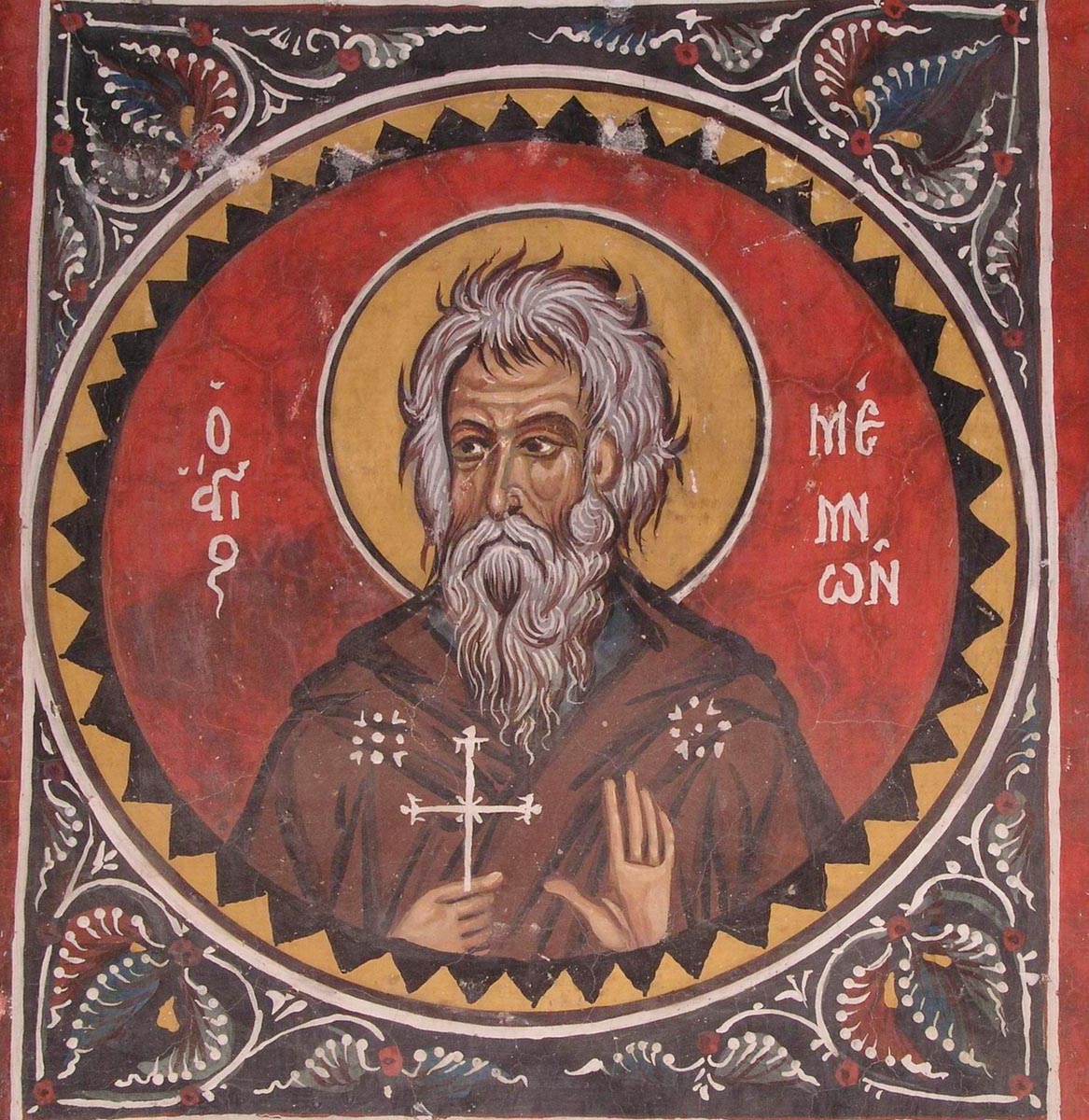
Memnon is painted as an ascetic elder: a monastic of the desert, gaunt, with a long white beard, wearing the brown or dark mandyas over the tunic, and most often holding the cross of the confessor of Christ in his right hand with the left raised open toward it or before the breast. He wears no hierarchical vesture and carries no Gospel book — the detail that visually distinguishes him from his namesake the archbishop of Ephesus — and where the icon is a bust in a medallion, as in the Byzantine churches of Cyprus, the inscription Ὁ ἅγιος ΜΕΜΝΩΝ is the whole of his identification.
The stored image is a twelfth-century fresco from the church of the Panagia Phorbiotissa at Asinou (Nikitari, Cyprus), one of the painted Troodos churches: the saint appears bust-length in a great red roundel framed with black-and-white saw-tooth and palmette ornament, inscribed Ὁ ἅγιο(ς) / ΜΕΜΝΩΝ, an old man with high, wind-blown white hair and a long forked beard, in a brown mantle sprinkled with white crosslets, holding a slender double-barred cross. The vigour of the drawing — the deep-set eyes turned aside, the dry cheeks — is characteristic of the Comnenian ascetic portraits of that church.
Disputed questions
- No date is transmitted. The synaxarion gives neither the century of his life nor the year of his repose, and no monastery is named that would allow him to be placed. The most that can be said is that he belongs to the Egyptian monastic world — that is, to the fourth century or later — and even that rests on the setting of the account rather than on a source. Modern reference works that assign him to a particular century (the second has been printed) do so without warrant; this entry therefore records no date, and he indexes among the saints of undetermined century.
- Egypt, and the question of Thrace. Every synaxarion witness consulted places him in the Egyptian desert and as abbot of an Egyptian monastery, and the twelfth-century Cypriot fresco described below is captioned "Memnon the Wonderworker, the Egyptian." Occasional modern listings attach him instead to Thrace; no source supporting a Thracian Memnon the Wonderworker has been found, and the attribution appears to be a confusion, most likely with one of the other bearers of the name (see below) or with a place of later veneration. Egypt is here followed.
- A second date, May 19. Greek synaxaristes also carry an "Osios Memnon the Wonderworker" on May 19. Whether this is a doublet of the same ascetic — the calendars are full of such duplications, especially for saints whose notices are one line long — or a distinct monastic of the same name cannot be settled from the material available; the April commemoration is the principal one and is the one kept in the Slavonic books.
- Not to be confused with Memnon, Archbishop of Ephesus (December 16, †c. 440), the hierarch who hosted and co-led the Third Ecumenical Council; nor with the martyr Memnon the Centurion, commemorated with the martyr Severus on August 20. The three are distinct: an Egyptian abbot, a metropolitan of Asia, and a soldier-martyr.