
Olympas, Rodion, Sosipater, Erastus, Quartus and Tertius of the Seventy
The Holy Apostles of the Seventy Olympas, Rodion, Sosipater, Erastus, Quartus and Tertius
Apostle of the Seventy · Apostle · Bishop · Martyr
Commemorated 4 January — Synaxis of the Seventy Apostles, 10 November — The six apostles of the Seventy named in Romans 16, commemorated together
These six apostles of the Seventy are all named by the Apostle Paul in the sixteenth chapter of the Epistle to the Romans, and the Byzantine calendar gathers them into a single commemoration on November 10. Olympas and Rodion (Herodion), companions of the Apostle Peter, were beheaded at Rome on the very day of Peter's crucifixion; Sosipater was bishop of Iconium and Erastus a steward of the Church and later bishop of Paneas; Quartus, bishop of Beirut, converted many pagans and reposed in peace; and Tertius, the scribe to whom Paul dictated the Epistle to the Romans, became the second bishop of Iconium and died a martyr. All lived in the first century, and all are commemorated again with the whole company at the Synaxis of the Seventy Apostles on January 4.
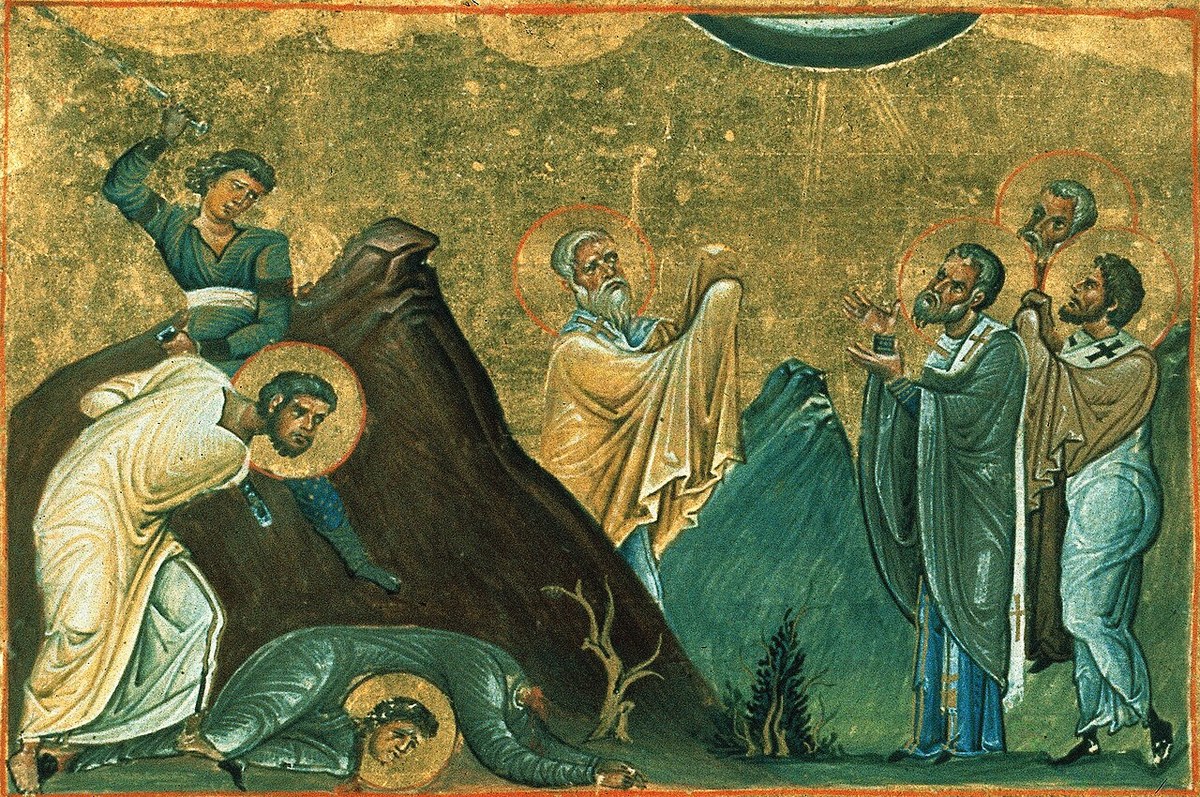
.jpg)
The six are gathered on one day as disciples of the Apostle Paul named in a single passage of his greatest letter — the roll of greetings that closes the Epistle to the Romans (chapter 16), where Paul salutes by name a great company of the faithful of Rome and sends the greetings of those with him at Corinth. The tradition of the Church numbers each of the six among the Seventy whom the Lord sent out (Luke 10), traces the later see and manner of death of each, and keeps their joint memory here.
Olympas
Olympas (Ὀλυμπᾶς) is greeted by Paul among the saints of the Roman church: "Salute Philologus, and Julia, Nereus, and his sister, and Olympas, and all the saints which are with them" (Romans 16:15). The tradition makes him a companion of the Apostle Peter and a fellow-labourer in his preaching, and records that he was beheaded at Rome, together with Rodion, on the very day and hour that Peter was crucified — in the persecution of Nero.
Rodion (Herodion)
Rodion — more fully Herodion (Ἡρωδίων) — is called by Paul "my kinsman": "Salute Herodion my kinsman" (Romans 16:11). The received account makes him bishop of Patras (New Patras in Achaia), who left his episcopal throne to follow the Apostle Peter to Rome, shared his apostolic labours, and, like Olympas, was beheaded there on the day of Peter's martyrdom. Herodion is also commemorated on April 8 with a further company of the Seventy — Agabus, Rufus, Asyncritus, Phlegon and Hermas — the tradition keeping both memories of him.
Sosipater
Sosipater (Σωσίπατρος) is named among those who send greeting from Corinth: "Timotheus my workfellow, and Lucius, and Jason, and Sosipater, my kinsmen, salute you" (Romans 16:21); he is generally identified with the Sopater of Beroea, son of Pyrrhus, who accompanied Paul into Asia (Acts 20:4). A native of Achaia, he is remembered as bishop of Iconium, where he reposed. He is commemorated again on April 28 together with the Apostle Jason, with whom he is chiefly venerated as an apostle of the Seventy and evangeliser of Corfu.
Erastus
Erastus (Ἔραστος) is greeted, or rather sends greeting, in the same passage: "Erastus the chamberlain [treasurer] of the city saluteth you, and Quartus a brother" (Romans 16:23); Paul names him again as one left at Corinth (2 Timothy 4:20). The tradition remembers him first as steward and treasurer (oikonomos) of the church at Jerusalem, and afterwards as bishop of Paneas (Caesarea Philippi), where he ended his life in peace.
Quartus
Quartus (Κούαρτος), named with Erastus as "a brother" in the greetings of Romans 16:23, is remembered as one who endured much for his piety, converted many pagans to Christ, and reposed in peace as bishop of Beirut (Berytus in Phoenicia).
Tertius
Tertius (Τέρτιος) is the amanuensis of the Epistle to the Romans, who alone of the scribes of Paul's letters names himself within one: "I Tertius, who wrote this epistle, salute you in the Lord" (Romans 16:22). The tradition numbers him among the Seventy, makes him the second bishop of Iconium in succession to Sosipater, and records that he ended his life as a martyr. Because Tertius is also commemorated on October 30 with the apostles Mark, Justus and Artemas, he is given his own entry with that company; see the note below and tertius-mark-justus-and-artemas-of-the-seventy.
Feast and commemoration
November 10 (church date; Old Calendar civil November 23). The six apostles share a single synaxarion notice on this day, the Church keeping the memory of the disciples whom Paul salutes together in Romans 16. All six are commemorated again with the whole company at the Synaxis of the Seventy Apostles on January 4; and Herodion (April 8) and Sosipater (April 28) have further feasts of their own. Where the OCA and the Slavic calendars lead the day's list with these apostles, the Greek Menaion gives the day's proper service to the martyr Orestes; the apostles receive their commemoration in the synaxarion and in the kontakion appointed below.
Hymns
Troparion — Tone 3
Holy apostles, intercede with the merciful God, that he may grant our souls forgiveness of offences.
Original translation from the Greek
Kontakion — Tone 2
Having illumined your minds with the divine light, O glorious apostles, you wisely undid the tangled snares of the orators, and drawing in all the nations as with a net you led them to the Master, teaching them to glorify the divine Trinity.
Original translation from the Slavonic
Iconography
The six are shown as apostles of the Seventy, several of them vested as bishops in the omophorion, in the manner of the earliest hierarchs. The stored image is the miniature for November 10 from the Menologion of Basil II (Constantinople, c. 985): at the left the executioner beheads Olympas and Rodion, the martyrs of the company, while at the right stand the bishops Erastus, Sosipater, Quartus and Tertius, robed and blessing — the one composition holding together the two ends of the company, those who died by the sword and those who reposed in peace.
Disputed questions
- Tertius's two feasts. Tertius the scribe of Romans is one person kept on two days: October 30 (with Mark of Apollonias, Justus and Artemas) and November 10 (with this company). He is not a namesake doubled but the same apostle, gathered into two different first-century groupings by the synaxaria — the November 10 notice grouping the disciples named together in Romans 16, the October 30 notice a separate quartet. His biography is given in full in the October 30 entry and is only summarised here; he is not minted afresh.
- Erastus of Corinth or of Jerusalem. The Erastus "treasurer of the city" (Romans 16:23) is the one commemorated here; some readers distinguish him from the Erastus "sent into Macedonia" (Acts 19:22) and the one "abode at Corinth" (2 Timothy 4:20), though the tradition treats the New Testament Erastus as one man. His see is given as Paneas (Caesarea Philippi) in the received notices.
- Sosipater and Sopater. The identification of the Sosipater of Romans 16:21 with the Sopater of Beroea (Acts 20:4) is traditional and widely held, but rests on the closeness of the names rather than an explicit statement of Scripture.
- Two sees called Iconium. Both Sosipater and Tertius are assigned to Iconium, Tertius as the second bishop after Sosipater; the sequence is that of the received Byzantine tradition. Neither is to be confused with the later Cornutus of Iconium, bishop and martyr, commemorated September 12, nor with Terence of Iconium, the hieromartyr bishop of that see kept on June 21 — whom the Slavonic books, however, identify with this Tertius outright. See the note at that entry.