
Tertius, Mark, Justus and Artemas of the Seventy
The Holy Apostles of the Seventy Tertius, Mark, Justus and Artemas
Apostle of the Seventy · Apostle · Bishop · Martyr
Commemorated 4 January — Synaxis of the Seventy Apostles, 30 October — The four apostles of the Seventy commemorated together
Tertius, Mark, Justus and Artemas were four apostles of the Seventy whom the Byzantine calendar commemorates together on October 30. Tertius, the scribe to whom Paul dictated the Epistle to the Romans, became second bishop of Iconium and died a martyr; Mark, the cousin of Barnabas, was bishop of Apollonias; Justus, called Barsabbas, was the candidate set beside Matthias to fill the place of Judas and later a martyred bishop of Eleutheropolis; and Artemas, the companion Paul thought to send to Titus, was bishop of Lystra and reposed in peace. Each is named in the New Testament; the Church keeps their joint memory among the Seventy sent out by the Lord.
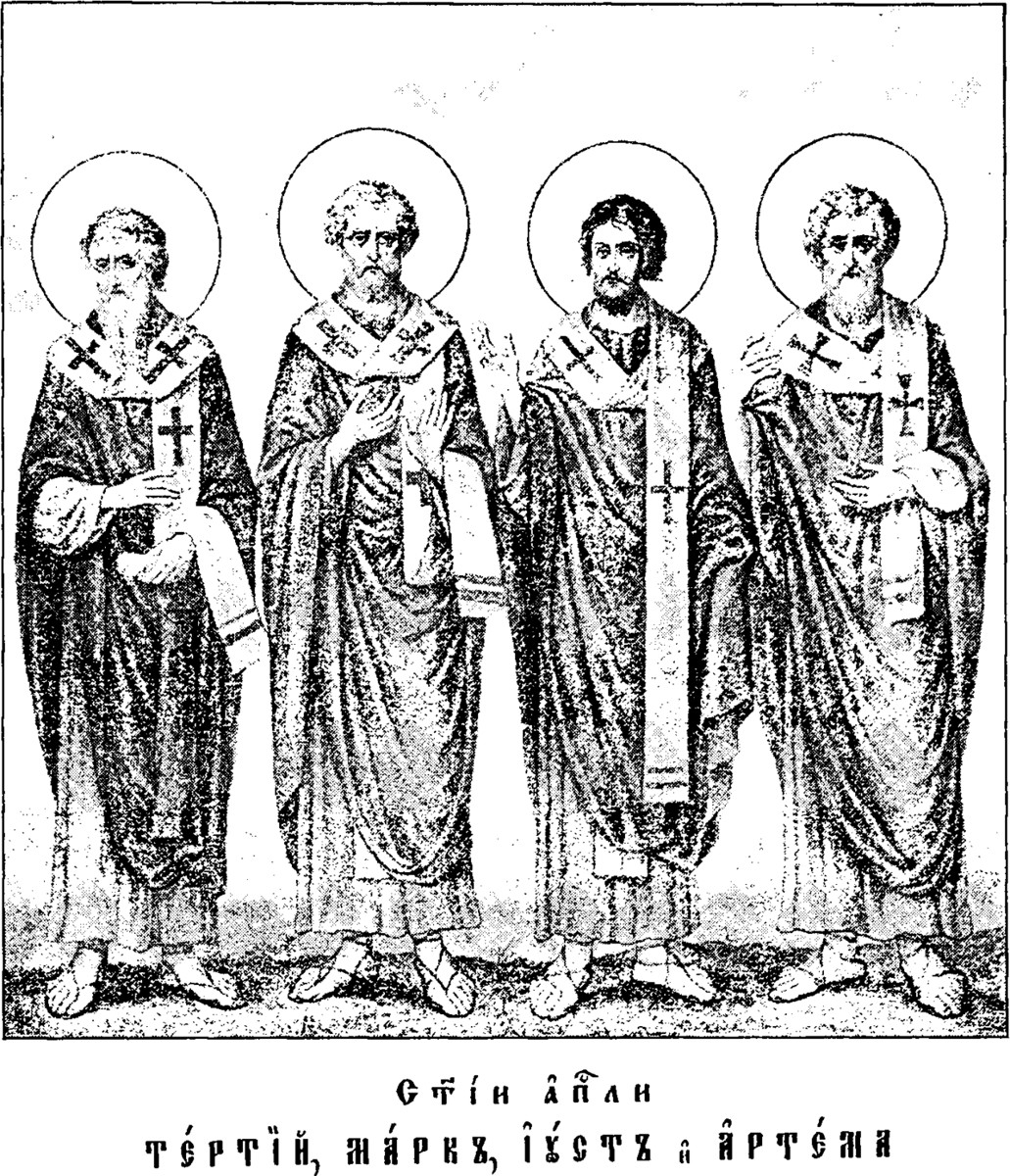
_-_икона_02302_Тертий,_Марк,_Иуст_и_Артема.png)
The four are gathered on one day as members of the Seventy, each attested by a verse of the apostolic writings and by the tradition of their later sees. Mark of Apollonias, whose identity is entangled with the several apostolic Marks, has his own entry; the other three are treated here.
Tertius of Iconium
Tertius is the amanuensis of the greatest of Paul's letters: at its close he sets down his own greeting — "I Tertius, who wrote this epistle, salute you in the Lord" (Romans 16:22) — the one place in the New Testament where the scribe of a Pauline letter names himself. The tradition numbers him among the Seventy and records that he became the second bishop of Iconium, succeeding Sosipater (himself an apostle of the Seventy), where he converted many pagans to Christ and at last ended his life as a martyr.
Justus (Joseph called Barsabbas)
Justus is identified by the Byzantine tradition with Joseph called Barsabbas, surnamed Justus, one of the two disciples "who accompanied us all the time that the Lord Jesus went in and out among us" and who was put forward with Matthias, by lot, to be numbered with the eleven apostles in the place of Judas (Acts 1:23–26). The lot fell to Matthias; Joseph Justus, the received account continues, was counted among the Seventy, was made a bishop, and died a martyr's death at Eleutheropolis in Palestine. The Byzantine synaxaria further name him a son of Joseph the Betrothed, the guardian of the Mother of God — the tradition that reckons the "brethren of the Lord" as children of Joseph from a former marriage.
Artemas of Lystra
Artemas appears in the Epistle to Titus, where Paul writes, "When I shall send Artemas unto thee, or Tychicus, be diligent to come unto me to Nicopolis" (Titus 3:12). The tradition makes him an apostle of the Seventy and bishop of Lystra, and records — alone of the four — that he reposed in peace rather than by martyrdom.
Feast and commemoration
October 30 (church date; Old Calendar civil November 12). The four apostles share a single synaxarion notice on this day, the day's proper service belonging to the martyrs Zenobius and Zenobia of Aegae. All four are commemorated again with the whole company at the Synaxis of the Seventy Apostles on January 4.
Hymns
Troparion — Tone 3
Holy apostles, intercede with the merciful God, that he may grant our souls forgiveness of offences.
Original translation from the Greek
Iconography
The four are shown as apostles of the Seventy, several of them vested as bishops, in tunic and himation and holding the Gospel book or a scroll. The stored image, from the Russian synodal Lives of the Saints (1903–1911), ranges the four together — Tertius, Mark, Justus and Artemas — each named, standing with books and blessing hands.
Disputed questions
- Mark, the fourth of the company, is Mark the cousin of Barnabas, bishop of Apollonias (Colossians 4:10), commemorated within this group; he is given a separate entry for the three-Marks disambiguation and is not a further namesake. See mark-of-apollonias.
- Tertius and Iconium. Tertius is styled second bishop of Iconium after Sosipater; he is not to be confused with Cornutus of Iconium, a later bishop and martyr of that see commemorated on September 12 (cornutus-of-iconium). He is likewise to be kept distinct from Terence of Iconium, the hieromartyr bishop of that see commemorated on June 21 — with the caution that the Slavonic books identify the two outright, listing the June 21 saint as "Тертий (Терентий), епископ Иконийский," while the Greek books keep him as Terentios and never style him an apostle of the Seventy. The question is unsettled; the June 21 commemoration is filed under its own entry, and if the identification is accepted it becomes a third feast of this Tertius rather than a separate saint.
- Tertius's second feast (November 10). The same Tertius is commemorated again on November 10, gathered there with a different first-century company — Olympas, Rodion, Sosipater, Erastus and Quartus, the disciples Paul salutes together in Romans 16. That is the same apostle, not a namesake: the synaxaria simply keep him on two days in two groupings. His biography is given in full here; the November 10 entry summarises it and cross-links back. See olympas-rodion-sosipater-erastus-quartus-and-tertius-of-the-seventy.
- Artemas's see. The received English notice places Lystra "in Lycia"; Lystra was in fact a city of Lycaonia, and the localisation varies in the transmission.