
Orestes of Cappadocia
The Holy Martyr Orestes the Physician of Tyana in Cappadocia
Martyr · d. c. 304
Commemorated 10 November — Martyrdom at Tyana under Diocletian
Orestes (†c. 304) was a physician and soldier of Tyana in Cappadocia who suffered martyrdom for Christ in the persecution of Diocletian. Brought before the imperial officer Maximinus, sent to root out the faith from Cappadocia, he refused every inducement to sacrifice to the idols; at his prayer the pagan temple and its images collapsed. After long tortures he was pierced with nails, bound to a wild horse, and dragged to his death over the stones, and his relics were cast into the sea. His memory is kept on November 10, and the Greek Menaion gives him the day's proper service. He is not to be confused with the Orestes numbered among the Five Martyrs of Sebaste (December 13).
.jpg)
Origins
Orestes lived at Tyana in Cappadocia during the reign of the emperor Diocletian (284–305). Several Greek and Slavonic notices remember him as a learned and skilful physician, and at the same time as an illustrious soldier — a man of standing in both the healing art and the army. From childhood he had served Christ with a pure heart, offering the sacrifice of praise to God and refusing the demons which the pagans call gods.
Confession and martyrdom
When Diocletian's command to stamp out the now widespread Christianity of Cappadocia was carried into Tyana, the officer charged with it — named Maximinus in the acts — brought Orestes among the first to trial. Orestes confessed the Lord Jesus Christ without wavering. The prosecutor offered him riches, honours and fame if he would turn idolater, and, when these were refused, tried by every pressure to make him deny Christ; the saint would not. He was stripped, beaten and flogged, and shut in prison seven days.
On the eighth day he was led to a pagan temple and again commanded to sacrifice. To the officer's demand Orestes answered that in political and earthly matters he was a willing subject, but that he acknowledged no king save the one true God. Forty soldiers in turn scourged him with lashes, rods and rawhide and tormented him with fire. The martyr cried out in the words of the psalm, "Shew me a token for good; that they which hate me may see it, and be ashamed" (Psalm 85/86:17). At his prayer the earth shook, the idols toppled and were shattered, and as he left the temple the whole building collapsed.
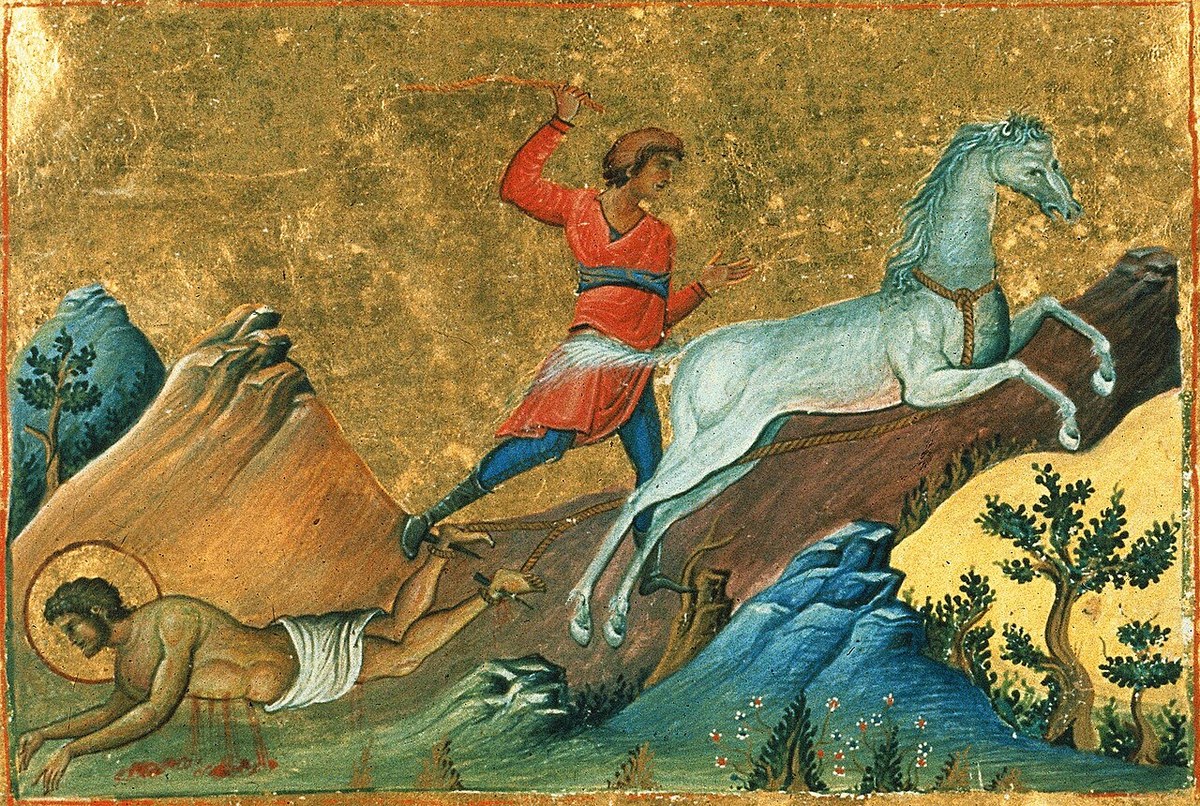
Enraged, Maximinus had the martyr shut up again seven days without food or drink, and on the eighth resumed the torture. Twenty nails were hammered into his legs, and he was tied to an untamed horse; dragged over the stones, Orestes gave up his soul to the Lord, in the year 304. His relics were thrown into the sea.
The vision to Demetrius of Rostov
In 1685, when Demetrius (later bishop of Rostov, commemorated October 28) had just finished writing the Life of Orestes for the press of the Kiev Caves Lavra, he grew weary and fell asleep during the Nativity Fast, shortly before Matins. The martyr appeared to him with a joyful face and said, "I suffered more torments for Christ than these," and, baring his body, showed him the deep wound in his left side where the spear had pierced him, and the places where his arms and, behind the knees, his legs had been cut with a scythe — "Now you see that I suffered more torments for Christ than you have described." When the monk wondered whether this might be the Orestes of the Five Martyrs of Sebaste, the martyr answered, "I am not that Orestes, but him whose Life you have just finished writing," and with the ringing of the bells for Matins the vision ended. The tradition records the vision both as a witness to the martyr's sufferings and as the Church's own distinction of the two saints named Orestes.
Feast and commemoration
November 10 (church date; Old Calendar civil November 23). In the Greek Menaion Orestes holds the day's proper sanctoral service, the apostles of the Seventy of the same day receiving synaxarion commemoration; the Slavic and OCA calendars lead the day with the apostles and keep Orestes among the martyrs of the day.
Hymns
Troparion — Tone 4
Thou didst endure the severing of thy limbs and the fierce torment of fire, O martyr, and having contended, O all-glorious one, thou wast truly crowned with the crown incorruptible, O most blessed; now thou standest before the throne of the Holy Trinity — entreat him that he save us who sing to thee with faith, O martyr Orestes.
Original translation from the Slavonic
Iconography
Orestes is depicted as a young beardless martyr, in the tunic and mantle of a layman rather than in armour, in the fashion of the early martyrs. The stored image is the miniature for November 10 from the Menologion of Basil II (Constantinople, c. 985), showing the martyr at the moment of his torment.
Disputed questions
- Two saints named Orestes. This Orestes of Tyana (November 10) is a distinct person from the Orestes numbered among the Five Martyrs of Sebaste — Eustratius, Auxentius, Eugene, Mardarius and Orestes — commemorated on December 13. The vision to Demetrius of Rostov turns precisely on the distinction, the martyr declaring himself "not that Orestes."
- The persecuting officer. The acts name the officer sent to Tyana "Maximinus"; the name recurs in the Cappadocian martyr-acts of the period and should not be pressed into an identification with the emperor Maximinus Daza.