
Five Martyrs of Sebaste
The Holy Five Martyrs of Sebaste — Eustratius, Auxentius, Eugene, Mardarius and Orestes
Martyr · d. c. 296
Commemorated 13 December — Martyrdom at Sebaste in Armenia under Diocletian
The Five Martyrs of Sebaste — Eustratius, Auxentius, Eugene, Mardarius and Orestes — suffered for Christ at Sebaste in Armenia during the persecution of Diocletian, about the year 296. Their leader Eustratius was a learned nobleman and scholarch, the military governor of Satala, who confessed his hidden faith when he saw the presbyter Auxentius seized; drawn into the confession one by one, the priest Auxentius, the soldier Orestes, and the bystanders Eugene and Mardarius each won the martyr's crown by fire and the sword. Eustratius, burned alive last of all, left behind a great prayer of thanksgiving that is still read at the Saturday Midnight Office in the Byzantine rite; the prayer of the Third Hour is likewise ascribed to Mardarius. They are commemorated together on December 13.

Sebaste and the persecution
Sebaste (Sebastea, the modern Sivas) in Lesser Armenia was a city that gave the Church a host of martyrs — most famously the Forty Martyrs of Sebaste of a generation later. Under Diocletian (284–305), when the imperial officers Lysias the dux and Agricolaus the governor were charged with rooting out the faith from the region, the churches of Armenia and Cappadocia were emptied and their confessors dragged to trial. The passion of the five, one of the fuller martyr-acts to survive from the East, unfolds as a chain of confessions, each martyr moved to speak by the constancy of the one before him.
Auxentius and Eustratius
The first of the company to be taken was Auxentius, a presbyter of the Christians of Arabraca, arrested and imprisoned with others of the faithful. When he was led out for trial, Eustratius — a man of rank and learning, the scholarch and military governor of the city of Satala and commentarisius (registrar) of the province, who had until then kept his Christianity secret — could not bear to see the priest suffer alone. Casting off his soldier's belt, he presented himself before Lysias and openly named himself a Christian. The governor, who had known and honoured him, tried first flattery and then torture: Eustratius was beaten, and iron sandals studded with sharp nails were fastened to his feet, in which he was made to march the road to Arabraca.
Mardarius
As the tormented Eustratius was brought into Arabraca, a man of the town named Mardarius, watching from the crowd with his wife and children, was so struck by the martyr's endurance that he cried out that he too was a Christian, of the same faith as Eustratius. Commending his young sons to God and to a neighbour's care, he gave himself up. Holes were bored through his ankles, ropes passed through them, and he was hung head-downward while heated spits were driven into his body; he died under the torment. The tradition ascribes to him the prayer "O Master, Lord God, Father Almighty…," read at the close of the Third Hour.
Eugene and Orestes
Eugene, a companion already imprisoned with Auxentius, confessed with equal boldness; his tongue was torn out, his hands and feet were cut off, and he was beheaded. Auxentius the presbyter was led out and beheaded by the sword. There remained Orestes, a young soldier of Eustratius's own following, tall and comely, whose Christianity was betrayed when the sign of the cross he wore was seen at his breast during a display of archery. Sentenced to be stretched upon a bed of red-hot iron, he faltered for a moment as he drew near the fire; strengthened by a word from Eustratius, he signed himself with the cross, lay down upon the burning bed of his own will, and gave up his soul.
The martyrdom and prayer of Eustratius
Eustratius was reserved to the last and condemned to be burned alive at Sebaste on December 13. Before the furnace he made his confession of faith and, at the prompting of Blaise the bishop of Sebaste, committed to writing a long prayer of thanksgiving and self-offering, beginning "I magnify Thee exceedingly, O Lord, for Thou hast regarded my lowliness, and hast not shut me up in the hands of mine enemies." Entrusting the text and a small bequest to Blaise, he stepped into the fire and was consumed. His prayer passed into the daily office of the Church and is still appointed to be read at the Midnight Office of Saturday.
Feast and commemoration
December 13 (church date; Old Calendar civil December 26), within the Nativity Fast. The five are kept together universally in the Byzantine rite, with a full proper service in the Menaion; Eustratius, as the leader and the author of the Saturday-Midnight prayer, is named at the head of the company. The day is also kept, in the jurisdictions that observe them, by Lucy of Syracuse and — as his principal feast — Herman of Alaska.
Hymns
Troparion — Tone 4
Let us sing the splendour of the all-honoured martyrs, the five passion-bearers who scorned the glory of earth: Eustratius, the shining sun and all-wise orator, together with his fellow-sufferers, who dared the fire and the torments for Christ the King of all, and were endowed from His throne of glory with the honour of crowns. By their prayers, O Christ God, save our souls.
Original translation from the Slavonic
Kontakion — Tone 3
Discoursing on things divine before the lawless, thou didst endure the beatings with a most valiant heart; thou didst shine forth with divine signs, O most wondrous one, and didst quench the towering flame of delusion. Therefore we honour thee, O all-blessed Eustratius, martyr of Christ.
Original translation from the Slavonic
Iconography
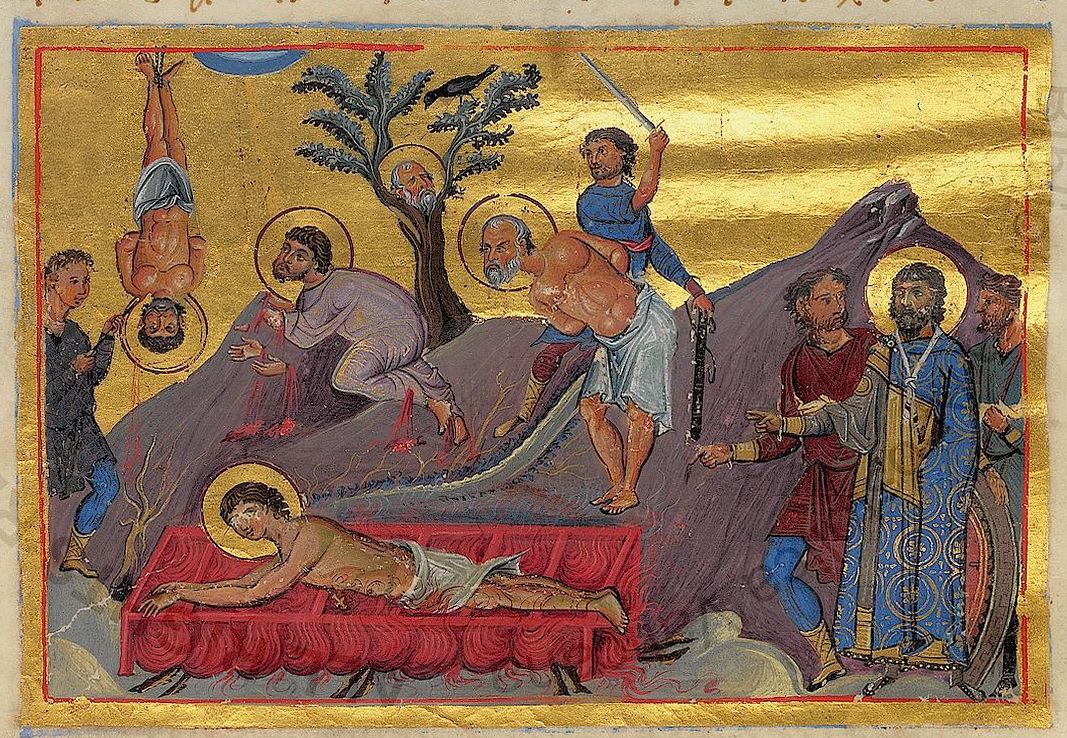
The five are shown together as a company of martyrs of varied age and station: Eustratius most often in the tunic and chlamys of a nobleman or officer, the white-bearded Auxentius as a priest, the young Orestes and Eugene beardless, and Mardarius among them, sometimes at the moment of his suffering. The scene proper to the feast is their execution. The stored image is the miniature for December 13 from the Menologion of Basil II (Constantinople, early eleventh century, Vatican gr. 1613), which depicts the martyrdom of the five together.
Disputed questions
- Date of the martyrdom. The Greek synaxaria place the passion about the year 296; some accounts set it later, within the Great Persecution begun by Diocletian's edicts of 303. The persecuting officers are named Lysias and Agricolaus, the same pair remembered in the acts of the Forty Martyrs of Sebaste.
- Two saints named Orestes. The Orestes of this company is not the same as Orestes of Cappadocia, the physician and soldier of Tyana martyred under Diocletian and commemorated on November 10. The Church herself drew the distinction: when Demetrius of Rostov, having written the Life of the Tyana Orestes, wondered whether his subject might be the Orestes of the Five Martyrs, the martyr appeared to him and answered, "I am not that Orestes." The two are kept as distinct persons.
- Mardarius the name. This martyr Mardarius of Sebaste is distinct from Mardarius the Recluse of the Kiev Caves (13th century), who shares his December 13 commemoration, and from the modern Serbian bishop Mardarije of Libertyville (December 12).