
Oswald of Northumbria
The Holy King and Martyr Oswald of Northumbria
King · Martyr · b. c. 604, in Bernicia — d. August 5, 642, at Maserfield
Commemorated 5 August — His death in battle against Penda at Maserfield, 642
Oswald was king of Northumbria from 634 to 642, and the man through whom the north of England became Christian. Baptised in exile among the Irish of Iona, he returned to a kingdom that had collapsed into apostasy, set up a wooden cross with his own hands before the battle of Heavenfield and knelt his army down to pray before it, and won. He then sent to Iona for a bishop, received Aidan, gave him Lindisfarne, and stood beside him interpreting his Irish to the Northumbrian nobles — a king acting as his missionary's translator. His almsgiving was proverbial, and the hand that gave the alms was said never to have decayed. On 5 August 642 he was killed at Maserfield by the pagan Penda of Mercia, at thirty-eight, praying for the souls of his own men as he fell. His cult became one of the most widespread in medieval Europe.
.jpg)
Exile and baptism
Oswald was the second son of Æthelfrith, the fierce pagan king of Bernicia, and of Acha, a princess of the rival house of Deira; he was born about 604, in the years when his father was welding the two peoples north and south of the Tees into the single kingdom of Northumbria. In 616 Æthelfrith was killed in battle by Rædwald of East Anglia, who set Acha's brother Edwin on the throne, and the sons of Æthelfrith fled for their lives.
Oswald spent seventeen years in exile, chiefly among the Irish of Dál Riata and at the monastery of Iona, the house of Columba. There he was baptised, and there he learned Irish well enough to speak it as his own. This is the fact that decides everything afterwards: the future king of Northumbria was formed not by the Roman mission at Canterbury but by the Celtic monasticism of the Hebrides, and when he came into his kingdom he sent for his clergy to the place where he had been converted.
Heavenfield
In 633 Edwin — who had himself been baptised, by Paulinus — was killed at Hatfield Chase by Cadwallon of Gwynedd, a Christian British king, allied with Penda of Mercia, a pagan. Northumbria fell apart. The two men who took the kingdoms of Deira and Bernicia, Osric and Oswald's brother Eanfrith, both apostatised and both were killed within the year; Bede regarded the year as so accursed that he struck it from the reckoning and credited it to Oswald's reign.
Oswald came south from the Irish with a small force. Near the Roman Wall at a place called Heavenfield (Hefenfelth), not far from Hexham, he made his stand. Bede's account is particular: Oswald had a wooden cross made in haste, dug the hole for it himself, held the shaft upright with both hands while his soldiers packed the earth around it, and then called out to the whole army — Let us all kneel, and together beseech the true and living God Almighty in His mercy to defend us from the proud and fierce enemy. They did, and at dawn they attacked and destroyed Cadwallon's host at the burn called Denisesburna.
Adomnán of Iona adds that on the night before the battle Columba appeared to Oswald in a vision, spread his cloak over the camp and promised him victory — an account Adomnán says came down from Oswald's own telling of it.
The cross of Heavenfield became the first Christian monument of Bernicia. Bede, writing a century later, says the monks of Hexham came there yearly to keep vigil on the eve of Oswald's death, and that splinters of the wood, put in water, healed men and beasts. The site is a church to this day.
King, and interpreter
Oswald reunited Bernicia and Deira and held an overlordship acknowledged, Bede says, by all four nations of Britain — Angles, Britons, Picts and Irish; he is the sixth of the kings in Bede's list of those who held imperium, the list later writers turned into the title Bretwalda.
He at once sent to Iona for a bishop. The first man they sent was rigid and censorious and came home having achieved nothing, saying the English were unteachable; at the council that followed, a monk named Aidan observed mildly that perhaps he had given them strong meat before milk, and was told to go himself. Aidan came, and Oswald gave him the island of Lindisfarne for his see, close enough to the royal fortress of Bamburgh to be under the king's hand and separate enough to be a monastery.
Bede's most attractive picture of Oswald belongs to these years: because Aidan at first had little English, the king himself stood beside him and translated his sermons into the Northumbrian tongue for his ealdormen and thegns. There is no other scene quite like it in the conversion of England.
He was also, Bede says, extraordinarily generous to the poor, and given to long private prayer — often sitting with his hands turned upwards on his knees, having risen at daybreak and prayed until it was time to hold court. The most famous story is of an Easter feast: a silver dish of rich food was set before the king, and the officer whose duty it was to relieve the poor came in to say that a crowd of them was sitting in the street begging alms. Oswald sent out the food at once, and ordered the silver dish to be broken up and distributed as well. Aidan, sitting beside him, seized the king's right hand and cried, May this hand never perish. It was afterwards believed that the prayer was granted: the hand and arm, cut from the body after his death, were kept in a silver casket in the church at Bamburgh and were held to be incorrupt.
Oswald married Cyneburh, daughter of Cynegils of Wessex, and stood as godfather at Cynegils' baptism by Birinus — so binding the northern and southern kingdoms in the faith at once.
Maserfield
The pagan Penda of Mercia, who had helped destroy Edwin, remained. On 5 August 642 the two met at a place Bede calls Maserfield — traditionally identified with Oswestry on the Welsh march, whose name is read as "Oswald's tree" — and Oswald was killed. He was thirty-eight years old and had reigned eight years.
Bede reports his last words as a prayer, not for himself but for the men dying around him: God have mercy on their souls — which passed into an English proverb, "God have mercy on their souls, said Oswald as he fell."
Penda had the body dismembered, and the head and the arms set up on stakes — a pagan treatment of a Christian king that fixed his status as a martyr in the eyes of his people from the first, though he died in battle and not in a persecution.
Relics and cultus
The parts of him went in three directions, and the cult went everywhere.
- The head was recovered by his brother Oswiu the following year and buried at Lindisfarne; when the monks fled the Vikings in 875 carrying Cuthbert's body, they carried Oswald's head inside the coffin with it, and it came to rest in Cuthbert's shrine at Durham, where it remains.
- The arms and hand were kept at Bamburgh, and are the subject of the incorruption tradition.
- The body was taken by his niece Osthryth, queen of Mercia, to the abbey of Bardney in Lindsey. The monks, being Mercians, would not at first admit the bones of a king who had conquered them, and left the wagon outside the gates overnight; a column of light stood over it until morning, and they took him in. From Bardney the relics travelled in the tenth century to Gloucester.
Bede devotes the greater part of Book III of the Ecclesiastical History to him and records miracle after miracle at the places of his death and burial — the earth from Maserfield, the stake on which his head was set, the dust of the floor where the water that washed his bones was poured out. His cult spread with the English mission to the continent and became astonishingly popular in Germany, Flanders, Bohemia and Switzerland, where Zug keeps him as its patron; over sixty English churches bear his name.
Feast and commemoration
August 5 (church date; Old Calendar civil August 18), the forefeast of the Transfiguration and within the Dormition fast — the anniversary of Maserfield. He is commemorated in the Orthodox calendars of the British Isles and by the Orthodox Church in America; the Greek listings for the day carry him as Ἅγιος Ὀσβάλδος. In the Roman and Anglican calendars the day is likewise August 5, and there are secondary observances of the translations of his relics.
Hymns
Apolytikion — Tone 4
Thou didst raise the Cross with thine own hands upon the field of heaven, O King Oswald, and didst bow thy people down before it; thou wast a father to the poor and an interpreter of the word to thy nobles, and at the last thou didst pray for thy dying men and receive the martyr's crown: entreat Christ God that our souls may be saved.
Iconography
Orthodox images of Oswald, which are recent, follow the type of the crowned royal martyr: a young king in the chlamys and crown, holding a cross in the right hand and sometimes a model of a church in the left, after the manner in which the East paints the holy princes. Where the Northumbrian setting is invoked, the wooden cross of Heavenfield stands beside him.
Western medieval art gives him a settled and quite different set of attributes: the crown and sceptre, a raven with a ring in its beak (from a late legend of his marriage embassy), and — most characteristically — the silver dish or ciborium of the Easter alms, or his own head carried in his hands, for the dismemberment at Maserfield. The great east window of Durham and a long series of German and Swiss altarpieces develop these.
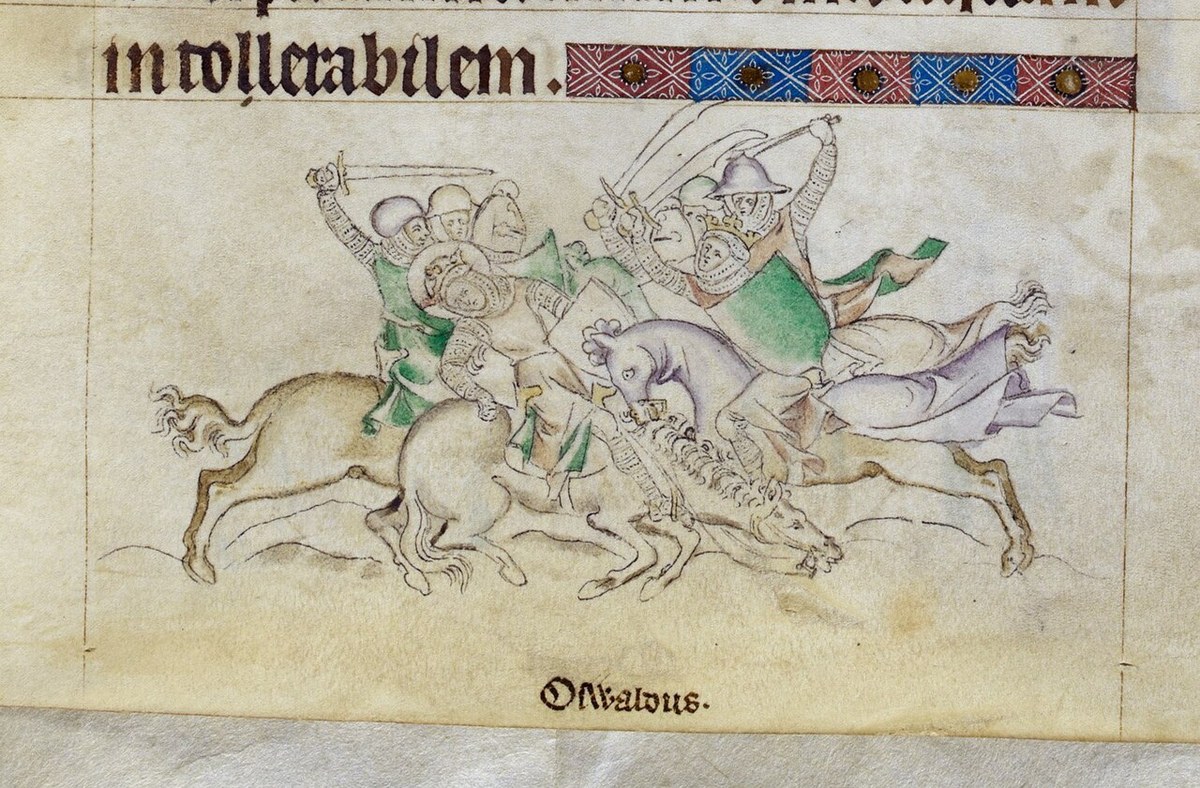
The stored image is a detail from the Queen Mary Psalter (British Library MS Royal 2 B VII, f. 259), an English illuminated manuscript of about 1310–1320 and one of the finest of the period. It shows the battle of Maserfield in the delicate tinted-drawing technique of that book's marginal cycle: two lines of mailed horsemen meeting with raised swords, the horses falling, and the name "Oswaldus" written in black letter beneath the scene, which is what identifies it. It is a narrative miniature rather than an icon, and it is stored as the earliest securely identified image of the saint available under a free licence; a Byzantine-form icon of Oswald remains wanted.
Disputed questions
- Was he a martyr? He died in battle against a pagan king, fighting for his kingdom as much as for the faith. Bede and the whole medieval tradition nevertheless call him a martyr, on the grounds that Penda's war was a war against Christ and that Oswald died praying for his enemies' men; the dismemberment of his body settled the matter for popular devotion. The category is close to the Slavic passion-bearer, and the reference classifies him as king and martyr, following the calendars.
- Where Maserfield was. Oswestry in Shropshire is the traditional identification and the etymology supports it; some scholars have argued for a site in Lincolnshire or nearer the Northumbrian border, on the grounds that Oswestry is deep in Welsh territory. No identification is certain.
- His age and the years. Bede gives his age at death as thirty-eight and his reign as eight years, counting from 634 — the year he assigned to Oswald although Osric and Eanfrith reigned in it. The birth-year of c. 604 is derived from these figures.
- His place in the Orthodox calendar. Oswald belongs to the undivided Church and is kept in Orthodox usage among the saints of the British Isles, on the day of his death. He has no Byzantine proper office; the common of a martyr is used.
- Not to be confused with Oswin of Deira (†20 August 651), the king of the southern Northumbrian kingdom who succeeded to Deira after Oswald's death and was murdered by the treachery of a friend at Gilling. Oswald was a warrior-king killed by the heathen Penda; Oswin disbanded his army rather than fight and was killed by Oswald's own brother Oswiu. The two names are constantly interchanged.