
Paisius the Great
Our Venerable Father Paisius the Great, of the Egyptian desert
Venerable · Wonderworker · d. c. 417, in the Egyptian desert
Commemorated 19 June — Repose in the desert of Egypt
Paisius the Great was an Egyptian ascetic of the Nitrian desert, a disciple of the elder Pambo, and one of the fathers whose austerity the desert itself thought extraordinary: he is said to have gone three years with his eyes fixed on the ground, to have fasted for weeks and at last for seventy days together, and to have received in his cell a vision of Christ promising that the wilderness he had chosen would be peopled with monks. He is remembered above all as the physician of the fallen — for the two disciples whom he won back, one from doubt of Christ's divinity and one from open apostasy, by taking their sin upon himself in prayer. He reposed in extreme old age, and his relics were laid by Isidore of Pelusium beside those of his friend Paul. He is honoured in the Coptic Church as Anba Bishoy, "the beloved of our good Saviour."

Origins and the school of Pambo
Paisius was born in Egypt, the youngest of seven children of Christian parents. The Life opens with a scene of his mother's widowhood: an angel is said to have appeared to her after her husband's death and to have asked for one of her sons for God, and when she pointed to whichever the angel should choose, the angel chose the youngest. She gave him accordingly to the Church, and he came in time into the desert.
There he was received by the great Pambo, one of the fathers of Nitria and a disciple of the first Egyptian generation, who was also the teacher of John the Dwarf — so that Paisius stands within the central line of Egyptian monasticism, at one remove from Antony himself. Pambo's teaching, as the Life presents it, was above all a discipline of the senses: that a monk should guard what he lets in through the eyes, since the war is lost or won there first. The young Paisius took the instruction literally and with a young man's violence, and went three years with his eyes cast down, not lifting them to look at anything. The detail is characteristic of the man throughout: he did what he was told, further than he was told, and without discussion.
The ascetic struggle
His fasting became proverbial in a country where fasting was the common trade. He began by eating once a week; he went on to fast two weeks together; and at the last, having received the Holy Mysteries, he is said to have passed seventy days without food of any kind. The Life is careful about the order of the two things — communion first, then the fast — because the point being made is not endurance but nourishment: the fathers held that the Body of Christ sustains, and Paisius's fast is told as a demonstration of it rather than as a feat.
He withdrew deep into the desert of Nitria, into a place where no one had settled, and there, in the cell he had dug, the Lord appeared to him. The vision is the hinge of the Life. Christ, the account says, told him that this wilderness would be filled with monks on his account; that those who lived there in obedience would be provided for and guarded from the assaults of the demons; and that Paisius was not to fear the desolation of the place. The promise was fulfilled at once in the ordinary way such promises are fulfilled — men came, heard of him, and stayed.
The lavra and its rule
A community formed around him, and he gave it one governing principle, which the Life states in a single sentence: that no one should do anything by his own will, but that in all things each should fulfil the will of his elder. This is the classic Egyptian doctrine of obedience as the shortest road, and Paisius held it so strictly that when the numbers grew and the noise of the settlement grew with them, he did not reform the community but left it, withdrawing to a remoter cave where he could keep the silence he had taught others to value. He continued to receive those who sought him, and to send away those who came for the wrong reasons.
The two fallen disciples
Two incidents are told of him more often than any others, and they are the reason the Church keeps his memory rather than merely his austerities.
A disciple of his went into the town on an errand and fell into conversation with a Jew, who mocked the divinity of Christ; the monk, out of politeness or weakness, did not contradict him, and let the blasphemy pass in silence. When he returned, Paisius would not recognise him — he looked at him and said that he did not know who he was, that the Christian he had sent out had not come back. Pressed, the monk remembered the conversation and understood that by his silence he had denied his baptism, and that the grace of it had departed from him. He repented, and Paisius shut himself up and prayed until the grace returned; the Life says he saw it come back like a dove.
The second case was worse. Another of his monks abandoned the desert altogether and, in Egypt, apostatised outright. Paisius went after him, found him, and prayed — and, as the tradition tells it, asked God to lay the man's sin upon himself. The prayer was heard: the apostate was restored, and Christ is said to have appeared to Paisius and to have shown him that the burden he had asked to carry had been accepted, and that such a request pleased Him more than any fast. The pairing of the two stories is deliberate in the hagiography: the first shows the cost of a silence, the second the price a father is willing to pay to undo it.
Repose and relics
Paisius reposed in great old age, worn out with abstinence, in the desert where he had spent his whole life. His body was taken up by St Isidore of Pelusium, who carried the relics to his own monastery and laid them beside those of St Paul, whom Paisius had loved in life; the two are commemorated together in the Egyptian tradition, and the joint burial is remembered in the Coptic Difnar.
Feast and commemoration
June 19 (church date; Old Calendar civil July 2). The day's office in the Menaion belongs to the Apostle Jude, and Paisius is a synaxarion commemoration under it, sung with the common of a venerable father; the Slavonic books give him a fuller notice than the Greek. He is much loved in Russian usage, where he is invoked particularly for the salvation of those who have died outside the faith or in apostasy — a patronage that grows directly out of the story of the disciple whose sin he took upon himself. The Coptic Church keeps him as Anba Bishoy on 8 Epip.
Hymns
Apolytikion — Tone 8
By a flood of tears thou didst make the barren desert to bring forth; with sighs from the depths thou didst make thy labours bear fruit a hundredfold; and thou wast made a beacon for the whole world, shining with miracles, O Paisius our father. Intercede with Christ God that our souls may be saved.
Kontakion — Tone 2
Thou didst dwell in the wilderness as in a paradise, O all-blessed one, and didst tame the passions by long fasting; and taking upon thyself the sin of thy brother, thou wast shown to be a true father. Wherefore we cry to thee: cease not to pray for us who honour thy memory, O Paisius, glory of the ascetics.
Original translation from the Greek
Iconography
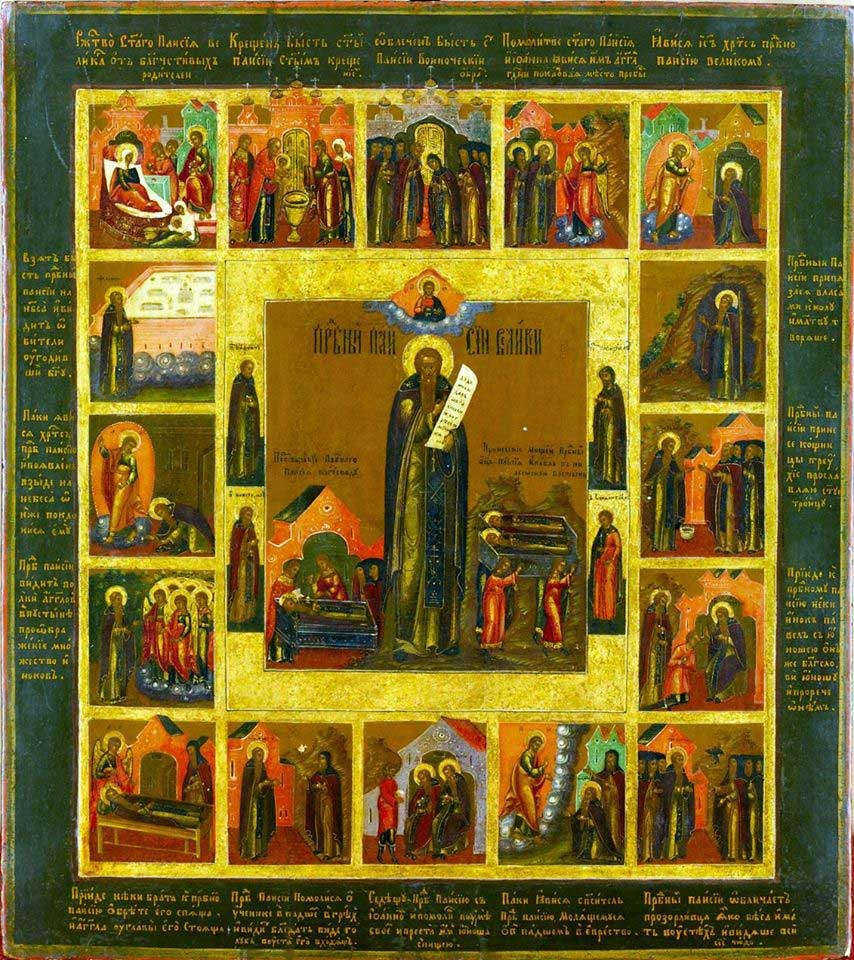
Paisius is painted as an aged monk of the Egyptian desert: gaunt and hollow-cheeked from the long fasting, with a long white or grey beard, in the dark tunic, analavos and mantle of the great schema, holding a scroll and often with the right hand raised in blessing. The scroll, where it is inscribed, carries a sentence of the desert on obedience or on the guarding of the eyes. In the Egyptian tradition his most familiar image is the Coptic one, in which he appears with Christ upon his shoulders in the likeness of a poor traveller — the episode that gave him the Coptic title "the beloved of our good Saviour" — and often paired with St Paul of Tammah, with whom he is buried. In Byzantine and Russian menologia he appears simply among the ranks of the venerable fathers of June.
No pre-1900 image of him alone has been located for this collection. The Coptic icons in circulation are twentieth- and twenty-first-century work and are under copyright; the older Egyptian material at Wadi al-Natrun is not available in a public-domain reproduction, and the Menologion of Basil II, which would be the first resort for a saint of this class, covers only September to February and so cannot serve a June commemoration.
The stored image is a 19th-century icon of the great Egyptian father.
Disputed questions
- Paisius the Great and the Coptic Anba Bishoy. The Greek Παΐσιος and the Coptic Pishoy (Bishoy) are the same name, and the Byzantine Paisius the Great is generally identified with Anba Bishoy of Scetis (c. 320–417), one of the greatest of the Coptic fathers, whose monastery in the Wadi al-Natrun bears his name and holds his body to this day. The two Lives agree in the essentials — the Egyptian birth, the seven children, the discipleship under Pambo, the withdrawal into Scetis, the vision of Christ, the friendship with Paul — and the identification is generally accepted. The calendars, however, differ: the Byzantine books keep him on June 19, the Coptic Church on 8 Epip (July 15), and the Coptic tradition adds a body of material the Greek does not carry, most famously the story that Christ came to his cell in the likeness of a traveller and that Bishoy carried Him on his shoulders. This corpus records the identification without asserting that every episode of the Coptic Life belongs to the Byzantine saint.
- The dates. No secure chronology is transmitted in the Greek notice. The dating to the fourth and fifth centuries, with repose about 417, follows the Coptic tradition and the discipleship under Pambo (†c. 375); the OCA notice places him more loosely "in the fifth century." The century of repose is recorded here as the fifth on that basis.
- Not to be confused with the later Slavic and Athonite saints of the name — Paisius Velichkovsky (†1794, November 15), the restorer of the Philokalic tradition; Paisius of Hilendar, the Bulgarian historian, who shares this very day; and the Russian monastics Paisius of Galich and Paisius of Uglich. All of them were given the name in his honour.
- Not to be confused — or possibly to be identified — with Psoy of Egypt, the venerable Ψόης commemorated on August 9, to whose bare synaxarion notice the modern synaxaria attach the Coptic life of Anba Bishoy told here (Shansa, the washing of the traveller's feet, the carrying of the cripple, the repose of 417 in the Wadi al-Natrun). The Greek books give the August 9 saint no life at all, which suggests they did not take him for the father already kept on June 19. This repository keeps the two entries separate and cross-referenced; the question is open and set out in full under Disputed questions in the August 9 entry.