
Jude the Apostle
The Holy Apostle Jude, the Brother of the Lord, called also Thaddaeus and Lebbaeus
Apostle · Martyr · d. c. 80, near Mount Ararat in Armenia
Commemorated 19 June — Memory of the apostle and his martyrdom, 30 June — Synaxis of the Holy Twelve Apostles
Jude — called also Thaddaeus and Lebbaeus, and in the Gospel lists simply "Jude of James" — is one of the Twelve, and in the Eastern tradition one of the "brethren of the Lord," a son of Joseph the Betrothed. He speaks once in the Gospels, at the Mystical Supper, where the Evangelist takes care to identify him as "Judas, not Iscariot" (John 14:22); he is the author of the short catholic Epistle of Jude, in which he calls himself not the Lord's brother but "the servant of Jesus Christ and brother of James." After Pentecost he preached in Judea, Samaria, Idumea, Syria, Mesopotamia and Persia, and came at length to Armenia, where about the year 80 he was crucified and shot through with arrows near Mount Ararat. He is not to be confused with Thaddaeus of the Seventy (August 21), the apostle of Edessa, with whom the tradition has conflated him since antiquity.

Names, and the difficulty of them
No apostle of the Twelve is harder to name. The four New Testament catalogues do not agree on the word by which the tenth or eleventh apostle is called:
- Matthew 10:3 — the Byzantine text reads Λεββαῖος ὁ ἐπικληθεὶς Θαδδαῖος, "Lebbaeus, whose surname was Thaddaeus"; the great uncials Vaticanus and Sinaiticus give simply Θαδδαῖος; and a strand of Old Latin and Syriac witnesses reads instead "Judas the Zealot."
- Mark 3:18 — Θαδδαῖον, "Thaddaeus," with no second name.
- Luke 6:16 and Acts 1:13 — Ἰούδαν Ἰακώβου, "Jude of James."
- John 14:22 — Ἰούδας, οὐχ ὁ Ἰσκαριώτης, "Judas, not Iscariot."
The Church has always read these as one man under several names, and the Greek and Slavonic synaxaria pile them up: Jude, Thaddaeus, Lebbaeus, and (in the Slavonic tradition following the Great Reading Menaia) Barsabas as well. The names are not arbitrary. Thaddaeus and Lebbaeus are alike Semitic bynames of the affections — the one from Aramaic taddā, the breast, the other from Hebrew lēb, the heart — so that both may be rendered something like "the warm-hearted," a nickname before it was ever a name. That such a man should have carried a byname in daily use is entirely natural for the plainest of reasons: his given name was Judas, and after the betrayal that name could not be spoken among Christians without qualification. John's parenthesis is the first evidence of the embarrassment; English versions have prolonged it for four centuries by shortening his name to Jude while leaving the traitor's as Judas, though in Greek there is no difference at all between them.
His kinship with the Lord
The Eastern tradition places Jude among the "brethren of the Lord" — the four men whom the townsfolk of Nazareth name in a breath: "Is not this the carpenter's son? … and his brethren, James, and Joses, and Simon, and Judas?" (Matt. 13:55; cf. Mark 6:3). In the Greek usage he is therefore styled ἀδελφόθεος, "brother of God," as is James the Brother of the Lord, and the synaxarion accounts for the kinship in the ordinary Eastern way: that Joseph the Betrothed had sons by an earlier marriage, and that Jude was one of them, and so the Lord's brother by law and household and not by nature.
The three ancient positions on what "brethren of the Lord" means — the sons of Joseph by a first wife, the cousins, or the later children of Joseph and Mary — are set out at length in the entry for James, under Disputed questions, and are not argued again here. What must be said is that the Eastern answer, the first of the three, is the one on which this entry's own tradition rests: it is because Jude is reckoned a son of Joseph that the Byzantine books call him adelphotheos and give him a place in the Sunday after Nativity beside Joseph and David and James.
There is a further sting in the record which the synaxaria do not soften. Of these brethren the Evangelist says flatly, "neither did his brethren believe in him" (John 7:5). The tradition takes the words seriously and applies them to Jude: he came late to faith, and the memory of that lateness is given as the reason for the extraordinary self-effacement of the opening of his epistle, where a man who might have written "the brother of the Lord" writes instead "the servant of Jesus Christ."
His one word in the Gospels
Jude speaks once. At the Mystical Supper, when the Lord has promised that he who loves Him will be loved of the Father, and that He will manifest Himself to him, the Evangelist writes: "Judas saith unto him, not Iscariot, Lord, how is it that thou wilt manifest thyself unto us, and not unto the world?" (John 14:22). It is the last question any of the apostles asks in that discourse, and it is the question of a man who has understood the promise and not yet understood its manner: he expects a manifestation to the world, a public vindication, and asks why it is to be private. The Lord's answer — that the Father and the Son will come and make their abode with the one who keeps the word — is one of the great Johannine sayings on the indwelling of God, and it was given in answer to Jude.
After Pentecost: the mission
Jude was numbered with the eleven in the upper room (Acts 1:13) and received the Holy Spirit at Pentecost with the rest. Beyond that Scripture says nothing of him, and the geography of his mission comes from the synaxaria and the apostolic lists.
The Byzantine account sends him first through the country of the Jews — Judea, Galilee, Samaria and Idumea — and then out into Arabia, Syria and Mesopotamia. The distinctive note in the Eastern telling is what he did at Edessa: he came there, the synaxarion says, to complete the work that Thaddaeus of the Seventy had begun in the days of King Abgar. That sentence is the Church's own resolution of the great confusion between the two men; it presupposes that they are two, and that the later of them built on the earlier. From Edessa the tradition carries him east into Persia, and it is from Persia that several accounts date the writing of his epistle.
The Armenian tradition is older and stronger than any of these, and it is the one that governs the account of his death. Armenia counts two apostolic founders, Bartholomew and Thaddaeus — its "first illuminators" — and the Thaddaeus of that tradition is understood in Armenia to be Jude of the Twelve. The Bartholomew entry records the same claim from the other side. The reputed site of Jude's preaching and burial in the province of Artaz, in what is now Iranian Azerbaijan, is marked by the ancient Monastery of St Thaddeus — the Qara Kelisa, the "Black Church" — which remains a place of Armenian pilgrimage.
Martyrdom
The manner of his death is transmitted in two principal forms, and they cannot both be right.
- Armenia and Ararat. The account which the Slavonic and Russian synaxaria carry, and which the Orthodox Church in America follows, sets his martyrdom in Armenia near Mount Ararat, about the year 80, where the pagans crucified him and, as he hung, shot him through with arrows. The double death — the cross and the arrows — is the form fixed in the hagiography and in the iconography of the East, and is bound up with the Armenian tradition of the king Sanatruk, who is said to have received the faith and then apostatised, and to have put both Thaddaeus and his own daughter to death.
- Edessa. The Greek notice printed in the Ὀρθόδοξος Συναξαριστής keeps the arrows but moves the place, saying that after preaching in Mesopotamia amid many dangers he was martyred at Edessa. This is very probably the conflation with Thaddaeus of the Seventy showing through in the Greek books themselves.
The Latin tradition has a third form again: that Jude worked in Persia together with Simon the Zealot, and that the two suffered there on the same day, for which reason the Roman Church keeps them jointly on October 28. A fourth and much weaker report puts his death at Beirut about 65, again with Simon. The Eastern books know the Persian mission but not the joint martyrdom.
Relics and later cultus
Relics claimed for Jude have travelled far. The Armenian monastery of Artaz holds his tomb by its own tradition; a considerable portion is claimed at Rome, in St Peter's Basilica, where he lies with Simon under one altar in accordance with the Western story of their common death; other portions are shown at Reims and Toulouse. In the East his memory was carried chiefly by the calendar and by the epistle rather than by a great relic-shrine.
One later development belongs entirely to the West and should be recorded because it now dominates the popular image of the saint. From the later Middle Ages his name kept the faithful away from him: no one wished to pray to a saint called Judas, and it was said that he was therefore invoked only by those who had nowhere else to turn. Out of that reluctance grew, in the nineteenth and twentieth centuries, the immense Roman Catholic devotion to "St Jude, patron of desperate cases and lost causes." It has no Eastern counterpart and no basis in the Byzantine synaxaria; but it is the reason his name is better known in the English-speaking world than that of almost any other of the Twelve.
The Epistle of Jude
The twenty-five verses of the Epistle of Jude are among the shortest books of the New Testament and among the fiercest. The writer names himself "Jude, the servant of Jesus Christ, and brother of James" — a double act of humility and of identification, claiming no kinship with the Lord and resting his authority on the name of his brother, who was known to the whole Church as the head of the Jerusalem community.
He had meant, he says, to write of "the common salvation," and found himself compelled instead to write an exhortation "that ye should earnestly contend for the faith which was once delivered unto the saints" (v. 3) — the verse which has done more than any other in the New Testament to shape the Orthodox understanding of tradition as a deposit received and guarded rather than a construction. What follows is a catalogue of judgement: the unbelieving generation destroyed after the Exodus; "the angels which kept not their first estate," reserved in everlasting chains under darkness; Sodom and Gomorrah; the way of Cain, the error of Balaam, the gainsaying of Korah. The intruders he denounces are men who "turn the grace of our God into lasciviousness," who feast without fear at the Church's own love-feasts — "spots in your feasts of charity," "clouds without water, carried about of winds; trees whose fruit withereth, without fruit, twice dead, plucked up by the roots; raging waves of the sea, foaming out their own shame; wandering stars, to whom is reserved the blackness of darkness for ever." The letter closes with one of the great doxologies of the New Testament: "Now unto him that is able to keep you from falling, and to present you faultless before the presence of his glory with exceeding joy…"
Two features made the epistle contested in antiquity. It refers to the dispute of the Archangel Michael with the devil about the body of Moses (v. 9), a story not found in the Old Testament and drawn from the apocryphal Assumption of Moses; and it quotes as prophecy a passage from the book of Enoch (vv. 14–15). Eusebius accordingly lists it among the antilegomena, the books "spoken against," and notes that few of the ancients cited it. It was nevertheless read in the churches, is included in the canon of the thirty-ninth festal letter of St Athanasius (367), and was received without further question in the East; the Church's judgement was that an inspired writer may use a source that is not itself inspired, as Paul quotes the Greek poets.
The Byzantine synaxarion summarises the epistle's teaching as being "concerning the Holy Trinity, concerning the Incarnation of our Lord Jesus Christ, concerning the good and the evil angels, and concerning the dread Judgement" — and adds the moral that runs through the whole of it, that faith which does not show itself in works is no faith at all.
Feast and commemoration
June 19 (church date; Old Calendar civil July 2) is the apostle's principal feast in the whole Byzantine world, and the day carries his proper service in the Menaion — an apolytikion and kontakion of his own, which is more than many of the Twelve are given on their own days. June 19 falls in most years within the Apostles' Fast, whose beginning moves with Pascha and whose end is fixed at June 28; in years of a very late Pascha the fast has not yet begun on this day, so the position is not asserted here.
He is commemorated a second time, with the whole college, at the Synaxis of the Holy Twelve Apostles on June 30.
The Latin Church keeps him with Simon on October 28, following the Persian tradition of their common martyrdom, and the Armenian Church keeps its "Thaddaeus" as one of the two first illuminators of the nation with a cycle of his own. The Georgian and Coptic calendars have their own days. Where the Greek books of June 19 differ from the Slavonic, it is chiefly in the place of the martyrdom (Edessa against Ararat), which is noted under Disputed questions.
Hymns
Apolytikion — Tone 1
Knowing thee to be a kinsman of Christ, O Jude, and a steadfast martyr, we praise thee with sacred hymns: for thou didst trample down error and keep the faith. Wherefore, as we celebrate today thy most holy memory, we receive by thy prayers the loosing of our sins.
Kontakion — Tone 1
Out of a glorious root thou didst spring up for us, a branch given of God, O eyewitness of the Lord, apostle and brother of God, all-wise herald of Christ; thou dost feed the whole world with the fruits of thy words, teaching the Orthodox faith of the Lord, as one initiated into grace.
Original translation from the Greek
Appointed readings
Epistle — Jude 1–10
1Jude, the servant of Jesus Christ, and brother of James, to them that are sanctified by God the Father, and preserved in Jesus Christ, and called: 2Mercy unto you, and peace, and love, be multiplied. 3Beloved, when I gave all diligence to write unto you of the common salvation, it was needful for me to write unto you, and exhort you that ye should earnestly contend for the faith which was once delivered unto the saints. 4For there are certain men crept in unawares, who were before of old ordained to this condemnation, ungodly men, turning the grace of our God into lasciviousness, and denying the only Lord God, and our Lord Jesus Christ. 5I will therefore put you in remembrance, though ye once knew this, how that the Lord, having saved the people out of the land of Egypt, afterward destroyed them that believed not. 6And the angels which kept not their first estate, but left their own habitation, he hath reserved in everlasting chains under darkness unto the judgment of the great day. 7Even as Sodom and Gomorrha, and the cities about them in like manner, giving themselves over to fornication, and going after strange flesh, are set forth for an example, suffering the vengeance of eternal fire. 8Likewise also these filthy dreamers defile the flesh, despise dominion, and speak evil of dignities. 9Yet Michael the archangel, when contending with the devil he disputed about the body of Moses, durst not bring against him a railing accusation, but said, The Lord rebuke thee. 10But these speak evil of those things which they know not: but what they know naturally, as brute beasts, in those things they corrupt themselves.
Gospel — John 14:21–24
21He that hath my commandments, and keepeth them, he it is that loveth me: and he that loveth me shall be loved of my Father, and I will love him, and will manifest myself to him. 22Judas saith unto him, not Iscariot, Lord, how is it that thou wilt manifest thyself unto us, and not unto the world? 23Jesus answered and said unto him, If a man love me, he will keep my words: and my Father will love him, and we will come unto him, and make our abode with him. 24He that loveth me not keepeth not my sayings: and the word which ye hear is not mine, but the Father’s which sent me.
Iconography
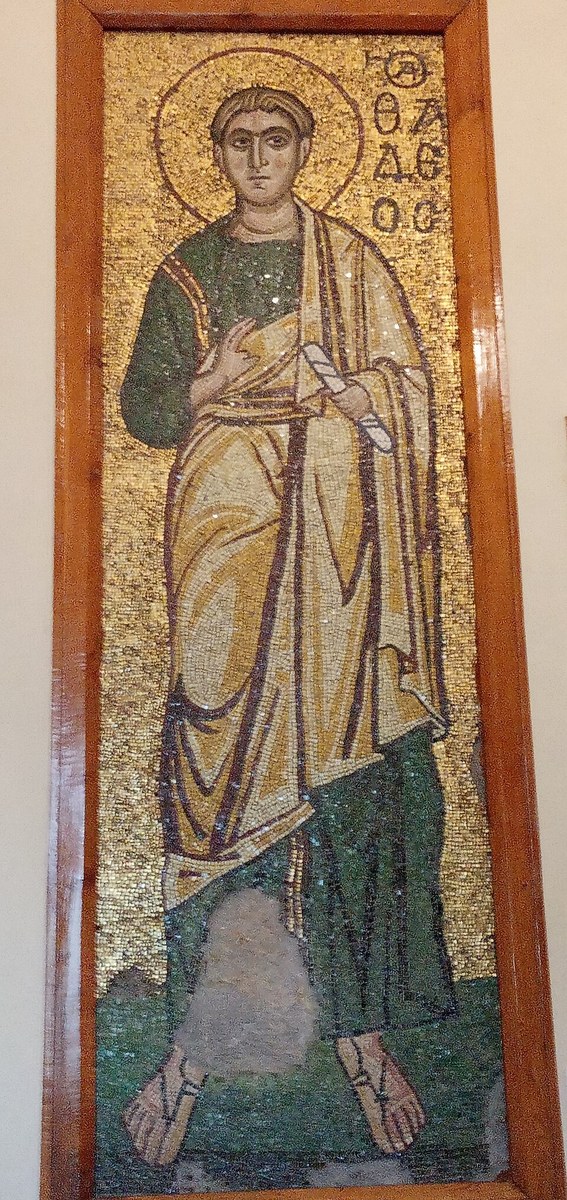
Jude is painted as an apostle of middle years, dark-haired and bearded, in tunic and himation, holding a scroll or a closed codex — his epistle — and often with the right hand raised in speech or blessing. He has no distinctive Byzantine attribute of his own; the Greek inscription is normally the short Ο ΑΓΙΟΣ ΘΑΔΔΑΙΟΣ ("the holy Thaddaeus") or, in the Slavonic books, Ап. Иуда, and in scenes of the martyrdom he is shown bound or crucified and pierced with arrows. In Western art he carries a club or halberd — the instrument of a quite different martyrdom legend — and very often a medallion bearing the face of Christ, an attribute imported from the Abgar story and belonging properly to Thaddaeus of the Seventy; the borrowed medallion is the clearest visual sign of the ancient conflation of the two men.
The stored image is the twelfth-century mosaic of the Apostle Thaddaeus from St Michael's Golden-Domed Monastery in Kyiv (c. 1108–1113), one of the panels rescued when the monastery was demolished in the 1930s and now shown in the Museum of St Sophia Cathedral. The apostle stands full-length in green chiton and gold-white himation, holding a closed scroll, against a gold ground, and is inscribed vertically Ο ΑΓ(ΙΟΣ) ΘΑΔΔΑΙΟΣ — the ordinary Byzantine label for Jude of the Twelve when he appears in an apostolic series. The mosaic is far out of copyright; the photograph is an in-situ shot of the framed panel and is used under its photographer's CC BY-SA 4.0 licence (see the entry's record), not under the faithful-reproduction doctrine.
A second candidate was examined and rejected: a tenth-century panel at the Monastery of St Catherine on Sinai, published on Wikimedia Commons as "Apostle Jude Thaddeus," carries no legible inscription in the available reproduction and is filed on Commons under Thaddeus of Edessa — that is, under the other saint. Storing it would have silently taken a side in the identity question set out above, which §8 of the PRD forbids. A framed nineteenth-century icon inscribed simply ΘΑΔΔΑΙΟΣ, from the church of St John the Forerunner in Jerusalem, was likewise passed over for the same ambiguity and for the poor quality of the only available photograph.
Disputed questions
- Jude of the Twelve and Thaddaeus of the Seventy are two men, not one. This is the single most important distinction in the entry, and it is ancient, deep-rooted, and constantly ignored. The Eastern Church commemorates on August 21 Thaddaeus of the Seventy, a Jew of Edessa converted at Jerusalem and baptised by John, who was sent to King Abgar of Edessa and healed him, and who preached in Mesopotamia and reposed at Beirut; and it commemorates on June 19 this Jude, one of the Twelve, brother of James and son of Joseph. The Byzantine books hold both, and hold them apart — the June 19 notice makes Jude the man who completed at Edessa what the other had begun. Yet the identification of the two is older than the separation: the Syriac tradition of Addai (Aramaic for Thaddaeus) already speaks of one apostle of Edessa without troubling to say which; the Armenian Church's "Thaddaeus," the founder with Bartholomew, is understood in Armenia as one of the Twelve; and Western art has for centuries given Jude the medallion or cloth bearing the face of Christ, which is an attribute borrowed wholesale from the Abgar legend and therefore belongs, strictly, to the other man. This corpus follows the Byzantine calendar and treats them as two, while recording that the conflation is not a modern blunder but a very old fusion of two Edessene traditions. The apostle of Edessa has his own entry at Thaddaeus of the Seventy (August 21), where the question is treated from the other side. He is likewise distinct from Thaddeus the Confessor of the Studion (December 29), a ninth-century monk who shares nothing with either but the name.
- "Jude of James": brother or son? The Greek of Luke 6:16 and Acts 1:13 is simply Ἰούδας Ἰακώβου, "Jude, the [something] of James" — the genitive is unqualified, and in ordinary Greek usage the word to be supplied is son. The King James and Douay versions supply "brother," on the strength of the epistle's own self-description; most modern critical translations supply "son," and thereby detach the apostle from the writer of the epistle. The Church's reading has always been "brother," and it is not an arbitrary one: the epistle exists, it names its author as the brother of James, and it was received by the same Church that read the apostolic lists. But the ambiguity is real and it is in the text.
- Did the apostle write the epistle? Those who read Luke's genitive as "son" generally assign the epistle to a different Jude — the brother of the Lord who was not of the Twelve — and some modern critics assign it to a later hand writing in his name, chiefly on the grounds of its polished Greek and its apparent look backwards at the apostles as a past generation (v. 17). The Orthodox tradition, which does not divide the brother of the Lord from the apostle, has no such difficulty; the point is noted here because the whole modern discussion of the epistle turns on it.
- Jude and Judas Iscariot. The distinction needs no argument and every Evangelist makes it, but it must be stated because the shared name is the reason for nearly every one of the saint's other names. John marks it in the text (14:22); Luke marks it in the list by the patronymic; Matthew and Mark avoid the name altogether and use the byname. The Church, in its turn, has made the distinction liturgically: the traitor has no commemoration, and this Jude is sung on June 19 as a kinsman of Christ and a steadfast martyr.
- Jude and Jude the brother of Simon. The Greek synaxaristes calls Simon the Zealot the brother of Jude Thaddaeus, and one strand of the tradition makes both, with James the son of Alphaeus, sons of Clopas. That genealogy competes with the one that makes Jude a son of Joseph, and the sources do not reconcile them; both are recorded here without preference, as they are in Simon's entry.