
Paphnutius of Egypt and his 546 Companions
The Holy Martyr Paphnutius the Anchorite of Egypt and the 546 Martyrs with him
Martyr · d. c. 303
Commemorated 25 September — Crucifixion of Paphnutius; martyrdom of his companions
Paphnutius was an Egyptian anchorite of the desert who, in the great persecution under Diocletian at the opening of the fourth century, left his solitude and presented himself of his own accord before the persecuting governor. His fearless confession under torture, and the wonders that attended it, drew a multitude to Christ — soldiers, prisoners and citizens, traditionally numbered 546 in all — who sealed their new faith with their blood by fire and the sword. Paphnutius himself, whom the tradition would not suffer to die an ordinary death, was crucified, the synaxarion says, on a palm tree. He and his companions are commemorated together on September 25.
.jpg)
Paphnutius belongs to the first generation of Egyptian monasticism, an anchorite pursuing the solitary life in the desert — the later Greek lists locate him loosely "in Egypt," the Coptic tradition at Dendera in the Thebaid — when the edicts of Diocletian (303 onward) loosed the last great persecution on the Egyptian church, whose sufferings in those years were, by the witness of Eusebius, the most terrible in the empire.
The account transmitted in the synaxaria relates that the governor of the district (the received Greek account calls him Hadrian; the Coptic passions of Paphnutius of Dendera set the trial before Arianus, the notorious persecuting governor of the Thebaid) sought out the famous hermit; Paphnutius did not wait to be hunted, but appeared before the tribunal of his own accord, wearing his monastic habit, and confessed Christ. He was tortured at length, and the endurance and radiance of the old ascetic — with the wonders that the account records of his imprisonment — became itself the persecutor's defeat: soldiers of the guard, fellow prisoners, and onlookers of every station confessed Christ, among them, the tradition specifies, officials and household members of the governor's own court. The company of these converts, given in the Greek and Slavic lists as 546, was destroyed by the standard instruments of the persecution — some by fire, some by the sword.
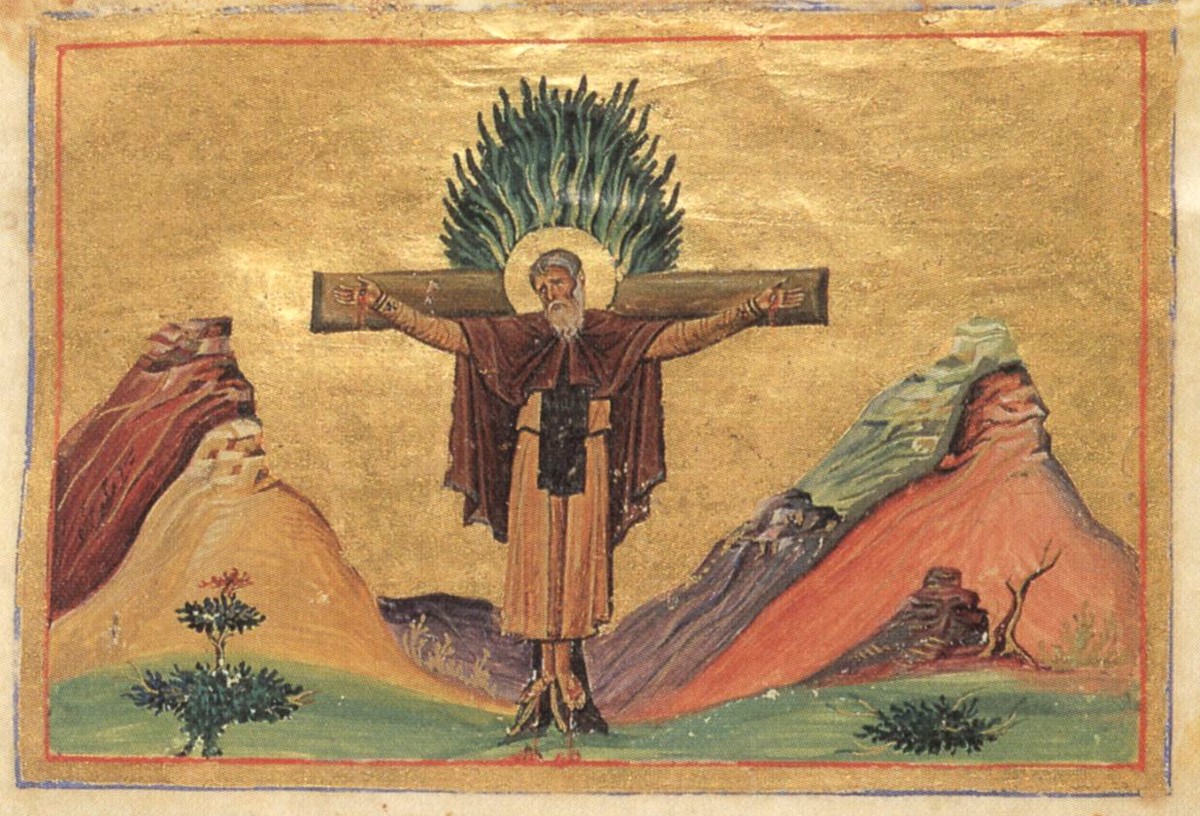
For Paphnutius himself a singular death is recorded: he was nailed to a palm tree — a crucifixion, which the verses of the synaxarion turn into his epigram: "The lovers of this world crucify Paphnutius, who long before had been crucified to the whole world." Some redactions add that he was sent bound to Diocletian himself before sentence. His martyrdom is placed about the year 303.
Feast and commemoration
September 25 (church date; Old Calendar civil October 8), in the Greek, Slavic and OCA calendars alike — the OCA styles the commemoration "Martyr Paphnutius and 546 companions in Egypt." In the Greek Menaion the day's proper service belongs to Euphrosyne of Alexandria, the martyr receiving a synaxarion notice with verses; the Coptic Church keeps its Paphnutius of Dendera separately in its own calendar.
Iconography
Paphnutius is shown as an aged, grey-bearded anchorite in the monastic habit — and, uniquely among the ascetics of the Egyptian desert, crucified: the Menologion of Basil II paints him stretched on the crossbeam against a flourishing palm whose fronds spread behind his haloed head, blood at his wrists, between the desert mountains. The stored image is that miniature (Constantinople, c. 1000), the classic witness to his commemoration.
Disputed questions
- Which Paphnutius? The name (Coptic Papnoute, "the man of God") is among the commonest of Christian Egypt, and the calendars carry several bearers whom the sources do not always keep distinct. The martyr of September 25 is to be distinguished from Paphnutius the venerable, father of Euphrosyne of Alexandria, commemorated the very same day with his daughter (and treated in her entry); from Paphnutius the Confessor, bishop in the Thebaid, the one-eyed father of Nicaea (commemorated in some calendars September 11 or November 25); and from the later Russian Paphnutius of Borovsk (May 1). Some Greek lists style the September 25 martyr "the Hierosolymite" (of Jerusalem) and rank him a hieromartyr — an epithet hard to reconcile with the Egyptian setting of the account, and perhaps born of confusion with yet another bearer of the name; the OCA and Slavic books keep him simply as the Egyptian martyr.
- Identity with Paphnutius of Dendera. The Coptic Church venerates a crucified martyr Paphnutius of Dendera under Diocletian, and the Byzantine September 25 martyr is generally identified with him (so the labelling of the Menologion miniature stored here, and the Wikidata identifier recorded above); the identification is probable rather than demonstrated, and the two traditions differ in details such as the persecutor's name.
- The number. The 546 companions are a figure of the synaxarion tradition; the sub-groups (soldiers, prisoners, courtiers) vary between redactions, and no independent record of the company survives.