
Euphrosyne of Alexandria
Our Venerable Mother Euphrosyne of Alexandria, daughter of Paphnutius the Egyptian
Venerable · Virgin · b. early 5th century — d. mid-5th century
Commemorated 25 September — Repose; with her father, the venerable Paphnutius
Euphrosyne of Alexandria (5th century) was the only daughter of Paphnutius, a wealthy and devout citizen of Alexandria. Vowed to virginity but betrothed by her father to a rich suitor, she fled on the eve of the marriage and — to escape the search she knew would comb every women's convent — put on a man's habit and entered a men's monastery as the eunuch "Smaragdus," where she lived unrecognised in an enclosed cell for thirty-eight years. Her own father, who came for years to the monastery for consolation in his grief, was comforted by the monk Smaragdus without ever knowing her, until she revealed herself on her deathbed. Paphnutius, commemorated with her, ended his days a monk in his daughter's cell. She is commemorated on September 25, and is the chief saint of the day in the Greek Menaion.
.jpg)
Origins and early life
The Life — one of the most widely read monastic tales of the Byzantine world — places Euphrosyne in Alexandria in the reign of Theodosius the Younger (408–450). Her father Paphnutius, called "the Egyptian" in the synaxaria, was rich, honoured and devout; her mother, after twelve years of childless marriage, bore this one daughter at the prayers of a monastic elder, and died when the girl was about twelve. Paphnutius had his daughter taught the Scriptures and letters, and her beauty and wisdom made her a famous match: at eighteen he betrothed her to the son of an eminent and wealthy house.
But Euphrosyne's heart had been taken elsewhere. Through her father's custom of visiting a nearby monastery with her, and through the words of its abbot and of a travelling monk, she conceived a longing for the virgin's life and came to regard the marriage prepared for her with dread. Secretly she received the tonsure — the Life says from a wandering monk who visited the house while her father was away at a vigil — and resolved on flight.
Ascetic struggle
Her stratagem is the pivot of the story. Knowing that her father would search every women's community in Egypt, she cut her hair, put on a man's dress, and presented herself at a men's monastery outside the city — according to the Life, the very community her father frequented — calling herself Smaragdus ("Emerald"), a eunuch of the imperial court who desired to save his soul. The abbot received the newcomer; but the beardless beauty of the young "eunuch" so troubled the brethren that the abbot assigned Smaragdus a solitary cell and the direction of the strictest of the elders, Agapitus, under enclosure. There Euphrosyne lived thirty-eight years in fasting, vigil, and unbroken seclusion, advancing so far in the life of prayer that the community came to regard the unseen recluse as its hidden treasure.
Paphnutius meanwhile sought his vanished daughter with every resource — searches, rewards, inquiries in the convents and harbours and among the caravans — and, finding nothing, brought his inconsolable grief year after year to the abbot. The abbot, wishing to comfort him, sent him to the holy recluse Smaragdus. The Life dwells on the long irony that follows: the father pouring out his sorrow for his lost child to the very child he sought, and the daughter, mastering herself, consoling him with the promise that he would yet see his daughter in this life, while asking his prayers and receiving his visits over many years.
Repose
When Euphrosyne fell into her final illness, Paphnutius came again to the cell, begging the prayer of the dying monk. Then she revealed herself: "I am Euphrosyne thy daughter; and I beg thee, let no one else prepare my body for burial." The father fell speechless with grief and wonder; she died in his arms, and only then did the brethren learn that the recluse of thirty-eight years had been a woman. Paphnutius, having buried his daughter in the monastery, distributed his wealth to the poor and to that community, received the habit, and lived the last ten years of his life in his daughter's cell, dying in peace and being buried beside her. The Greek books commemorate him with her on September 25 as "the venerable Paphnutius, her father," with his own synaxarion notice.
Veneration and later cultus
The Life of Euphrosyne circulated very widely in Greek and passed early into Latin (she stands in the Vitae Patrum), Syriac and other languages; in the West her feast entered the martyrologies (January 1 or February 11 in Latin books), and in the East her memory has stood on September 25 since at least the tenth century — she has a full service with two canons in the Menaion, appears in the Synaxarion of Constantinople and the Menologion of Basil II, and remains the titular saint of the day's Greek service. A later namesake, Euphrosyne the Younger (†c. 921, commemorated November 8), took her name and imitated her disguise, which is why some Greek sources style the Alexandrian "Euphrosyne the Elder."
Feast and commemoration
September 25 (church date; Old Calendar civil October 8). In the Greek Menaion she is the chief saint of the day, with the proper service and two canons; her father the venerable Paphnutius is commemorated with her, and the day's synaxarion joins to them the martyr Paphnutius of Egypt, the memory of the great earthquake of 447, and the martyrs Paul, Tatta and their children. The OCA and the Slavic calendars keep her on the same day, where the Russian books give precedence to Sergius of Radonezh, who shares it. The commemoration is universal.
Hymns
Troparion — Tone 8
In thee, O Mother, was preserved unimpaired that which is according to the image; for taking up the Cross, thou didst follow Christ, and by thy deeds didst teach us to disregard the flesh, for it passes away, but to care for the soul, a thing immortal. Wherefore thy spirit, O venerable Euphrosyne, rejoices with the angels.
Original translation from the Greek
Kontakion — Tone 2
Yearning to attain the life on high, thou didst eagerly forsake the delight below, and didst mingle thyself among men, O all-lauded one; for the sake of Christ thy Bridegroom thou didst despise a passing bridegroom.
Original translation from the Greek
Iconography
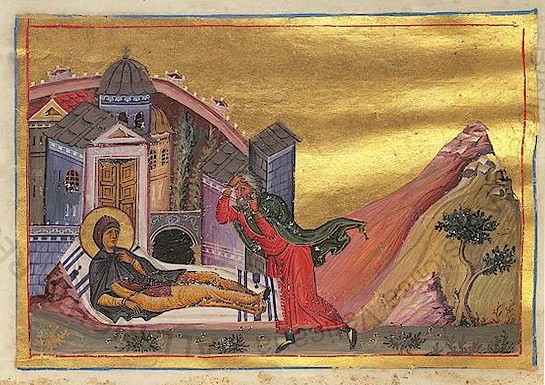
Euphrosyne is painted as a nun in the monastic mantle and cowl — the manuscripts sometimes show her in the male habit of her disguise — with the cross of a virgin ascetic; narrative images depict her deathbed revelation to her father. The stored image is the miniature of the Menologion of Basil II (Constantinople, c. 1000): the saint lies at her repose before the monastery gate while her father Paphnutius, learning at last who she is, mourns over her — the one scene by which the whole story was remembered.
Disputed questions
- Historicity. Euphrosyne's Life belongs to the well-defined group of Byzantine lives of women who lived as monks in men's communities — Theodora of Alexandria (September 11), Mary/Marinos, Apollinaria, Anastasia the Patrician, Pelagia — several likewise set in Egypt in the fifth century. Modern hagiographical scholarship treats the group largely as edifying literature, and no independent documentary trace of Euphrosyne survives; the Church's calendars have received her without hesitation for over a millennium. Both facts are recorded here, and the Life above is given as the tradition tells it.
- Chronology. The Life sets the story under Theodosius II; with entry to the monastery at eighteen and thirty-eight years of enclosure, her death falls near the middle of the fifth century, and printed calendars offer figures ranging from c. 445 to c. 470. No precise year is transmitted; the entry's record states the century only.
- The two Euphrosynes of September 25. She is not to be confused with Euphrosyne of Suzdal, the thirteenth-century Russian princess-nun commemorated the same day — an entirely different saint whose name in religion was taken, precisely, in honour of the Alexandrian. Distinguish her also from Euphrosyne the Younger (November 8), from Euphrosyne of Polotsk (May 23) and Euphrosyne of Moscow (July 7), and — a near-name, not a namesake — from Euphrosynus the Cook (September 11), whose entry already cross-references hers.