
Parthenius of Lampsacus
Our Father among the Saints Parthenius the Wonderworker, Bishop of Lampsacus
Bishop · Wonderworker · d. 4th century (after 325)
Commemorated 7 February — Repose of the wonderworking bishop of Lampsacus
Parthenius (fourth century) was bishop of Lampsacus on the Hellespont in the age of Constantine the Great, and one of the most celebrated wonderworkers and healers of the early Church. Born at Melitopolis, the son of a deacon, and a fisherman by trade who gave the price of his catch to the poor, he was ordained priest and afterward consecrated bishop of the still largely pagan Lampsacus. He converted the city, overthrew its idols, and — armed with an edict he obtained from the emperor — pulled down its temples and raised a church in their place. His memory is bound above all to the abundance of his miracles: he healed the sick of every kind of disease and was renowned as a caster-out of demons, before whom, the tradition says, the unclean spirits fled at his mere word. He reposed in peace and is kept on February 7.

Origins at Melitopolis
Parthenius was a native of Melitopolis, a town of the province of the Hellespont in Asia Minor, near the coast of the Sea of Marmara. His father, Christopher, was a deacon of the local church, so that the boy grew up within the worship and Scriptures of the Church. The tradition remembers a striking detail of his childhood: he could not read, and remained unlettered, yet by attending the divine services and listening he came to know the Holy Scriptures thoroughly, storing them in his heart rather than on the page. From his youth he showed the two marks that would define him — a tender-heartedness toward the poor and a spirit of prayer that already drew down the grace of healing.
By trade he was a fisherman, working the waters near his home; and the synaxarion dwells on his charity, for he would sell his catch and give away the proceeds to the destitute, keeping nothing back. It was in these years, according to his Life, that the grace of God first worked visible miracles through him: while still a layman he healed the sick and cast out demons, so that his reputation went before him and reached the bishop of the district.
Ordination and the see of Lampsacus
Philetus, bishop of Melitopolis, seeing the young man's virtue and the gifts that accompanied him, ordained him priest. As a presbyter Parthenius continued and increased in the works of mercy and healing for which he was already known. In time Ascholius, the metropolitan (archbishop) of Cyzicus — the ecclesiastical mother-city of the region — consecrated him bishop of Lampsacus.
Lampsacus (Greek Λάμψακος) was an ancient and famous city on the eastern shore of the Hellespont (the Dardanelles), in the district of the Troad; in Parthenius's day it was still deeply pagan, notorious in antiquity as a centre of the cult of Priapus, and its Christian community was small. Into this city the new bishop came as a missionary as much as a shepherd. By his preaching, his life, and the wonders that attended him he turned the people to Christ, so that the pagan majority gave way and the city became Christian.
The overthrow of the idols and the emperor's edict
Having won the people, Parthenius set about ridding the city of its idolatry. The Life places his episcopate in the reign of Constantine the Great (306–337), the first Christian emperor, and recounts that Parthenius obtained from the emperor authority — an imperial edict or letter — to demolish the pagan temples of Lampsacus and to build in their place a church for the Christian people. One tradition attaches to the demolition a characteristic wonder: as the workmen tore down a temple and a demon that had haunted it took flight, or as a possessed man cried out under the saint's command, Parthenius rebuked the unclean spirit and it departed. Where the shrines of the idols had stood he raised the house of God, and the conversion of the city was set in stone.
The wonderworker and healer
It is as a wonderworker (θαυματουργός) and a healer that the tradition loves Parthenius best, and the synaxaria heap up the accounts of his cures. He healed every kind of sickness — fevers, paralysis, blindness, cancers and tumours, the bites of serpents — laying his hands on the afflicted and invoking the Name of Christ; and the poor came to him from the whole region as to a physician who asked no fee. His most celebrated gift, however, was over the demons. He was renowned as a caster-out of unclean spirits, before whom, the tradition insists, the demons could not stand: at his command they confessed themselves and fled from the bodies of the possessed.
One episode is told across the sources with particular relish. A demon, commanded by the saint to come out of a man and to enter no other, is said to have begged Parthenius for a place to dwell, pleading that it might at least enter into a herd of swine or into another man; and the bishop answered that he would give it a dwelling — offering his own body, "come and dwell in me" — at which the demon, unable to bear the presence of one in whom Christ dwelt, fled shrieking and vanished, having no power over the servant of God. The episode, whatever its precise transmission, crystallises the tradition's whole portrait of Parthenius: the meek fisherman-bishop before whom the powers of darkness are helpless because his heart is wholly Christ's.
Repose
Parthenius governed Lampsacus in peace, honoured by his flock and sought out by the sick and the demon-tormented of many cities, and reposed in peace in his old age. The century is fixed by the reign of Constantine under which his episcopate falls — the fourth — though the exact year of his death is not transmitted. He was buried at Lampsacus, and his tomb continued to work the healings that had marked his life, so that his cultus spread quickly through the Greek East.
Feast and commemoration
Parthenius is kept on February 7 (church date; Old Calendar civil February 20), within the afterfeast of the Meeting of the Lord. On the same day the Byzantine calendars keep the great ascetic and wonderworker Luke of Steiris (Luke of Hellas), so that February 7 joins two celebrated healers — a hierarch of the fourth century and a monk of the tenth. The Greek Menaion, the Slavic menologia, and the Antiochian, OCA, and GOARCH calendars all keep Parthenius on this day; the Greek service pairs his office with that of Saint Luke. His veneration is universal in the Byzantine rite, and he is invoked especially against cancers and tumours and for the casting-out of demons — the two afflictions his Life most often shows him healing.
Hymns
Troparion — Tone 4
O God of our Fathers, who ever dealest with us according to Thy forbearance: take not Thy mercy from us, but by his supplications guide our life in peace.
Original translation from the Greek
Iconography
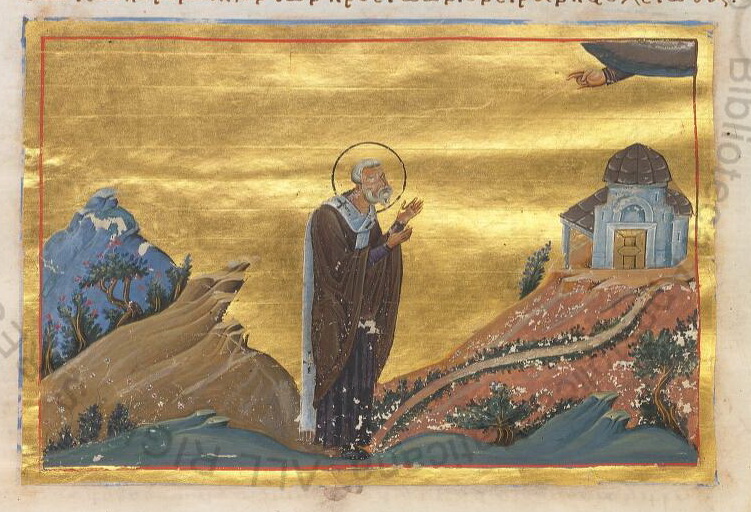
Parthenius is depicted in the settled type of a holy bishop: an aged hierarch, grey-bearded, vested in the phelonion (or the cross-figured polystavrion) and the omophorion, holding the Gospel-book and raising his right hand in blessing. Narrative images show him at his most characteristic work — healing the sick and exorcising demons, the possessed cast down before him as he commands the unclean spirit to depart.
The stored image is the miniature for February 7 from the Menologion of Basil II (Constantinople, c. 985; Vatican, Vat. gr. 1613), depicting Saint Parthenius as a vested bishop (source, public domain, pd-old-work).