
Paul of Xeropotamou
Our Venerable Father Paul, Founder of the Monastery of Xeropotamou on the Holy Mountain
Venerable · d. 10th century, on the Holy Mountain — Athonite tradition gives c. 820
Commemorated 28 July — Repose on the Holy Mountain
Paul is honoured as the founder of two of the twenty ruling monasteries of Mount Athos — Xeropotamou, which he restored out of ruins, and the house of St George that afterwards took his own name, Agiou Pavlou — and as one of the fathers who prepared the Holy Mountain for the great organised coenobitism of the tenth century. The Athonite tradition makes him Procopius, son of the emperor Michael I Rhangabe, a man of the first rank of Byzantine learning who exchanged the purple for a beggar's rags, hid his erudition under the habit for years together, healed an emperor in Constantinople and asked in return nothing for himself but the rebuilding of his monastery. He reposed on July 28, and the relics of the True Cross that he brought to his two houses are among the Mountain's great treasures.

Procopius, son of an emperor
The received Life identifies Paul as Procopius, son of Michael I Rhangabe, who reigned at Constantinople from 811 to 813 and, on his defeat by the Bulgars at Versinikia, laid down the crown, entered monastic life under the name Athanasius, and lived out his days in a monastery. The boy, the Life says, was given the finest education the capital could provide and became one of the most learned men of his generation, celebrated for theological compositions and for the mastery of rhetoric and philosophy. His family's fall did not diminish his standing: the tradition places him for a time at court, honoured for his learning even by the emperors who had displaced his father.
To the Holy Mountain
Learning and rank he put off together. Exchanging his fine clothing for the rags of a beggar, Procopius left the city and made his way to Athos, then a mountain of scattered hermits and small kellia without any great coenobium. He settled by the dry torrent-bed — the xeros potamos that gave the place its name — among the ruins of a monastery which the tradition attributes to the empress Pulcheria, and built himself a cell there. He was tonsured by an elder named Cosmas and took the name Paul.
For a long while he concealed both his birth and his education, living as an unlettered ascetic among ascetics; and it is characteristic of the Athonite hagiographical taste that this concealment is treated as the greatest of his labours. His holiness could not be hidden as easily as his learning, and his name became known through the whole Mountain.
The healing of the emperor and the rebuilding of Xeropotamou
When the emperor Romanus — whom the Life calls Paul's kinsman — came to the throne and fell sick, he sent for the monk of Athos. Paul came to Constantinople in his torn habit, was received by an emperor and a court that had expected something else entirely, and by his prayer restored the sick man to health. Offered whatever he might ask, he asked for nothing for himself, but for his monastery: and the emperor's endowment allowed the ruins by the dry torrent to be raised again as a proper coenobium, dedicated to the Forty Martyrs of Sebaste. Disciples came in numbers, and Paul governed them.
The second foundation, and the wood of the Cross
The office of superior did not hold him. Leaving Xeropotamou to another, he withdrew higher into the wilderness of the Mountain's south-western flank, and there, as disciples again gathered, he founded a second monastery dedicated to St George, and was its first abbot. That house is the one which came in time to be called after him — the monastery of Agiou Pavlou, St Paul's. To both foundations he brought portions of the wood of the True Cross, given him, the tradition says, out of the imperial treasury; the great relic of Xeropotamou, one of the largest surviving fragments of the Cross anywhere, is still shown as his gift.
Repose
Foreseeing his end, Paul called the brotherhood together, gave them his last instructions, received the Holy Mysteries and reposed on July 28. He had asked to be buried at a place the Life calls Pongosa; but the ship carrying his body was turned by wind and providence to Constantinople, where the emperor and the patriarch received the relics and laid them in the Great Church of Hagia Sophia. After the Latin sack of the city in 1204 they were carried west, and are said to rest at Venice. His memory on the Holy Mountain, however, never depended on the presence of his body.
Feast and commemoration
July 28 (church date; Old Calendar civil August 10), the day of his repose. His feast is kept with solemnity at Xeropotamou and at Agiou Pavlou on the Holy Mountain, and by the Greek calendars generally; the Slavonic and OCA books carry him as a notice of the day. The day falls in the open season between the Apostles' Fast and the Dormition Fast, four days before the Procession of the Cross on August 1 — a proximity the Athonite houses observe, since the relics of the Cross he gave them are brought out for veneration in that season.
Hymns
Troparion — Tone 8 (common of a venerable father)
In thee, O Father, was the divine image preserved with exactness: for taking up the cross, thou didst follow Christ, and by thy deeds thou didst teach us to despise the flesh, for it passeth away, but to care for the soul, which is a thing immortal. Wherefore, O venerable Paul, thy spirit rejoiceth with the angels.
Original translation from the Greek
Iconography
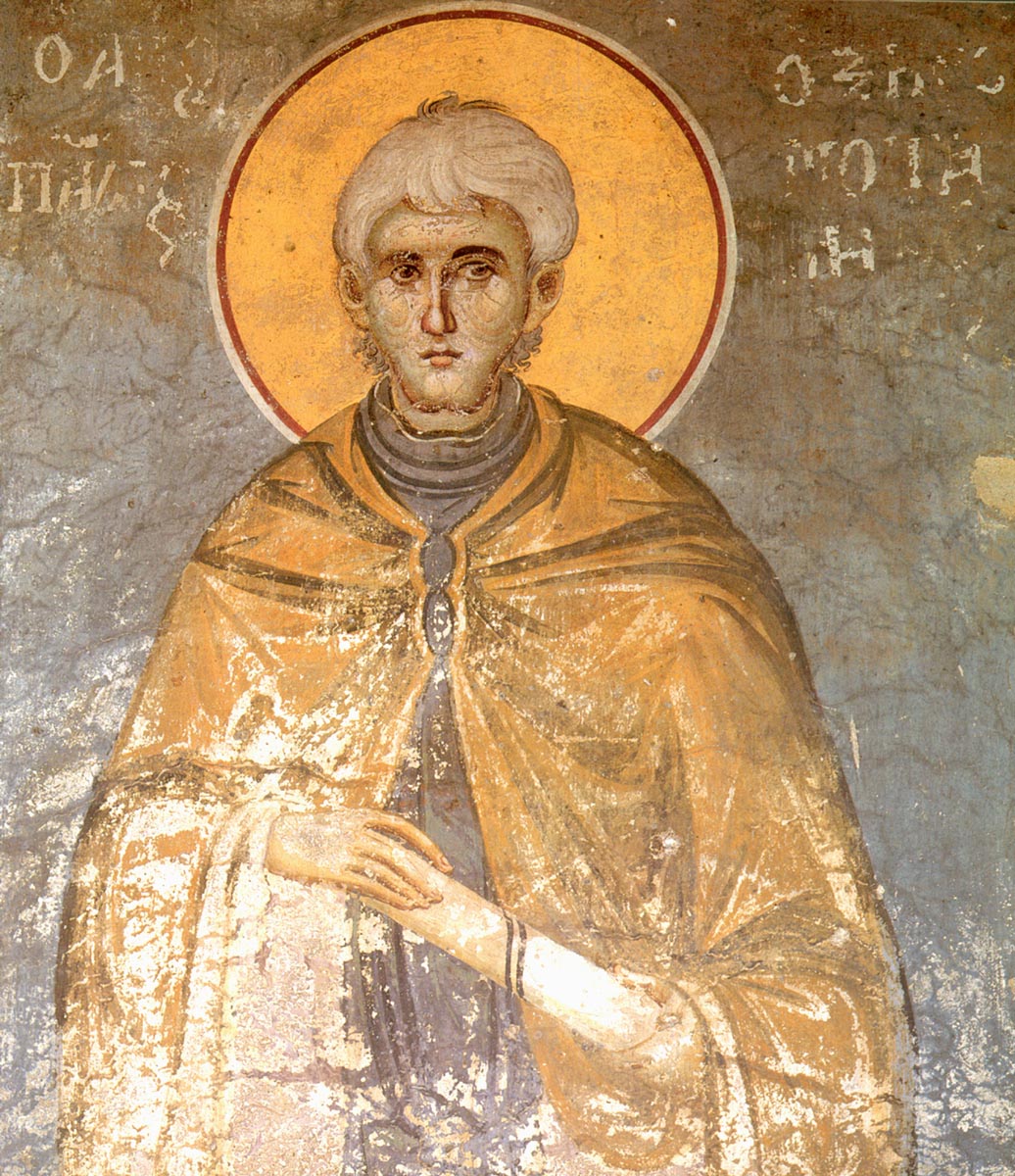
Paul is shown as a monk of middle years — an unusually youthful face for a founder, with fair curling hair and a short, sparse beard — in the analavos and the great monastic mantle, his hands crossed or holding a scroll. Where the composition allows, he holds a model of his monastery in the manner of founders, or a cross-reliquary, in reference to the wood of the True Cross he gave to his houses; on the Mountain he is frequently paired with Athanasius the Athonite in the ranks of the Athonite fathers.
The image stored here is the fresco of the Protaton church at Karyes, the administrative centre of the Holy Mountain, painted about 1300 and belonging to the cycle traditionally attributed to Manuel Panselinos — the finest surviving monument of the Macedonian school and the closest thing the Mountain has to an official portrait gallery of its own saints. The inscription flanking the halo reads Ὁ ἅγιος Παῦλος on the left and ὁ Ξηροποταμη(νός) on the right, which fixes the identification beyond doubt. It is an out-of-copyright wall-painting of about 1300, reproduced photographically and hosted on Wikimedia Commons under a public-domain tag.
Disputed questions
- The chronology is irreconcilable as transmitted. A son of Michael I Rhangabe (deposed 813) cannot also have been healed by an emperor Romanus — the first of that name reigned 920–944, the second 959–963 — and cannot have founded a coenobium in a period when Athonite coenobitic life, on all other evidence, begins with Athanasius the Athonite and the Great Lavra in 963. Some Athonite sources give Paul's repose as early as 820, which is impossible on the face of it; others place him squarely in the tenth century, contemporary with or a little before Athanasius, which fits the documentary record — Xeropotamou's name appears in tenth-century Athonite acts. The likeliest reconstruction is that a genuine tenth-century founder named Paul has been given an imperial pedigree from three generations earlier, either by conflation with another Procopius or by the ordinary hagiographical impulse to ennoble a founder. This entry dates him to the tenth century and records the traditional filiation as tradition.
- Which monastery is "his"? Xeropotamou keeps him as restorer; Agiou Pavlou keeps him as founder and bears his name. Both claims are ancient and neither excludes the other.
- Not to be confused with Paul the Simple, Paul of Thebes, Paul of Latros, or Paul the Confessor of Constantinople; nor with the later Athonite Paul of Xeropotamou commemorated in local lists — the epithet, and the two foundations, are what identify him.