
Athanasius of Athos
Our Venerable and God-bearing Father Athanasius the Athonite, Founder of the Great Lavra and of Cenobitic Life on the Holy Mountain
Venerable · b. c. 920, Trebizond — d. c. 1000 (the Lives give no year; 1001 and 1003 are also proposed)
Commemorated 5 July — Repose in the fall of the vault of the Lavra church, with six of his disciples
Athanasius the Athonite (c. 920 – c. 1000) is the father of organised monastic life on Mount Athos. Born Abraham at Trebizond and educated at Constantinople, where he was a celebrated teacher, he was tonsured at Kyminas in Bithynia under Michael Maleinos and fled thence to the Holy Mountain to hide among its hermits. Sought out by his friend the general Nicephorus Phocas — soon emperor — he founded in 963, with imperial money, the Great Lavra at Melana on the Mountain's south-eastern tip: the first true monastery of Athos, given a written Typikon on the Studite pattern and defended, against the bitter opposition of the older solitaries, by the imperial charter of 972 known as the Tragos. He died beneath the fallen vault of his own church with six of his disciples, and the Lavra he built remains first in rank among the twenty monasteries of the Holy Mountain.

Origins and early life
The saint was born about the year 920 at Trebizond on the Black Sea coast, and given in baptism the name Abraham (Ἀβράμιος). His father, the Lives report, came from Antioch and died before the child was born; his mother died soon after bearing him, and the orphan was taken up by a pious nun, a friend of the family, who nursed and reared him. The detail is not decorative: the boy learned the monastic day — the fasting, the vigils, the psalmody — from his foster-mother before he learned anything else, and the Lives say that in his childhood games he played not at soldiers but at being an abbot, appointing his schoolfellows their obediences.
A visiting official of the imperial fleet took the promising boy to Constantinople, where he studied under a famous grammarian and rapidly outstripped him. Made a teacher himself while still young, he acquired a reputation in the capital for learning and for integrity, and taught for some years with such success that his own master withdrew from the city rather than compete with him. His ascetic manner of life in the world — barley bread and water, little sleep, no wine — drew as much notice as his lectures.
In the capital he came into the circle of the Maleinos and Phocas families. He was known to the general Nicephorus Phocas and to his brother Leo, and this friendship, formed in the schoolroom and the drawing-room of Constantinople, was to make the Holy Mountain what it is. But the city wearied him. Having met the great ascetic Michael Maleinos, abbot of the monastery of Kyminas in Bithynia and uncle of Nicephorus, he laid down his teaching chair and followed him.
Kyminas and the flight to Athos
At Kyminas he was tonsured and given the name Athanasius — the name, the Lives note, of the teacher whom he had honoured. He passed there some four years in extreme austerity, standing at prayer through the night, eating every second or third day, and was thought by his elder the most gifted of his disciples. Michael Maleinos began to speak of him as his successor. Athanasius, who wanted nothing less, and who had already been embarrassed by a visit from Nicephorus and Leo Phocas, fled.
He came about 958 to Mount Athos, that long wooded promontory which since the days of Peter the Athonite, its first hermit, had been the refuge of solitaries living in caves and huts under a loose common oversight at Karyes. Athanasius concealed himself: he gave a false name, pretended to be an unlettered rustic, and put himself under the obedience of an old and severe hermit, from whom he received the roughest treatment and to whom he never disclosed who he was. The disguise did not hold. The Protos of the Mountain, discovering his hand in a piece of writing, unmasked him, and Athanasius withdrew to the wildest end of the peninsula, to a place called Melana under the great peak, and settled there in a cell.
Nicephorus Phocas and the founding of the Lavra
Nicephorus Phocas, meanwhile, had not forgotten him. Before sailing on the great expedition that recovered Crete from the Arabs (960–961) he sent for Athanasius, and the saint came unwillingly to the fleet; the general asked his prayers, and vowed that when his campaigns were done he would lay down the world and become a monk under him. After the victory Nicephorus put into Athanasius's hands a great sum of money and charged him to build on Athos a monastery where he himself might end his days.
With this money the work at Melana began, and in the year 963 the Great Lavra was founded — the first organised monastery of the Holy Mountain, and the mother of all that followed. Athanasius raised the great church (the katholikon, whose dedication the Greek tradition gives as the Annunciation of the Theotokos, while the Slavonic Life speaks rather of a church of the Forerunner), the refectory, the cells, the hospital, the guest-house, the aqueduct, the harbour and the mill; he brought in oxen and ploughs and craftsmen, and cleared and planted the land. He worked with his own hands at the building, carrying stone with the labourers.
In the same year, however, Nicephorus was proclaimed emperor at Caesarea. Athanasius, who had built a monastery for a monk and not for a sovereign, took the news bitterly and left the Mountain for Cyprus, refusing the summons of the new emperor. There, the Lives say, he was turned back by a revelation, and returned to Athos and to his work; Nicephorus confirmed his grants and left the Lavra in peace until his murder in 969.
The Tragos and the opposition of the hermits
The building of the Lavra was not welcomed by the men already on the Mountain. The old anchorites of Athos had lived by hesychia and by their own hands; they saw ships, oxen, walls, hired workmen, a written rule and a great community, and they judged that Athanasius had brought the world onto the Holy Mountain and destroyed the desert. They complained first to Nicephorus and then, after his death, to his successor John Tzimiskes, alleging that the Lavra's growth and its farming and trading were an innovation contrary to the Mountain's whole vocation.
Tzimiskes — who, far from suppressing the Lavra, doubled its imperial pension — sent the Studite monk Euthymius to hear both parties. The result, issued in 972, was the document known from the goatskin on which it is written as the Tragos (τράγος, "the goat"): the first Typikon of the Holy Mountain, signed by the Protos and by the abbots and elders, still preserved at Karyes. It confirmed the Lavra and the cenobitic life, while protecting the rights and the silence of the solitaries and regulating what the monasteries might and might not do — no large livestock, no ships beyond a certain size, no women or beardless youths on the Mountain. Athos has been governed on this constitutional pattern ever since, and the quarrel that produced it is remembered as the first great debate between the eremitic and the cenobitic ways on the Mountain, settled not by the suppression of either but by the recognition of both.
The Typikon and the cenobitic life
For his own community Athanasius wrote a Rule (the Hypotyposis, with the Diatyposis that serves as his testament), founded on the tradition of Basil the Great and above all on the discipline of Theodore the Studite, and shaped also by what he knew of the old Palestinian lavras. It ordered a life fully cenobitic: everything in common and nothing owned; the whole cycle of services sung in the church; obedience to the abbot in all things; the refectory shared, the work shared, the abbot elected by the brotherhood and not appointed from outside. Around the coenobium he allowed the older Athonite way to continue — hesychasts in cells and huts within the Lavra's bounds, keeping silence and coming in for the feasts — and this combination of a great cenobitic house with dependent hermitages is precisely the shape Athonite monasticism has kept for a thousand years.
The community grew from eighty to a hundred and twenty monks in his own lifetime, and other founders came to him. John the Iberian and his son Euthymius, with the Georgian general Tornikios, were his disciples before they founded Iviron; Georgians, Armenians, Italians and Slavs came to the Lavra, so that the Mountain was international from its beginning. Athanasius himself served the sick with his own hands, and the Lives dwell on his tenderness to the weak and his refusal to impose on others the austerity he practised himself.
Miracles and traditions
The best-loved of the traditions of the Lavra belongs to the years of building. A famine emptied the storehouses; the brethren left one by one; and Athanasius at last set out on the road to Karyes to seek help, having decided to abandon the half-built monastery. On the way a woman in a blue veil met him — an impossibility on the Holy Mountain, where no woman comes — and asked him where he was going. When he had told her, she bade him turn back, saying that she would provide, and that she herself would be the steward of his house. Athanasius asked who she was; she told him to strike the rock beside the path with his staff. He struck, the rock split, and a spring of water broke out which still flows. Returning, he found every storeroom full of grain, wine and oil. From that day the Great Lavra has appointed no oikonomos, no steward: the Mother of God is the Stewardess (Ἡ Οἰκονόμισσα, the Economissa), and the monk who does the work is only her assistant. The icon of the Economissa — the Theotokos enthroned with the Child, with Athanasius at her feet offering the model of the Lavra and Michael of Synnada beside her — is venerated in the Lavra to this day, and the saint's spring is drunk by pilgrims on their way to his tomb.
The Lives record besides the gift of tears, the discernment of thoughts, healings of the sick of the brotherhood, and the stilling of a demonic assault that drove him for a time from his cell.
Repose
Athanasius foretold his end. In extreme old age, about the year 1000, he went up with six of his disciples — and, in some accounts, with Daniel the master-builder — onto the scaffolding of the new dome of the Lavra church to inspect the work. The vault collapsed under them. Five of the monks were killed at once; Athanasius lay some hours beneath the stones, and those who dug for him heard him calling on the Lord until his voice ceased. He was brought out dead, his body — the Lives say — whole and unbroken, and was buried in the Lavra, where his tomb is in the chapel of the Forty Martyrs of Sebaste beside the katholikon. His relics have never been taken up, and his iron staff and pectoral cross are kept at the monastery.
The six disciples who died with him are commemorated with him in the Greek synaxaria — "Athanasius of Athos and the six disciples with him" — though the sources do not transmit their names uniformly, and no independent cultus of them is attested.
Veneration and later cultus
Two Greek Lives of Athanasius survive, written within a generation or two of his death (the older by Athanasius of Panagiou); they are among the best-informed pieces of middle Byzantine hagiography, and much of what is known of tenth-century Athos comes from them. His veneration spread wherever the Athonite pattern went: to Georgia through Iviron, to the Slavic lands through the Athonite dependencies, to Russia through Nikon of Radonezh's generation of cenobitic founders, who looked back past their own tradition to the Studite and Athonite rules that Athanasius had married. The Great Lavra stands first in the hierarchy of the twenty ruling monasteries of the Holy Mountain, and keeps his memory as its patronal feast.
Feast and commemoration
July 5 (church date; Old Calendar civil July 18). The day is kept universally, and on the Holy Mountain it is the greatest of the Lavra's feasts, celebrated with an all-night vigil at the saint's tomb. The Russian calendar keeps the same day, on which it also commemorates the uncovering of the relics of Sergius of Radonezh (1422); the Greek synaxaria name Athanasius first and add "and the six disciples with him." The Economissa icon of the Mother of God, which belongs to his story, is commemorated on the same day in Russian usage.
Hymns
Apolytikion — Tone 3
The ranks of the angels were amazed at thy life in the flesh: how, clothed in a body, thou didst go out to the invisible warfare, O ever-memorable one, and didst wound the phalanxes of the demons. Wherefore Christ hath rewarded thee, O Athanasius, with abundant gifts. Therefore, O Father, intercede that our souls may be saved.
Kontakion — Tone 8
Thee that wast a beholder of the immaterial powers and a true teacher of the things that must be done, the company of monastics honoureth as its guide; for having received the gift of wonders, thou pourest forth healings upon them that run to thee. Wherefore we cry unto thee: Rejoice, O Father Athanasius.
Original translation from the Greek
Iconography
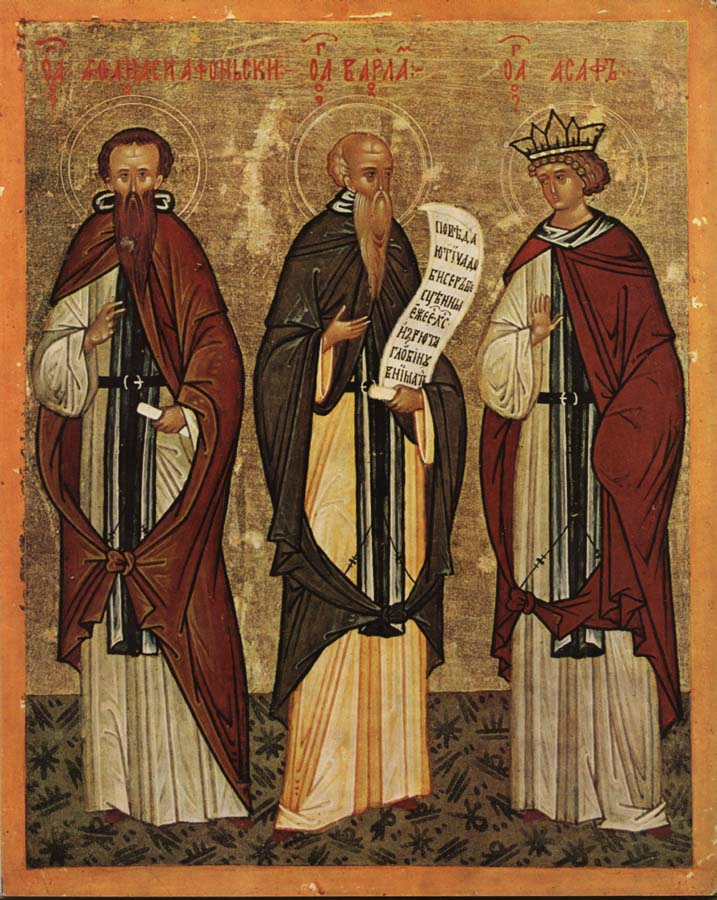
Athanasius is painted as an old man of middle height with a long, broad, forked or rounded beard, in the monastic schema — the tunic, the great mantle, the analavos with its crosses — and most often bare-headed. His usual attributes are the scroll of his Rule and, in the developed Athonite type, the model of the Great Lavra held in his hand, by which he is recognised at once; in the Economissa icon he kneels or stands at the throne of the Theotokos offering her that model, since she is the monastery's true stewardess. The scene of his death — the falling vault, the brethren beneath the stones — appears in Athonite wall-painting and in the illustrated Lives. He is regularly grouped with the other founding fathers of the Mountain, and, in Russian panels, with Peter the Athonite.
The stored image is a fifteenth-century Novgorod panel from the cathedral of Holy Wisdom (Novgorod Museum), inscribed at the left О[СВЯТЫЙ] АѲАНАСИ АФОНЬСКИ — "Saint Athanasius of Athos": he stands in the brown mantle over the monastic habit, dark-bearded and holding a small scroll, beside Barlaam and Joasaph, with whom Russian iconography frequently pairs him as an exemplar of the monastic life.
Disputed questions
- The year of his death. Neither Life gives a year. The internal evidence points to the turn of the millennium; c. 1000 is the usual reckoning, with 1001 and 1003 both defended, and the Russian calendar prints simply "†1000". Nothing in the tradition depends on the choice.
- The dedication of the great church. The Greek tradition of the Lavra gives the Annunciation; the Slavonic Life as printed by the Russian synaxaria speaks of a great church built in honour of the Forerunner. Both a katholikon of the Annunciation and a church of the Forerunner belong to the Lavra's later complex, and the disagreement is probably a confusion of the two rather than a genuine variant.
- Not to be confused with Athanasius the Great of Alexandria (January 18, May 2), nor with Athanasius the Wonderworker (June 3), whose bare epithet occasionally causes the two to be exchanged in catalogues, nor with Athanasius I of Constantinople (October 28), nor with Athanasius Parios (June 24), a much later Athonite.