
Perpetua and Felicity and Companions
The Holy Martyrs Perpetua and Felicity and their Companions
Martyr · b. 2nd century, at Carthage — d. c. 203, at Carthage
Commemorated 1 February — Martyrdom in the amphitheatre at Carthage under Septimius Severus
Perpetua and Felicity, with their companions Saturus, Revocatus, Saturninus, and Secundulus, were martyred in the amphitheatre at Carthage about the year 203, in the persecution of the emperor Septimius Severus. Vibia Perpetua was a young noblewoman of about twenty-two, a nursing mother; Felicity was a slave, heavily pregnant; the others were young catechumens arrested with them and baptised in prison. Their memory is uniquely precious because part of their story is told in Perpetua's own hand: the Passion of Perpetua and Felicity preserves her prison diary, with the visions that sustained her, and an eyewitness account of their death. Secundulus died in prison; Felicity gave birth to a daughter days before the games; and the rest were exposed to the beasts and then dispatched by the sword. They are among the most celebrated martyrs of the ancient Church, kept in the East on February 1.

The arrest and the company
The martyrs were seized at Carthage, the great city of Roman Africa, during the persecution that followed an edict of Septimius Severus (r. 193–211) against conversions to Christianity, about the year 203. They were catechumens — under instruction in the faith but not yet baptised — and were baptised while under arrest or in prison, in the very shadow of martyrdom.
The company, as the Passion names them, was:
- Vibia Perpetua, a well-born and educated young married woman of about twenty-two, with an infant son still at the breast;
- Felicity (Felicitas), a slave, and heavily pregnant — eight months gone at the time of the arrest;
- Revocatus, a slave and, the text implies, a fellow-servant of Felicity;
- Saturninus and Secundulus, two other young men;
- and Saturus, who had been the catechists' teacher and who was not taken with the rest but came forward of his own accord to share their imprisonment and their crown.
Perpetua's father, a pagan who loved her tenderly, came again and again to the prison to beg her to renounce Christ and spare herself, her child, and his old age; the diary's account of these scenes — her refusal, gentle but immovable, and his grief and fury — is among the most moving passages in all the literature of the martyrs.
The visions of Perpetua and Saturus
The Passion preserves, as Perpetua's own composition, the visions granted to her in prison. In the first she saw a golden ladder reaching to heaven, set about with swords and hooks and guarded at its foot by a dragon; she trod upon the dragon's head and climbed, and came into a great garden where a shepherd in white gave her curds to eat — a sign, she understood, that martyrdom was appointed and heaven opened. In another vision she saw her little brother Dinocrates, dead in childhood of a disfiguring illness, first in torment and thirst and then, after her prayers, healed, refreshed, and at play — a vision the tradition has long pondered for its bearing on prayer for the departed. In the last, on the eve of the games, she saw herself led into the arena, stripped for combat, and made a man, wrestling against a monstrous Egyptian whom she trod down and overcame, understanding that her true adversary was the devil and her victory already assured. Saturus too left the record of a vision, of the martyrs borne up by angels into a garden of light and received by the elders.
Felicity's child, and the martyrdom
Felicity's great fear was that her pregnancy would part her from her companions, for the law forbade the execution of a pregnant woman, and she dreaded being kept back to die later among common criminals. Two days before the games she was delivered — the Passion tells how she cried out in the pains of childbirth, and when a jailer mocked that if this made her cry, she would never endure the beasts, she answered that now she suffered of herself, but then Another would suffer in her, for whom she would be suffering. Her newborn daughter was taken and raised by a Christian woman of Carthage.
Secundulus died in the prison before the day of the games, and so, the text says, was spared the beasts though not the martyr's end. The rest were led out into the amphitheatre on the day appointed — the games held, the tradition holds, for the birthday of the Caesar Geta. The men were set upon by a leopard, a bear, and a wild boar; Perpetua and Felicity were exposed to a maddened heifer, which tossed them but did not kill them, and the two women were seen to rise and compose their torn garments and their hair with a modesty that struck the onlookers. At the last, the survivors were brought to the sword. Saturus died first; and Perpetua, when the young and trembling gladiator failed at the first stroke, is said to have guided his hand herself to her own throat — a woman, the ancient account marvels, who could not have been slain unless she willed it. Thus they were crowned together at Carthage, about the year 203.
The Passion of Perpetua and Felicity
The martyrs' fame rests in great part on the Passio Sanctarum Perpetuae et Felicitatis, one of the earliest and most remarkable of all Christian documents by or about women. Its core is presented as the prison diary of Perpetua herself, written in the first person — an extraordinary survival, the direct voice of an early-third-century Christian woman — together with the vision of Saturus in his own words, framed by an eyewitness narrative of the martyrdom and a preface and conclusion by an editor (whom an old tradition, not certainly, associated with Tertullian or his circle at Carthage). The text was read publicly in the African churches on the martyrs' anniversary, so much so that Augustine had to remind his hearers that the Passion was not to be ranked with Scripture. It remains a primary witness to the faith, the courage, and the inner life of the martyrs of the ancient Church.
Feast and commemoration
In the Byzantine East, Perpetua and Felicity and their companions are commemorated on February 1 (church date; Old Calendar civil February 14), among the saints of the day led by the Martyr Tryphon of Campsada and the forefeast of the Meeting of the Lord; the Greek synaxarion and the OCA calendar keep them on this day (the Greek books transmit the companions' names in variant forms — Satyrus/Saturus, Revocatus, Saturninus, Secundulus). In the West they are kept on March 7, the day of their martyrdom, and Perpetua and Felicity are named in the Roman Canon of the Mass among the women martyrs.
- Not to be confused with Felicitas of Rome (†c. 164, kept January 25), the Roman widow and mother of seven martyred sons: the two Felicities are distinct saints of different cities and generations, often confused because both are early martyrs named Felicitas. The Felicity of this entry is the slave-girl of Carthage, companion of Perpetua.
Hymns
Troparion — Tone 4
Thy martyrs, O Lord, in their contest received incorruptible crowns from Thee our God; for possessed of Thy might, they cast down the tyrants and shattered the feeble insolence of demons. By their supplications, O Christ God, save our souls.
Original translation from the Greek
Iconography
The martyrs are depicted as a company of youthful figures bearing the martyr's cross — Perpetua and Felicity as young women veiled in the maphorion, the men as beardless or lightly bearded youths. In Western art their emblem is the beasts of the amphitheatre, above all the wild cow or heifer set upon the two women; Perpetua is sometimes shown as a matron with her infant, or crowned between the beasts.
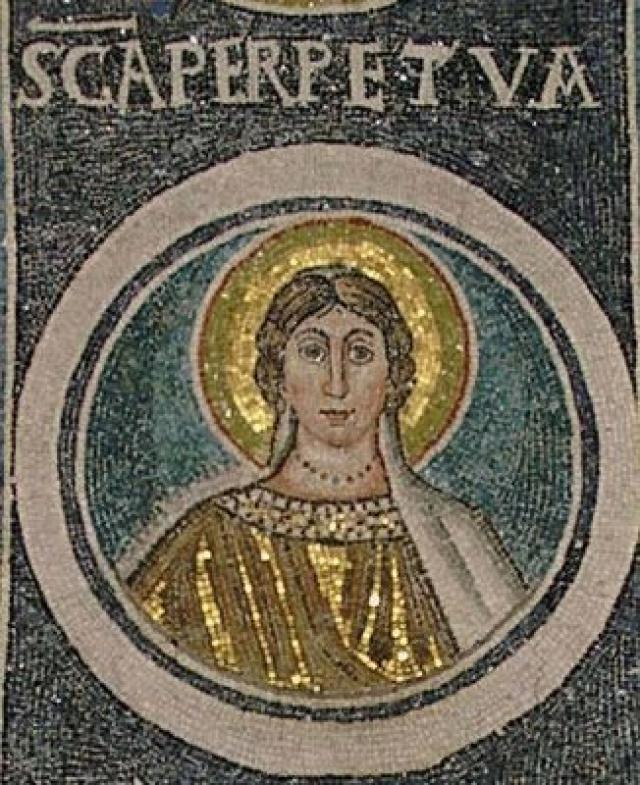
The stored image is the ancient mosaic of Saint Perpetua in the apse of the Euphrasian Basilica at Poreč (Parenzo) in Istria — the great sixth-century church whose mosaic programme, restored in the medieval centuries, ranges the holy women martyrs in procession; Perpetua stands robed and crowned, named in the mosaic, bearing her martyr's crown (source, public domain, pd-old-work). A Byzantine menologion portrait of the whole company is wanting.