
Peter of Alexandria
The Holy Hieromartyr Peter, Archbishop of Alexandria, the Seal of the Martyrs
Hieromartyr · Bishop · b. 3rd century, Alexandria — d. 311
Commemorated 25 November — Martyrdom at Alexandria under Maximinus Daia
Peter was archbishop of Alexandria from about 300 until his martyrdom in 311, the last of the great bishop-martyrs of the Egyptian church under the Roman persecutions — the tradition names him "the seal and the completion of the martyrs." Trained in and then head of the famous catechetical school of Alexandria, he governed his church through the fiercest years of the Great Persecution, largely from hiding, and left in his Canonical Epistle the Church's classic measure for restoring those who had lapsed under torture. He was the first to condemn and excommunicate the deacon Arius, before the Arian controversy had fully broken; the tradition tells of his vision of Christ as a boy in a torn robe, warning him not to receive the heretic back. Beheaded at Alexandria on November 25, 311, at the very spot of Saint Mark's martyrdom, he is venerated as a champion of Orthodoxy and a theologian whose writings were still cited at the Ecumenical Councils.
.jpg)
Origins, the school, and the episcopate
Peter was born and raised at Alexandria, the intellectual capital of the Christian East, and rose through its church to become head of its renowned catechetical school — the school of Pantaenus, Clement, and Origen. About the year 300 he was chosen archbishop of Alexandria, succeeding his teacher and spiritual father, the bishop Theonas, and so entering upon the throne of Saint Mark on the eve of the last and most terrible of the imperial persecutions.
Shepherd in the Great Persecution
From 303 the persecution launched under Diocletian and Maximian, and continued in the East by Galerius and Maximinus Daia, fell with peculiar severity on Egypt, whose Christians perished in great numbers. Peter withdrew from the city for its sake and his own, moving through many lands and governing his scattered flock by letter; when he could, he returned in secret to Alexandria, visiting the confessors in prison, strengthening the wavering, caring for widows and orphans, and keeping the services of the Church alive in hiding. The persecution also raised within the Church the hard question of the lapsi — those who had denied Christ, or contrived to seem to, under torture and threat, and now sought readmission. To this Peter addressed his Canonical Epistle (the Penitential Canons) of 306, a graduated and merciful discipline, fixing terms of penance according to the gravity of each fall: it became one of the foundation-texts of the Church's penitential law, received into the canonical collections of the whole Orthodox East.
His moderation on this point provoked the first great schism of the Egyptian church. Melitius, bishop of Lycopolis, taking a rigorist line and exploiting Peter's absence, usurped ordinations and set up a rival hierarchy — the Melitian schism, which long outlived them both and would trouble the Council of Nicaea. Peter, from prison, is said to have hung a curtain in the midst and separated himself from Melitius, refusing communion with the schism.
Arius and the vision of the boy-Christ
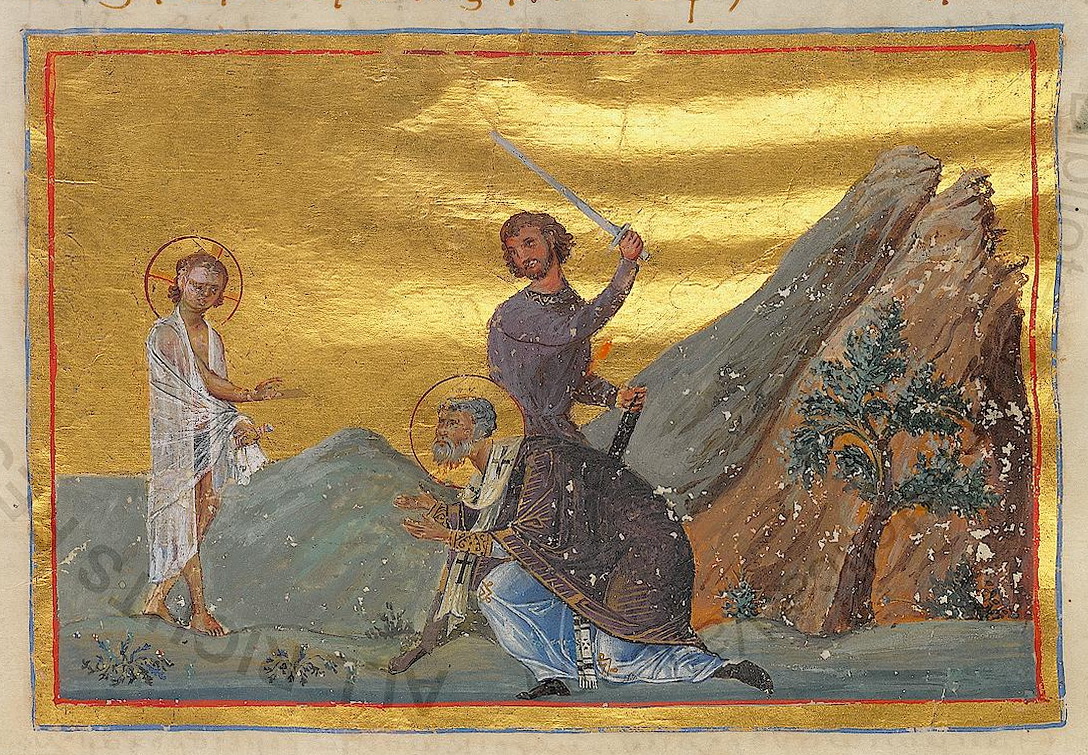
Peter's name is joined for all time to the beginnings of the Arian struggle. Arius, a deacon (soon presbyter) of Alexandria — by some accounts implicated in the Melitian party — began to teach that the Son of God was a creature, made and not eternal, denying His full divinity. Peter saw the danger before the heresy had a name, condemned Arius, and cut him off from the communion of the Church. When Arius, feigning repentance, sent two of Peter's presbyters to beg the sentence lifted, Peter refused, and to his presbyters Achillas and Alexander — who would succeed him in the see — he gave a solemn charge never to receive Arius back, having discerned his impenitence. The tradition attaches to this a celebrated vision: the Lord Jesus Christ appeared to Peter in the night as a boy of about twelve years, clothed in a robe torn from top to bottom; and when the bishop asked who had rent His garment, the Child answered, "Arius has torn it, for he has divided the people whom I purchased with My blood; receive him not into communion." The scene — the young Christ in the sundered robe beside the martyred bishop — became the saint's distinctive image.
Martyrdom
At the persecution's end, by order of Maximinus Daia, Peter was seized and condemned to death. So great was the people's devotion that a multitude gathered about the prison, ready to prevent the execution by force; to spare them bloodshed, the saint himself arranged that the soldiers should break through the back wall of the prison and lead him out secretly by night. They brought him beyond the walls and beheaded him — the tradition marks the very place where, long before, the Evangelist Mark had suffered. That night, it is told, a holy virgin heard a voice from heaven: "Peter the first of the Apostles; Peter the last of the martyrs of Alexandria." The date was November 25, 311. In the morning the faithful bore his body and head to the church, vested him, and set him upon the episcopal throne — the throne on which, in life, he had never dared to sit, seeing upon it a divine light and sensing a power not his own, so that he took his place instead upon its footstool. From that reverence the tradition drew the sense of his title: the last of Alexandria's martyr-bishops, the seal set upon the age of the martyrs.
Writings and theological legacy
Peter was reckoned among the notable theologians of the pre-Nicene church. His treatise On the Godhead (of Christ) was of such authority that passages from it were read and cited in the councils of Ephesus (431) and Chalcedon (451) as a witness of the ancient faith against the later heresies. He wrote also against the Origenist doctrine of the pre-existence of souls, on the soul, and on the reckoning of Pascha; but his most widely received work remained the Penitential Canons, which passed into the permanent canonical tradition of the Church.
Feast and commemoration
November 25 (church date; Old Calendar civil December 8), a universal commemoration of the Byzantine rite, kept together with the Hieromartyr Clement of Rome and joined to the leavetaking (apodosis) of the Entry of the Most Holy Theotokos into the Temple, whose full service is sung again on this day; the office of the two hierarchs is celebrated within that festal frame. The day falls within the Nativity Fast. The synaxaria head the notice with Clement and Peter together as the "two great hierarchs and martyrs" of the day.
Hymns
Kontakion — Tone 4
O unshakeable and God-minded towers of the Church, and truly firm pillars of the true worship, all-praised Clement and Peter: by your intercessions preserve us all.
Original translation from the Greek
Troparion — Tone 4
O God of our Fathers, who ever deal with us according to Your forbearance: take not Your mercy from us, but by the supplications of the holy hierarchs Clement and Peter, govern our life in peace.
Original translation from the Greek
Iconography
Peter is depicted as a bishop in vestments and omophorion, of middle age with a short dark beard; his proper and unmistakable image joins his martyrdom to his vision — the young Christ standing in a robe rent from top to bottom, addressing the kneeling or standing hierarch. The stored image is the miniature for November 25 from the Menologion of Basil II (Constantinople, c. 985; Vatican Library, Vat. gr. 1613): the bishop kneels bare-headed beneath the executioner's raised sword against a gold ground, while at the left the boy-Christ, haloed and wrapped in a torn white garment, stretches out His hand — the vision and the beheading shown as one. (The available scan carries a faint diagonal source-watermark; a cleaner reproduction is wanted.)
Disputed questions
- Date of accession. The sources place Peter's elevation to the see about 300 (some give 300, others 301), following Theonas; the entry gives c. 300.
- "The last of the martyrs." The heavenly voice and the title "seal of the martyrs" express his standing as the last bishop of Alexandria to die in the persecutions, not a literal claim that no Egyptian Christian suffered after him; it is a theological acclamation, recorded here as the tradition gives it.
- Not to be confused with the several later bishops named Peter of Alexandria (among them Peter II, the anti-Arian successor of Athanasius in the fourth century), nor with the other saints called Peter kept elsewhere in the calendar — Peter of Atroa, Peter of Capitolias, Peter the Tax-Collector, and the Apostle Peter, his own namesake and the "first of the Apostles" of the heavenly voice. Distinct too is the later Alexandrian hieromartyr patriarch Proterius (†457, kept February 28), slain in his baptistery for the faith of Chalcedon — a different man of a different age.