
Proterius of Alexandria
The Holy Hieromartyr Proterius, Patriarch of Alexandria
Hieromartyr · Patriarch · Bishop · d. 457, at Alexandria
Commemorated 28 February — Martyrdom at Alexandria, slain by a mob in the baptistery
Proterius (†457) was Patriarch of Alexandria from 451 to his death, and a hieromartyr of the Church. A presbyter of Alexandria under the Monophysite patriarch Dioscorus, he was raised to the see when Dioscorus was deposed by the Fourth Ecumenical Council at Chalcedon (451) for his defence of the heresiarch Eutyches; and as patriarch he upheld the Chalcedonian confession of the one Christ in two natures against the fierce opposition of the Alexandrian populace, who remained loyal to the deposed Dioscorus and to the party that would become the Coptic Church. After years of tumult, on the death of the emperor Marcian the Monophysites set up the priest Timothy Aelurus as a rival patriarch, and a mob fell upon Proterius; he was murdered in the baptistery of his church, about the feast of Pascha in the year 457, his body dragged through the streets and burned. The Church of Constantinople and Rome venerate him as a martyr for the faith of Chalcedon; the non-Chalcedonian Church of Egypt does not.
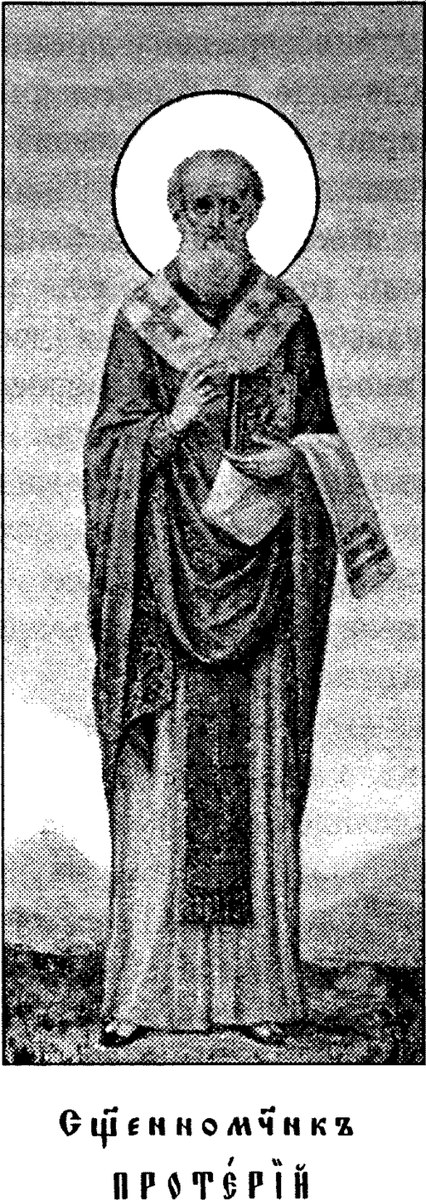
_-_%D0%B8%D0%BA%D0%BE%D0%BD%D0%B0_06281_%D0%9F%D1%80%D0%BE%D1%82%D0%B5%D1%80%D0%B8%D0%B9.png)
Presbyter of Alexandria and the shadow of Chalcedon
Proterius rose to prominence in the clergy of Alexandria in the middle of the fifth century, in the years when the great Christological controversy reached its crisis. He was a presbyter — by some accounts the archpriest — of the Alexandrian church under the patriarch Dioscorus, the powerful successor of Cyril of Alexandria who had thrown the weight of his see behind the archimandrite Eutyches and his teaching that in Christ the human nature was swallowed up in the divine, so that there was but "one nature after the union." At the Council of Chalcedon in 451 — the Fourth Ecumenical Council — Dioscorus was deposed both for his doctrine and for his violent conduct at the "Robber Council" of Ephesus (449), and the Council proclaimed the faith of the one Christ "acknowledged in two natures, without confusion, without change, without division, without separation." Proterius, who had held to the Council's faith, was chosen to fill the vacant throne of Alexandria.
Patriarch amid tumult
His elevation, about the year 451–452, was met not with peace but with riot. The people of Alexandria, proud of their see and devoted to the memory of Cyril and to the person of the exiled Dioscorus, regarded a Chalcedonian patriarch as an imposition of Constantinople and an insult to their church; the city rose against him. Blood was shed; the imperial authorities sent soldiers to restore order, and the disorders grew so violent that on one occasion a body of troops was said to have been besieged and burned in an old temple by the enraged crowd, and the grain-supply and public order of the great city were thrown into confusion. Through these years Proterius governed under the protection of the emperor Marcian and the imperial power, upholding the Chalcedonian definition and the communion of the wider Church, but never accepted by the greater part of his own flock, who looked to the deposed party as their true shepherds.
Martyrdom
The end came with the death of the emperor Marcian early in 457. With the imperial hand that had shielded Proterius withdrawn, the anti-Chalcedonian party seized their moment: two deposed bishops consecrated the presbyter Timothy Aelurus — "the Cat," or "the Weasel" — as a rival patriarch, and the city gave itself to him. Proterius, abandoned and hunted, took refuge in the church; and there, in the very baptistery where the newborn Christians were washed, the mob broke in and murdered him, running him through — the tradition says with a sword, or with sharpened reeds — about the time of the feast of Pascha, in the year 457. Not content with his death, they dragged his body through the streets of Alexandria, mutilated and abused it, and at last burned it, scattering the ashes to the wind. So the patriarch who had kept the confession of Chalcedon died by violence for the faith, and the Church numbers him among the hieromartyrs.
The judgement of history and the divided memory
Proterius's death did not end the schism it crowned; it deepened it. Timothy Aelurus was in time exiled by the emperor Leo, but the Alexandrian church remained largely estranged from Chalcedon, and from this fracture descends the enduring division between the Chalcedonian (Eastern Orthodox) and the non-Chalcedonian (Coptic Orthodox) communions. The two traditions remember these events in opposite key: the Eastern Orthodox Church honours Proterius as a lawful patriarch and a martyr for the true faith, while the Coptic Church reveres Dioscorus and Timothy as its rightful shepherds and does not accept Proterius among its patriarchs. The entry keeps him as the Byzantine and Roman calendars do — a hieromartyr slain in defence of the Council of Chalcedon.
Feast and commemoration
Proterius is commemorated on February 28 (church date; New Calendar civil February 28; Old Calendar civil March 13), the day of his martyrdom. His feast is kept by the Eastern Orthodox Church, and he is honoured as a martyr in the West as well; the Church of Alexandria itself is divided over his memory (see the Disputed questions). The Greek and Slavic calendars agree on the day.
Hymns
Troparion — Tone 4
As one who shared in the ways of the Apostles and succeeded to their thrones, thou didst find in thy labours, O God-inspired one, an ascent to divine vision; wherefore, rightly dividing the word of truth, thou didst contend for the faith even unto blood, O Hieromartyr Proterius. Intercede with Christ our God that our souls may be saved.
Original translation from the Greek
Iconography
Proterius is depicted as a patriarch of Alexandria — an aged, grey-bearded hierarch vested in the phelonion and omophorion, holding the Gospel-book — and, as a martyr, sometimes bearing a cross or shown in the scene of his death within the baptistery. The stored image is an early twentieth-century lithograph of the saint from the illustrated Lives of the Saints of St Dimitri of Rostov (the Zhitiya Svyatykh, 1903–1911) (source, public domain, pd-old-work); a pre-modern Byzantine icon is wanted in its place.
Disputed questions
- The hands that killed him. The sources agree that Proterius was murdered by a mob in the baptistery in 457, but differ on the immediate agents — whether the anti-Chalcedonian populace acting on its own, or partly the mutinous imperial soldiery caught up in the disorders. The tradition of the Church remembers him as slain by the enemies of Chalcedon.
- Not to be confused with the earlier hieromartyr Peter of Alexandria, "the seal of the martyrs" (†311); with the great patriarchs Athanasius and Cyril of Alexandria; or with the heresiarch Dioscorus, his deposed predecessor, and Timothy Aelurus, his rival — the very men against whose party Proterius stood and died.