
Peter of Damascus
The Holy Hieromartyr Peter, Bishop of Damascus
Hieromartyr · Bishop · Martyr · d. 8th century, in Arabia (in exile)
Peter of Damascus is honoured in the Byzantine calendars on February 9 as a hieromartyr — a bishop of Damascus who, in the age of the Arab conquest, confessed Christ openly against Islam and the errors of the Manichaeans, and for his boldness had his tongue cut out by the Muslim authorities and was sent into exile in the Arabian desert, where (the tradition holds) he continued to preach and at length died a martyr's death by the sword. His name is also borne by one of the great spiritual writers of the Philokalia, "the Damascene," second in bulk only to its longest authors; and Orthodox tradition, following Nikodemos the Hagiorite, long identified the martyred bishop with the Philokalic teacher, though modern scholarship distinguishes them and dates the writer to the twelfth century (see Disputed questions). The Church keeps him on February 9, with the leavetaking of the Meeting of the Lord.
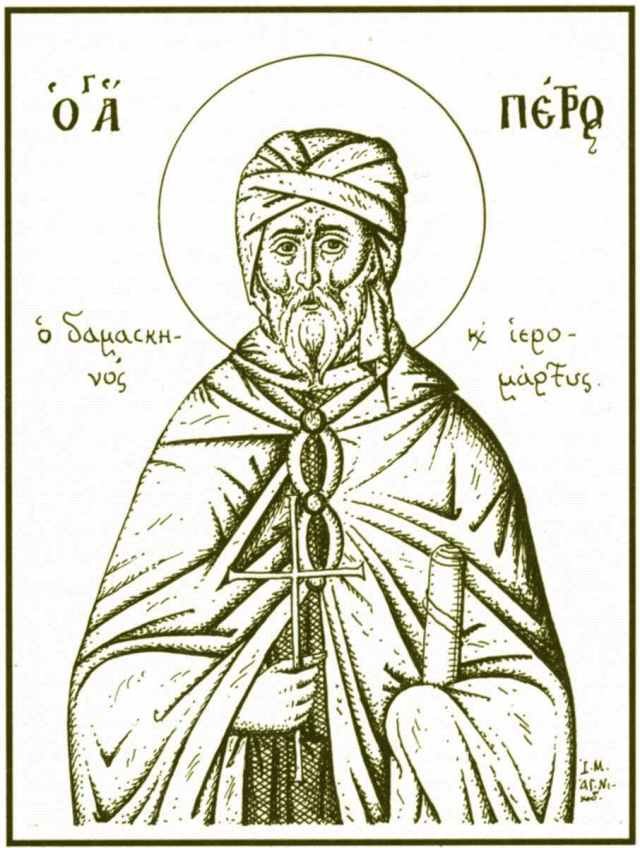

The bishop of Damascus and his confession
Peter belongs to the Christians of Syria under the early Caliphate, when Damascus, the ancient Christian city on whose road Saul was struck down (Acts 9), had become the seat of the Umayyad rulers and the Church there lived under Muslim dominion. Peter was its bishop, and he is remembered above all for the boldness of his confession: in a time when open dispute with Islam was perilous, he preached Christ crucified and risen without disguise, refuting the teaching of the new religion and, the tradition adds, the dualist errors of the Manichaeans who were also abroad in Syria. He would not be silent, and his witness reached the ears of the authorities.
Martyrdom
For his outspoken confession the Arab governor ordered Peter's tongue cut out — the punishment aimed precisely at the organ of his preaching, to silence the voice that had spoken against the ruling faith. But, as the tradition of such confessors loves to record (it is told also of the hymnographers Theodore and Theophanes the Branded and others of the age), the mutilation did not still him: Peter, the account holds, continued to speak and to preach even without his tongue, by a gift of God, confounding those who had thought to silence him. He was then sent into exile, banished to the deserts of Arabia Felix (the Yemen), where he went on proclaiming Christ to the tribes and winning converts, until at the last he was put to death — crucified or beheaded — and so completed his witness as a martyr. The Greek Menaion notes him precisely as one "perfected by the sword." His episcopate and passion are placed in the eighth century, in the generation of the Church's confessors under the early Arab rule.
Feast and commemoration
Peter is commemorated on February 9 (church date; New Calendar civil February 9, Old Calendar civil February 22), kept with the leavetaking of the Meeting of the Lord. He is styled hieromartyr in the Greek Menaion, which places his memory among the martyrs of the day; the proper service belongs to the leavetaking of the feast, and Peter receives synaxarion commemoration and the common office of a hieromartyr. Some sources also note a commemoration on October 4; February 9 is the firm Byzantine day.
Hymns
Apolytikion — Tone 4
Sharing in the ways of the Apostles and succeeding to their throne, thou didst find in labours an ascent to divine vision, O God-inspired one; wherefore, rightly dividing the word of truth, thou didst contend for the faith even unto blood, O Hieromartyr Peter. Intercede with Christ our God that our souls may be saved.
Iconography
Peter is depicted as a bishop — vested in the omophorion, holding the Gospel-book — with the cross or palm of martyrdom; narrative images show the cutting-out of his tongue, the mark of his confession. The stored image is a 1905 reproduction; copyright expired.
Disputed questions
- The bishop-martyr and the Philokalic writer. The name "Peter of Damascus" attaches in the tradition to two figures whom Orthodox usage long treated as one and whom modern scholarship distinguishes. The first is the hieromartyr bishop of the account above, an eighth-century confessor under the Arabs. The second is the "Peter of Damascus" of the Philokalia — a monastic spiritual writer whose two books (a Treasury of Divine Knowledge and twenty-four discourses) fill a large part of the third volume of the Greek Philokalia, and who is, after the longest contributors, its most voluminous author, prized for his ordered teaching on the virtues, the passions, watchfulness, and prayer. When Nikodemos the Hagiorite compiled the Philokalia (1782), he identified this writer with the eighth-century martyred bishop, and the identification passed into common Orthodox usage. Modern study, however, finds the Philokalic author quoting writers of the eleventh and twelfth centuries (Symeon the New Theologian and others) and places him in the twelfth century, a monk rather than a martyred hierarch — so that the martyr of February 9 and the Philokalic teacher are now generally reckoned two different men who share a name and a city. This entry keeps the commemoration as the Church keeps it — the hieromartyr bishop of the ninth of February — while recording the writer, and the received identification, candidly. (The Wikidata identifier attached here belongs to the Philokalic author, the nearest catalogued match; no separate item for the martyred bishop was found.)
- Date and details of the martyrdom. The particulars — the tongue cut out, the continued preaching, the exile to Arabia Felix, the manner of death — come from the synaxarion tradition and vary in the telling; the eighth-century Arab setting and the martyrdom by the sword are their constants.