
Phanourius of Rhodes
The Holy Great-Martyr Phanourius the Newly-Revealed, of Rhodes
Great Martyr · Wonderworker
Commemorated 27 August — Commemoration of the revealing of his icon at Rhodes
Phanourius is the saint whom the Church learned about from his own icon. Nothing of his life was transmitted: a panel bearing the name ΦΑΝΟΥΡΙΟΣ and twelve scenes of a martyrdom was found in the ruins of a church on Rhodes in the later Middle Ages, undamaged among damaged icons, and from the pictures alone the bishop of the island concluded that here was a martyr whom God had chosen to make known. His name means the revealer (from φανερόω, to bring to light), and his patronage followed the name: he is invoked for lost objects, lost people, and lost causes, and honoured with the Phanouropita, a plain sweet loaf baked and blessed at his feast. His office and his cult are frankly late; the icon is the whole of the evidence, and the Church has never pretended otherwise.

What is not known
There is no passio of Phanourius, no synaxarion notice earlier than his revealing, no tomb, no relics, no city that claims him as its own martyr, and no date. Every attempt to give him a century — the eighth is sometimes proposed, on no better ground than the military dress in the icon — is inference from the painting. The honest statement of the case, which is the statement the Greek tradition itself makes, is that he was a martyr whose memory had been entirely lost and was restored by the finding of his image; hence his title, ὁ Νεοφανής, "the newly-revealed."
The revealing of the icon
The account, transmitted in Greek in the office composed for him and in the later synaxaristae, runs as follows. The rulers of Rhodes were repairing the city walls, and took stone from ruined buildings outside the fortress. In one of the ruins the workmen uncovered the remains of a church, and on its floor a number of icons, all of them perished with damp and time — except one, which looked as though the paint had dried that morning. The metropolitan of Rhodes, Neilos, was fetched to see it.
The icon showed a young soldier, standing, holding in his right hand a cross with a lighted taper set on its upper arm. Around the border ran twelve small scenes: the saint examined before a magistrate; beaten with stones; stretched on the ground and flogged; his sides torn with iron hooks; shut in prison; brought a second time before the judge; burned with candles; bound on the rack; thrown to wild beasts; crushed under a great stone; standing before the idols with burning coals in his hands while a demon laments beside him; and at the last, standing upright in the midst of the fire with his hands raised in prayer. From this, said the bishop, the man is plainly a martyr, and God has preserved his image because he wills him to be honoured. The inscription gave the name and nothing else.
Neilos sought leave to restore the ruined church; being refused by the island's rulers, he went to Constantinople and obtained the decree there. The church was rebuilt, the icon set in it, and the veneration began.
The three priests of Crete
The miracle that carried the new saint's name off the island is told with the finding. Crete at that time was under Venetian rule, and the Venetians would allow no Orthodox bishop to be consecrated there, so that Cretans seeking ordination had to cross to Kythera. Three deacons who had done so were taken at sea on the voyage home, brought to Rhodes, and sold as slaves to three different masters. Hearing of the wonders at the new church, each of the three separately begged leave to pray there, and all three arrived at the same hour and fell down before the icon.
That night Phanourius appeared to each of the three masters and commanded them to release their captives. The masters took it for sorcery and used the priests worse than before; the saint came and struck off their chains, and appeared a second time to the masters with a plain warning. In the morning every household where a priest was held woke blind and paralysed. The masters sent for the priests, confessed themselves beaten, and let them go; the priests prayed and the households were healed. The three returned to Crete carrying the story, and there — where the icon-painters of the fifteenth century were the best in the Greek world — the image of Phanourius began to be copied.
The cult, the loaves, and the saint's mother
Two features of the veneration are worth stating exactly, because they are often reported loosely.
The Phanouropita (φανουρόπιτα) is a plain cake or loaf, made without dairy so that it can be offered on a fasting day, traditionally of seven or nine ingredients, brought to the church to be blessed at the saint's feast or whenever his help has been sought. The custom is tied to a story, current from an early date, that Phanourius' mother had been a bad woman, and that the saint asks in return for his help only that people pray for her — so the loaf is offered "for the forgiveness of the mother of Saint Phanourius." The story has no documentary basis whatever; it is folk piety attached to an anonymous martyr, and it is recorded here as custom, not as biography.
The patronage of lost things rests entirely on the name. Phanerono means to make manifest; a saint called "the revealer" was asked to reveal what was hidden, first the whereabouts of lost property and lost people, then in a wider sense whatever a person cannot find — a spouse, a livelihood, the truth of a matter. In Greece and Cyprus this is now the commonest of all reasons for lighting a candle to him.
Feast and commemoration
August 27 (church date; New Calendar civil August 27, Old Calendar civil September 9). The feast is kept with particular solemnity on Rhodes, where the church of Ayios Phanourios in the medieval old town — a small vaulted building with fourteenth-century frescoes — is his principal shrine, and throughout Crete and Cyprus, where his icon travelled early and where the Phanouropita is universal. Wherever Greeks have settled, a Phanourios chapel is among the commonest small dedications. In the Antiochian usage the day's chief commemoration remains Poemen the Great, and Phanourius is kept as a secondary commemoration.
Hymns
Apolytikion — Tone 4 (common of a martyr, with the saint's theme)
Thy martyr Phanourius, O Lord, in his contest received an incorruptible crown from Thee, our God; for possessing Thy strength he cast down the tyrants and shattered the feeble insolence of the demons. By his intercessions, O Thou who bringest to light the things hidden in darkness, save our souls.
Iconography
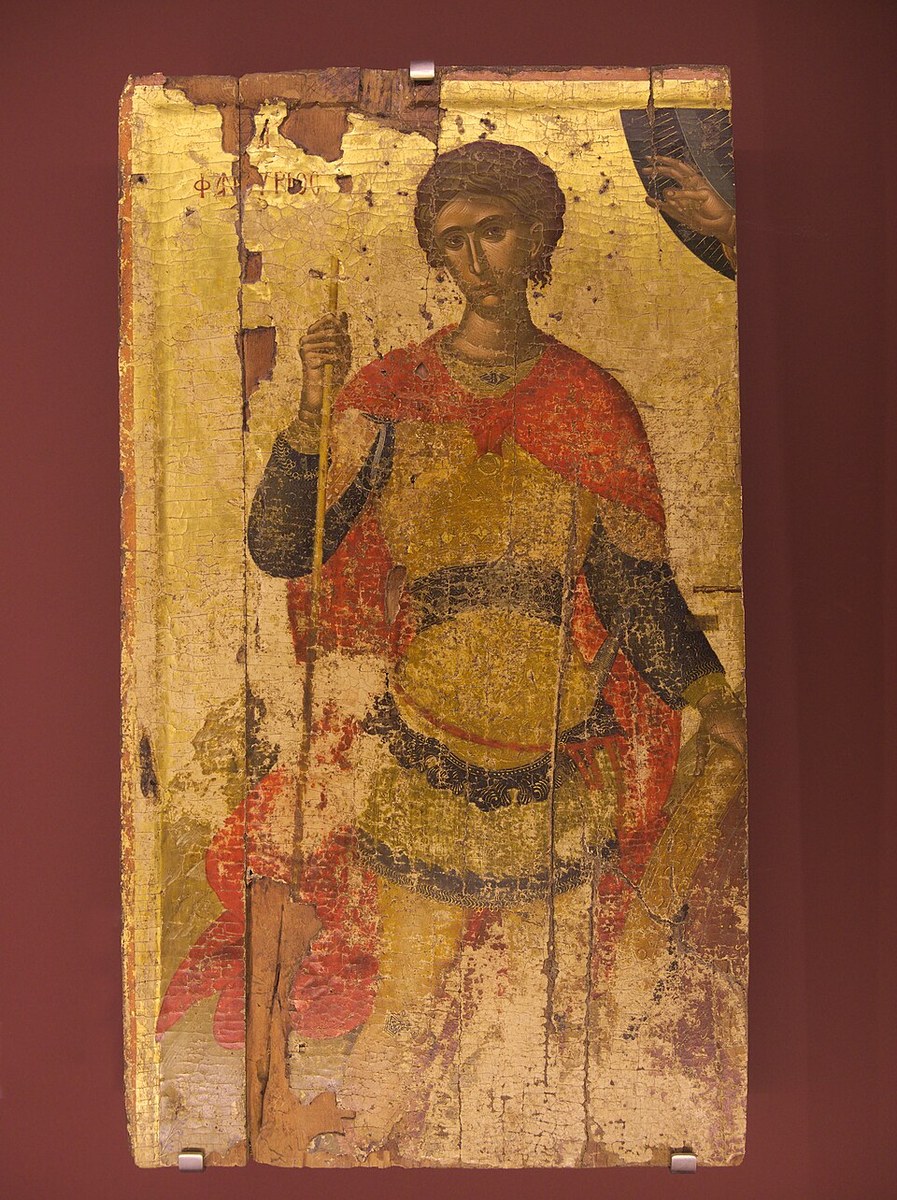
The type is fixed and unmistakable, and was fixed by the found panel itself. Phanourius is a beardless young soldier, standing frontally, in the tunic, cuirass and red or crimson chlamys of a military martyr, his hair curling; in his right hand he holds a slender cross-topped staff or a lighted taper — in the fullest form, a cross with a burning candle set on its upper arm, which is his one unique attribute and the visual pun on his name. A sword may hang at his side. In the complete form of the icon the field is bordered by the twelve scenes of the passion described above, which are the source of everything the Church says about him; abbreviated versions omit them and keep only the standing figure with the light.
The stored image is the panel by Angelos Akotantos, the leading Cretan painter of the first half of the fifteenth century (†c. 1450), from the monastery of the Hodegetria at Pyrgiotissa and now in the Agia Aikaterini collection at Heraklion: the saint standing, in gilded cuirass and red mantle, holding the tall slender taper, the name inscribed in red at the upper left, with the hand of Christ blessing from the upper corner. It is among the earliest surviving images of the saint and is itself the best evidence for the early dating of his cult.
Disputed questions
- When was the icon found? The popular account, followed by most English retellings, sets the discovery during the Ottoman occupation of Rhodes, which began in 1522, and therefore in the sixteenth century. This is very unlikely to be right. The metropolitan named in the account, Neilos, is most plausibly Neilos Diasorinos, who held Rhodes in the later fourteenth century; and, decisively, the earliest surviving panels of Phanourius — including the one stored with this entry — are Cretan work of the first half of the fifteenth century, one of them by Angelos Akotantos, who died about 1450. A manuscript of 1452 from Crete already records the Rhodian miracle. The cult therefore existed, and was already being exported to Crete, generations before the Turks took the island. The likeliest reconstruction is a fourteenth-century discovery under the Knights of St John — whose rebuilding of the Rhodes fortifications is well documented and who are the "rulers" of the account — with the Turks substituted for the Latins in later retellings.
- Did Phanourius exist? The Church commemorates him, and that settles the veneration; the historical question is separate and cannot be answered. Nothing about him is known independently of the panel. It is possible that the icon commemorated a local martyr whose memory had lapsed; it is equally possible that the inscription named a saint honoured elsewhere under another form of the name. What can be said is that the office and the synaxarion notice are late compositions, framed after the finding and derived from the twelve scenes, and that the entry in the Greek Menaion for August 27 is a modern one — his propers are not part of the old Byzantine corpus.
- Great-martyr? The Greek usage calls him μεγαλομάρτυς, "great-martyr," on the strength of the multiplied tortures shown in the border scenes. The title is a description of the icon rather than a datum about the man.
- August 27 and the day's other saints. His feast is a comparatively recent addition to a day already occupied by Poemen the Great, and in some Greek usage he is kept as the day's second commemoration; the OCA lists him last among the day's saints, and the entry was added to their calendar later than the rest.