
Philaret the Merciful
Our Righteous Father Philaret the Merciful, of Amnia
Righteous · b. c. 702 — d. 792
Commemorated 1 December
Philaret the Merciful (c. 702–792) was a wealthy landowner of Amnia in Paphlagonia whose boundless almsgiving reduced him and his family to poverty, and who is honoured by the Church as the very pattern of Christian charity. As raiders and his own open-handedness stripped away his herds, fields, and stores, he gave to the last of them, enduring his wife's reproaches with the patience of Job and keeping the hospitality of Abraham, trusting the promise that the righteous would never be forsaken. His trust was answered when imperial envoys, searching the Empire for a bride for the young emperor Constantine VI, lodged in his emptied mansion and chose his granddaughter Maria of Amnia for the throne — whereupon Philaret received back fame and riches and at once gave them away again to the poor. He died at ninety in a monastery of Constantinople in 792. His life, written soon after by his grandson, is one of the treasures of Byzantine hagiography, and his feast falls on December 1.
.jpg)
Origins and household
Philaret — the name means "lover of virtue" — was the son of George and Anna, raised in piety in the village of Amnia in the district of Paphlagonia, in the north of Asia Minor toward the Black Sea. He married Theoseba (Theosebo), a woman of a rich and illustrious family, and they had three children: a son, John, and two daughters, Hypatia and Evanthia. Philaret himself was a great landowner and a dignitary of the region, with broad fields, many herds, and a household of servants — a man, in the world's reckoning, of the first rank of his province.
He held his wealth, however, as a steward and not an owner. Remembering the Lord's word at the Last Judgment about "the least of these" (Matthew 25:40), the Apostle's reminder that "we brought nothing into this world, and it is certain we can carry nothing out" (1 Timothy 6:7), and the Psalmist's confidence that "the righteous is not forsaken, nor his seed begging bread" (Psalm 36/37:25), he made his estate an open storehouse for the poor. Those who received his gifts prospered, and it was said that whatever came from his hand multiplied in the receiver's — so that beggars and neighbours alike sought him out.
The stripping of his goods
A raid of the Ishmaelites — Arab horsemen — fell upon Paphlagonia and plundered Philaret's estate, and what the raiders left, his charity gave away. His grandson's Life preserves the scenes as a kind of holy comedy of dispossession. Left at last with two oxen, a donkey, a cow with her calf, some beehives, and the house, he gave one ox to a farmer who had lost his own, then the second, then the calf, then — when Theoseba protested that the cow was bellowing for the calf he had already given away — the cow as well, that the two not be parted. In a year of famine he borrowed six bushels of wheat and, prodded by his wife's bitter sarcasm, gave the whole load, the bag, and finally the donkey to carry it, to a single poor man, while his own children wept for hunger. Each time his wife reproached him as heartless and his children jeered, and each time he answered mildly that he had "hidden away riches and treasure" enough to feed them for a hundred years — meaning the treasure laid up in heaven. And each time God repaid the gift: when the last of the wheat was gone, a friend sent forty bushels unasked.
Through it all Philaret bore the anger of his household without resentment, blessing his wife even as she taunted him, so that the tradition sets him beside the two Old Testament exemplars named in his troparion: Abraham for his open-handed hospitality, Job for his patience under loss.
The bride-show and the return of fortune
In the year 788 the empress Irene, regent for her son Constantine VI, held a bride-show for the young emperor, sending emissaries throughout the Empire to find a maiden of suitable beauty and virtue. The envoys came at last to Amnia and sought lodging in the largest house of the place — Philaret's, still outwardly grand though emptied within. The saint received them with joy, and neighbours, hearing what guests he had, brought all that was needed for a splendid feast. The envoys were struck by the beauty, bearing, and modesty of the household's daughters, and chose Philaret's granddaughter, Maria, above all her rivals; she was taken to Constantinople and married to the emperor, and Maria of Amnia became empress.
Fame and riches returned to the grandfather of the empress. Philaret used them exactly as before. He kept three bags — one of gold, one of silver, one of copper — and, when a beggar came, would have a servant bring whichever bag God's providence appointed, and give without counting. He refused fine clothes and declined every imperial rank, saying it was honour enough to be called the grandfather of the empress; and he set the poor at his own table and served them with his family, so that people said, "This is a man of God, a true disciple of Christ."
Repose
Reaching the age of ninety, Philaret knew that his end was near. He went to the monastery of Rhodolphia — called "the Judgment" (Krisis) — in Constantinople, gave the abbess a gift of gold, and asked to be buried there, foretelling that he would die in ten days. He returned home, fell ill, and on the tenth day gathered his family, charging them to imitate his love for the poor if they wished to be saved; then he fell asleep in the Lord. He died in 792 and was buried in the Judgment monastery. A miracle at once confirmed his sanctity: as the body was borne to the grave, a man tormented by a demon followed the bier and tried to overturn the coffin, and at the graveside the demon threw him down and came out of him. Many healings followed at the tomb. His widow Theoseba, surviving him, gave herself to restoring the monasteries and churches that barbarian invasion had ruined.
Veneration and legacy
Philaret is one of the very few Byzantine laymen — married, a father, and never a monk until his deathbed retreat — to be venerated as a saint on the strength of a single virtue perfectly practised: mercy to the poor. The calendars style him "the Merciful" (ho Eleēmon, Милостивый), the same epithet borne by John the Almsgiver of Alexandria, and hold him up as the model of the almsgiver whose giving is not calculation but abandonment to Providence. His cultus spread with his Life through the whole Byzantine and Slavic world; the Slavic tradition keeps him with particular warmth as a domestic saint, patron of open-handed householders.
Feast and commemoration
December 1 on the church calendar (Old Calendar civil December 14), kept within the Nativity Fast and shared with the prophet Nahum. Philaret has a proper service in both the Greek and the Slavic books, with his own troparion and kontakion; the Slavic tradition transmits, besides the troparion given below, two further alternative troparia in Tone 8.
Hymns
Troparion — Tone 4
Imitating Abraham in faith and following Job in patience, O father Philaret, thou didst share the good things of the earth with the destitute and didst bravely endure their lack thyself. Therefore did Christ our God, the Giver of the prize, crown thee with a radiant crown; entreat him, that our souls may be saved.
Original translation from the Slavonic
Kontakion — Tone 3
Truly thy commerce is seen to be most excellent, and is judged wise by all who are rightly minded; for thou gavest away the things below that are fleeting, and soughtest the things on high that are eternal. Therefore hast thou worthily gained everlasting glory, O merciful Philaret.
Original translation from the Slavonic
Iconography
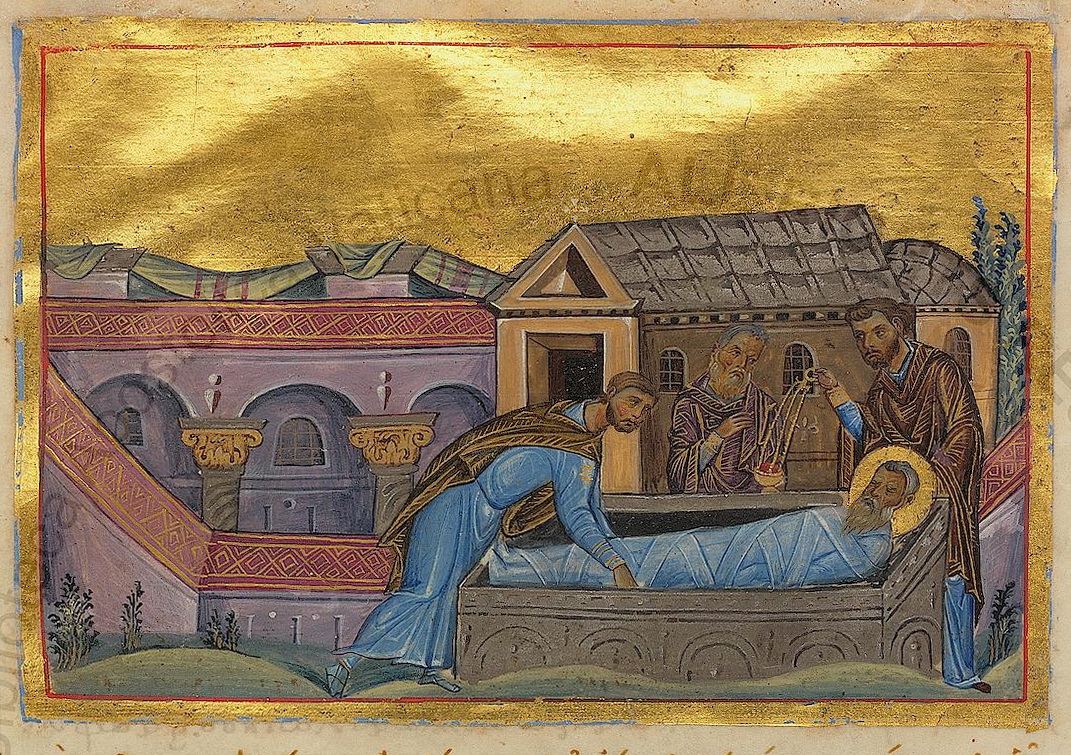
Philaret is shown as an elderly layman — grey-bearded, in the long tunic and cloak of a Byzantine noble rather than monastic habit — and is often depicted in the act that defines him: giving alms, a coin or a loaf held out to a beggar, or attended by the poor at his table. The stored image is the miniature of the Menologion of Basil II (Constantinople, c. 985), captioned "Philaretus of Paphlagonia," which places the saint of Amnia among the commemorations of December 1.
Disputed questions
- The date of the bride-show. The marriage of Constantine VI to Maria of Amnia is generally placed in 788 (Irene ruled as regent from 780 and in her own name from 797); the OCA notice's parenthetical dates for Irene reflect her sole reign rather than the year of the bride-show, which fell earlier in her regency.
- Not to be confused with Peter the Tax-Collector, the converted publican of sixth-century Africa, who is likewise surnamed "the Merciful" in some calendars for his own extravagant almsgiving — a wholly distinct saint of a different age and story (September 22 in the Slavic books, January 20 in the Greek).