
Philothea of Argeș
The Holy Virgin-Martyr Philothea of Argeș
Martyr · Child Martyr · Virgin · b. c. 1206 — d. c. 1218
Commemorated 7 December — Martyrdom; her relics rest at Curtea de Argeș, Romania
Philothea of Argeș (c. 1206 – c. 1218) is a child virgin-martyr of the Balkans whose incorrupt relics, enshrined at the monastery of Curtea de Argeș, made her one of the great protecting saints of Romania. Born near Trnovo in Bulgaria to a poor family, she was killed at about twelve years of age by her own father, who struck her in fury when he discovered that she was giving his food to the poor. Her body could not be lifted until the monastery of Curtea de Argeș was named as its resting place, and there she has been venerated for centuries with an annual festal pilgrimage on her feast, December 7.

Philothea was born around 1206 at Trnovo, the old capital of Bulgaria; her father was a farmer and her mother a Wallachian. Her mother, who had taught her prayer and almsgiving, died while Philothea was still a child, and her father remarried. Her stepmother resented the girl's piety and charity, accusing her of disobedience and of giving the family's goods away to the poor, and turned the father against her; yet Philothea persevered in attending the church services and in doing good, growing in the virtues of prayer, virginity and mercy.
She used to carry food out to her father as he worked in the fields, but would give part of it to the poor children who begged in the streets, so that not all of it reached him. When he complained that too little food was sent, his wife told him to ask his daughter what became of it. Resolving to spy on her, the father concealed himself and saw Philothea handing food to the poor children. In a violent rage he seized the small axe (or hatchet) from his belt and hurled it at the twelve-year-old, striking her in the leg; the wound was mortal, and she soon gave up her pure soul to God.
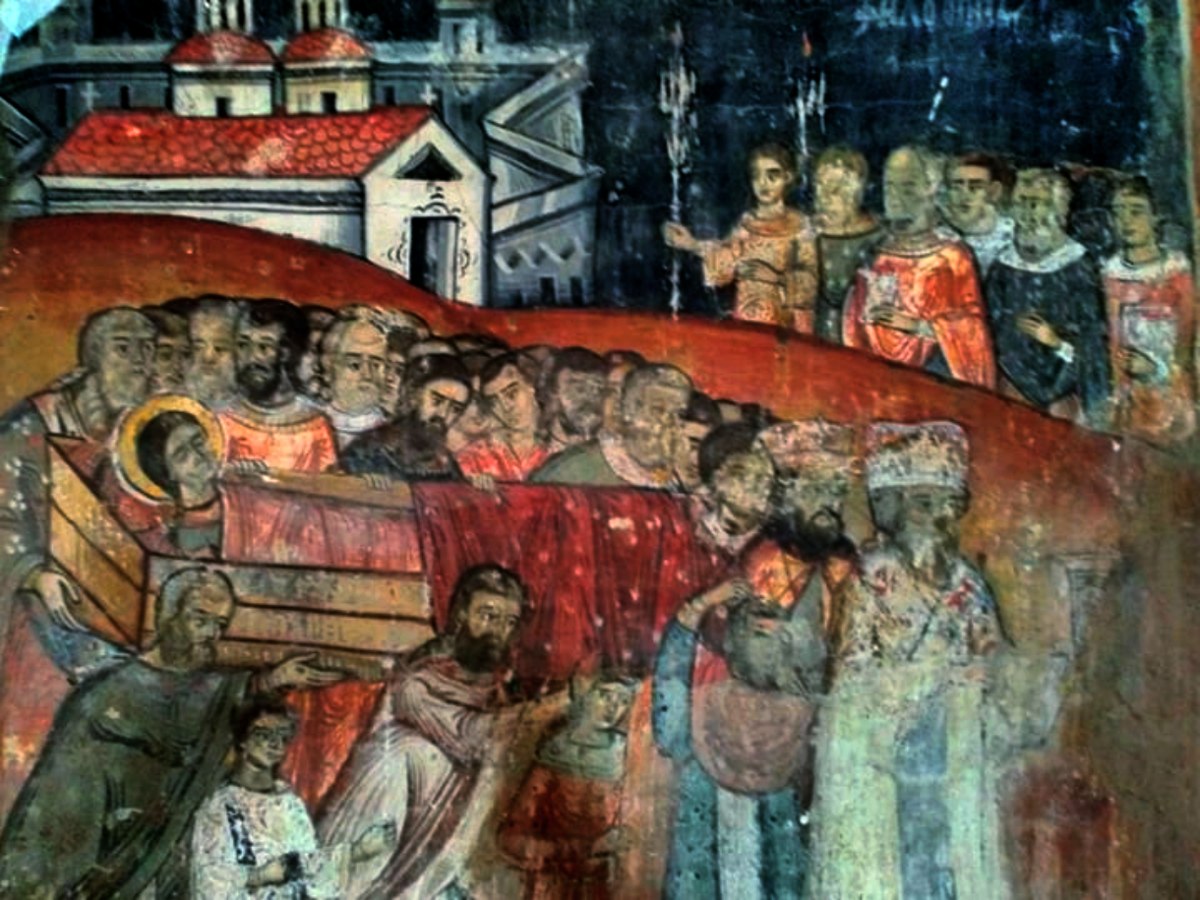
Overcome with fear and remorse, the father tried to lift her body, but it had become as heavy as stone. He ran to confess his crime to the Archbishop of Trnovo, who came with clergy, candles and incense to take up the martyr's body — but they too could not raise it. Understanding that the saint did not wish to remain in her homeland, the archbishop began to name churches and monasteries one by one; only when he named the monastery of Curtea de Argeș in Wallachia could the relics be lifted and laid in a coffin. He wrote to the Romanian voivode Radu Negru, who received the relics; carried in procession to the Danube and met there by Romanian clergy and faithful, they were borne to Curtea de Argeș, where they have rested ever since.
Feast and commemoration
December 7 (church date; Old Calendar civil December 20), within the Nativity Fast. Philothea is venerated especially in Romania — where she is honoured as a protectress of the land — and in Bulgaria, and more widely through the Orthodox world. Each year on her feast a great festal pilgrimage gathers at Curtea de Argeș from across Romania; her relics are carried in procession around the monastery courtyard, and many healings are reported at her tomb in the chapel behind the monastery church.
Hymns
Troparion — Tone 4
Thy lamb Philothea crieth out to thee with a loud voice, O Jesus: "O my Bridegroom, thee I love, and seeking thee I suffer; I am crucified and buried together with thee in thy baptism, and I endure for thy sake, that I may reign with thee; I die for thee, that I may live in thee: accept me as a spotless sacrifice offered to thee with love." By her prayers, O merciful One, save our souls.
Original translation from the Greek
Iconography
Philothea is depicted as a young girl, often crowned as a martyr and holding a cross, sometimes with the axe or hatchet of her passion, or shown reclining in the sleep of death; in Romanian churches her burial and the translation of her relics to Curtea de Argeș are also portrayed. The stored image is a detail from an eighteenth-century fresco layer in the church of St Nicholas at Curtea de Argeș, depicting the saint's burial.
Disputed questions
- Not to be confused with Philothei of Athens (†1589, kept February 19), the Athenian nun-martyr and foundress of monasteries under the Ottoman yoke — a wholly different saint of a later age. The two share only the name Philothea/Philothei; this Philothea is the twelfth–thirteenth century Balkan child virgin-martyr, protectress of Romania.