
Philothei of Athens
Our Venerable Mother Philothei of Athens, the Righteous New Martyr
Venerable Martyr · New Martyr · Venerable · b. 1522, at Athens — d. February 19, 1589, at Athens
Commemorated 19 February — Repose from the wounds of her martyrdom at Athens
Philothei of Athens (1522–1589), born Regoula Benizelou to one of the noblest families of Ottoman Athens, is the great nun-martyr and philanthropist of the enslaved city — venerated as a patroness of Athens, where her incorrupt relics rest in the Metropolitan Cathedral. Married against her will as a girl and widowed within a few years, she refused all further marriage and, after her parents' death, took the monastic name Philothei and founded on her own estate the convent of St Andrew, gathering about it a great complex of schools, workshops, hospices and refuges. From it she ransomed Christian captives, and above all sheltered and spirited to safety women fleeing the harems and the slavery of the conquerors — for which the Turkish authorities seized her at a night vigil, beat her savagely, and left her mortally hurt. She lingered some months and reposed of her wounds on February 19, 1589, and was numbered among the new martyrs of the Church under the Turkish yoke.

Origins and the Benizelos family
She was born in Athens in 1522, at the height of the Ottoman occupation of the city, and given at baptism the name Regoula (Ῥηγούλα, also transmitted Revoula-Paraskevi). Her family, the Benizeloi, were archons — the leading Christian aristocracy of Athens under the Turks, holders of the office of proestos or notable that stood between the subject Greek community and its masters. Her father Angelos and her mother Syriga were people of wealth, position and piety; the great Benizelos mansion in the Plaka, beneath the Acropolis, survives as the oldest house in Athens and is remembered as her family home. From childhood she was known for her devotion and her almsgiving, formed by a mother who had long prayed for a child and who raised her in the fear of God.
Marriage, widowhood, and the taking of the veil
At about fourteen her parents, against her own wish for the monastic life, gave her in marriage to a wealthy Athenian named Andreas Chiliadis (Chilas), a man much older and, the tradition says, harsh and unhappy in temper. The marriage was a suffering to her; but she bore it in patience, in prayer and in quiet works of charity, for some three years, until her husband died and she was left a widow while still very young. Her family and the notables of the city pressed a second marriage upon her, but she would not: she had determined upon God alone. Only after the death of her parents, whose grief she would not add to, did she at last enter upon the life she had always desired. In her convent she received the monastic tonsure and the name Philothei — "lover of God" — the name under which the Church knows her.
The convent of St Andrew and its works of mercy
On her own inherited estate Philothei raised a convent dedicated to the Apostle Andrew (near the site of the present Church of St Andrew in the centre of Athens), and about it, as the community grew to some two hundred nuns and lay sisters, she built up a whole institution of Christian mercy such as Ottoman Athens had never seen: schools for the children of the city (girls among them, at a time when their education was neglected), workshops in which women could learn a craft and support themselves, a hospital and hospices for the sick and the aged, a home for orphans, and hostels for pilgrims and the destitute. Into this refuge she gathered the abandoned and the enslaved — among her nuns were freed captives, Cypriot and other women redeemed from bondage. She founded, besides, dependencies (metochia) on the islands of Kea (Tzia) and Aegina and elsewhere, partly as further houses of prayer and partly as places of concealment and escape.
The ransoming and rescue of enslaved women
The most dangerous of her labours, and the one that brought her at last to her death, was her rescue of women held in slavery by the conquerors. She ransomed Christian captives with her family fortune; and — more perilous still — she received, hid, and helped to flee the country women who had escaped, or whom she drew out, from the harems and households of the Turks, including some who had been forced into Islam and wished to return to Christ. Her island convents served as stations on the way to safety. To the Ottoman authorities this was a capital provocation: the loss of slaves and the reclaiming of apostates. More than once she was denounced, arrested and threatened, and on one occasion, the tradition relates, she was on the point of being put to death and was spared only when the Turkish notables, whom she had so often relieved in their own need, interceded for her. She was undeterred, and continued her work.
Martyrdom and repose
On the night of the third of October 1588 — the eve of, or the vigil kept for, a feast (the tradition names the feast of St Dionysius the Areopagite, first bishop of Athens) — while Philothei and her sisters were keeping an all-night vigil at her dependency at Patisia, a band of Turks broke in upon the convent, seized the aged abbess, dragged her out and beat her without mercy, meaning to kill her; some accounts add that they meant to force her to deny Christ. She was left for dead, and though her nuns carried her back and tended her, she never recovered of her injuries. She lingered in her wounds for some months, and on February 19, 1589, gave up her soul to God, a martyr in all but the final stroke — perfected, as the Church counts her, by the death she died of the beating suffered for Christ and for His enslaved poor.
Relics and veneration
She was buried in her convent of St Andrew, and her tomb at once became a place of healing; a fragrance was reported from her relics, which were found incorrupt. Her veneration spread rapidly through Athens and the islands, and she was soon numbered among the new martyrs — the confessors and martyrs of the Church under the Ottoman yoke. Her sacred relics are today enshrined in the Metropolitan Cathedral of Athens (the Mitrópolis), where they are a treasured possession of the city; she is honoured as a patroness and protectress of Athens, one of the two great Athenian saints (with the martyr-hierarch Dionysius the Areopagite of apostolic times), and a central street of the modern city bears her name. The Ecumenical Patriarchate formally recognised her sanctity, and her memory is kept across the Greek world and beyond.
Feast and commemoration
February 19 (church date; New Calendar civil February 19; Old Calendar civil March 4), the day of her repose from the wounds of her martyrdom in 1589. The day is otherwise led by the apostle Archippus of Colossae with Philemon and Apphia; Philothei is the great new-martyr of the date and, for the Church of Greece and especially for Athens, its foremost commemoration. Her feast falls, most years, within the Triodion season of preparation for Great Lent. She is styled in the calendars both ὁσία (venerable, for her monastic and ascetic life) and new martyr (for the death she suffered at the hands of the Turks), and this entry carries both classifications, as the tradition does.
Hymns
Troparion — Tone 4
Having received the radiance of the venerable saints, O modest one, thou didst make bright the city of the Athenians by thine ascetic struggle and by thy grace; for, bearing the fruit of love for thy neighbour, thou wast lawfully perfected in contest, and hast received from the Lord a divine crown. O Philothei our mother, entreat Christ God that our souls may be saved.
Original translation from the Greek
Iconography
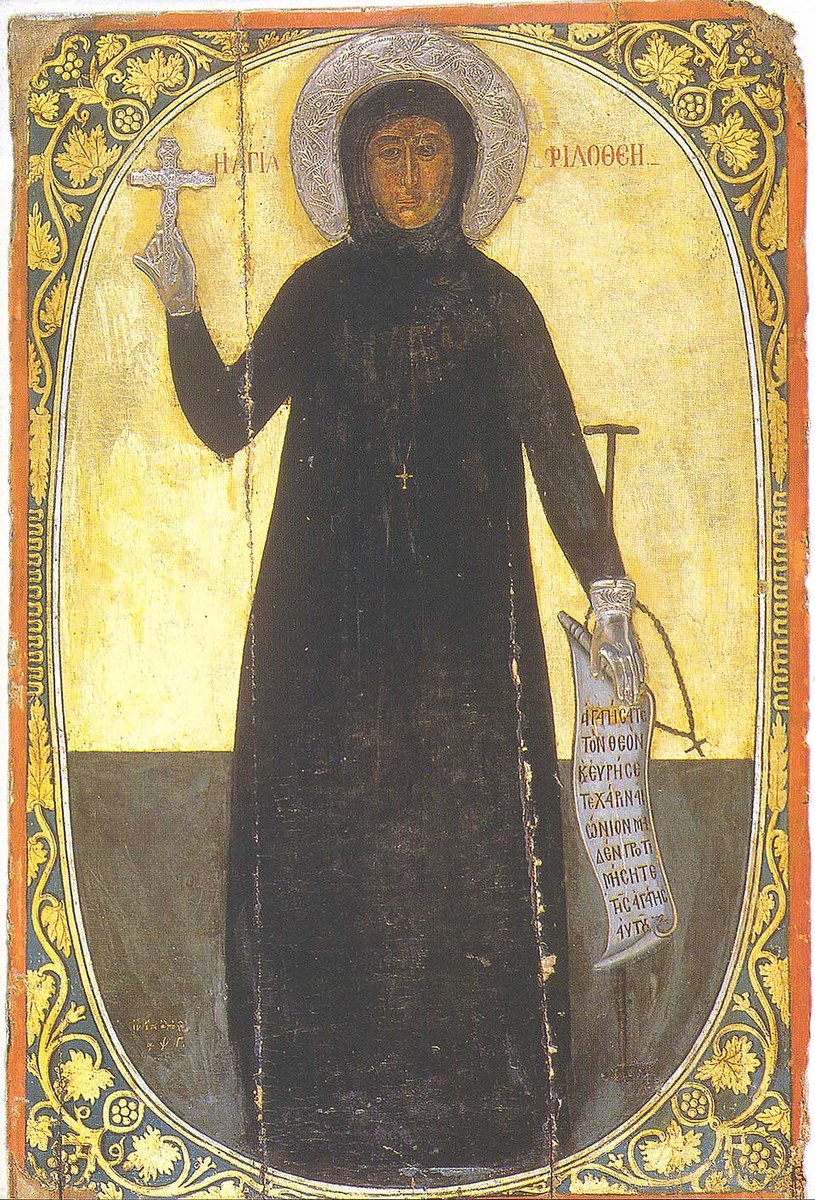
Philothei is depicted as an aged nun in the full monastic schema — dark mantle and koukoulion — holding a cross (the sign of her martyrdom) and often a scroll or a model of her convent; she may be shown as foundress with her church in hand, or in the narrative type of her passion, seized and beaten by her persecutors at the vigil. As a patroness of Athens she is frequently paired in iconography with Dionysius the Areopagite. The stored image is an early eighteenth-century (1703) Greek icon of the saint, "Philothei, patroness of Athens," a faithful pre-modern portrait of the nun-martyr with cross in hand (source, public domain, pd-old-work).
Disputed questions
- "Philothei" of Athens and other Philotheis. Philothei of Athens (†1589), the Athenian nun-martyr, is not to be confused with the child virgin-martyr Philothea of Argeș (†c. 1218, kept December 7), the protectress of Romania, nor with the martyr Philotheus of Samosata (one of the seven Martyrs of Samosata, January 29), nor with Philotheus the Presbyter of Asia Minor. The distinguishing marks are the city (Athens), the date of repose (February 19), and the Ottoman-era martyrdom.
- The manner of her death. The sources agree that she died of the beating she suffered at the vigil-raid of October 1588 and lingered until February 19, 1589; whether the final intent of her attackers was murder or the extraction of apostasy is variously told, but the tradition is constant that she is a martyr by the wounds she bore for Christ.