
Pimen the Much-Ailing of the Kiev Caves
Our Venerable Father Pimen the Much-Ailing, of the Near Caves of Kiev
Venerable · Wonderworker · d. 1110, at the Kiev Caves monastery
Commemorated 7 August — Repose after twenty years of sickness borne with joy, 28 September — Synaxis of the Venerable Fathers of the Near Caves
Pimen, surnamed the Much-Ailing (Mnogoboleznenny), is the monk of the Kiev Caves whose whole ascetic life was an illness. Born sick and never healthy, he begged his parents to bring him to the monastery; and when they, having brought him, began instead to pray for his cure, he prayed for the opposite — that his sickness might continue and that he might be tonsured. He was tonsured, the account says, by angels in the likeness of monks, who told him he would receive his health only on the day of his death. So it fell out: after twenty years of grievous suffering borne with joy, and often left days at a time without food or water by attendants worn out with him, he rose up whole, took leave of the brethren, communicated, prophesied over the graves of two monks, lay down on his bed and died. His relics rest in the Near (Antoniev) Caves, and he is commemorated on August 7.
.jpg)
The sick child who asked to stay sick
The Kiev Caves Paterikon preserves Pimen's story in full, and it is one of the most singular in the collection. He was born sickly and grew up sickly, and the Paterikon makes the theological point at once: the illness of his body preserved him from the illness of his soul, so that he came to the monastic life undamaged by the world.
For a long while he pressed his parents to take him to the famous monastery of the Caves at Kiev. They did at last bring him — and then, being parents, began to pray that their son might be made well. Pimen, who had already understood what the sources call the high value of suffering, prayed against them: that his sickness might remain, and that he might be granted the tonsure, which his parents would not consent to while they hoped for a cure.
The tonsure by angels
One night, radiant figures in the habit of monks came to him and tonsured him. They named him Pimen, invested him, and told him that he would be restored to health only on the day of his repose. Some of the brethren, hearing singing in the night, came and found him already clothed in the monastic habit, a lit candle in his hand; and his shorn hair was afterwards found at the crypt of Saint Theodosius. The narrative is careful to make it a real tonsure and not a vision: the habit, the candle and the hair are the evidence the monastery kept.
Twenty years in the bed
Thereafter Pimen lay ill for twenty years. The Paterikon does not idealise the brethren who nursed him: the account states flatly that those who attended him could not endure it, and would leave him two or three days together without food or drink — and that he bore this too with joy, and never reproached them.
Two episodes are transmitted from those years. He healed a crippled brother, who vowed to serve him until death; the brother in time grew slack in the service, and his old sickness returned upon him. Pimen healed him a second time, and gave with the healing the sentence that is the moral of his whole life: the sick and those who serve the sick receive an equal reward.
Repose
At the end of the twenty years, exactly as the angels had said, Pimen became well. He went into the church, took leave of all the brethren, and partook of the Holy Mysteries. Then, bowing before the grave of Abba Anthony, he pointed out the place he had chosen for his burial and carried his own bed there.
Standing among the graves, he prophesied over two of them: that one monk who had been buried in the great schema would be found without it, having lived unworthily of it; and that another, buried without the schema, would be found clothed in it, because he had desired it in life and was worthy. Then he lay down on the bed and fell asleep, and the brethren buried him with honour. The Paterikon records that his words were afterwards verified in both graves.
On the day of his repose, three pillars of fire were seen to stand over the refectory and pass across to the church.
The date of his death
The Paterikon gives no year. But the Kievan chronicle records the same portent of the fiery pillars under 11 February 1110 (the sign associated with the memory of Theoctistus of Chernigov, kept August 5), and the Russian tradition has therefore reasoned back from the omen to the date, assigning Pimen's repose to 11 February 1110 while keeping his memory on August 7. The inference is transparent and is recorded here as an inference. His relics lie incorrupt in the Near (Antoniev) Caves.
Feast and commemoration
August 7 (church date; New Calendar civil August 7, Old Calendar civil August 20), within the afterfeast of the Transfiguration and within the Dormition fast (August 1–14). He is kept a second time on September 28, among the Synaxis of the Venerable Fathers of the Near Caves, and on the second Sunday of Great Lent with all the fathers of the Caves. His veneration is Russian and Ukrainian in origin and is carried by the OCA calendar; the Greek books know him only as a bare notice ("a Russian monk who fell asleep in 1110"), which is a fair measure of how local the cultus remains.
He is invoked, naturally, by the sick and by those who nurse them — the second being as much his patronage as the first, on the strength of his own sentence about equal reward.
Hymns
Troparion — Tone 8 (common of a venerable father of the Caves)
Thou didst ask of God not health but sickness, and receiving it as a gift thou didst bear it twenty years with thanksgiving; tonsured by the hands of angels, O father Pimen, thou wast made whole in the hour of thy departing. Entreat Christ God that our souls may be saved.
Original translation from the Slavonic
Iconography
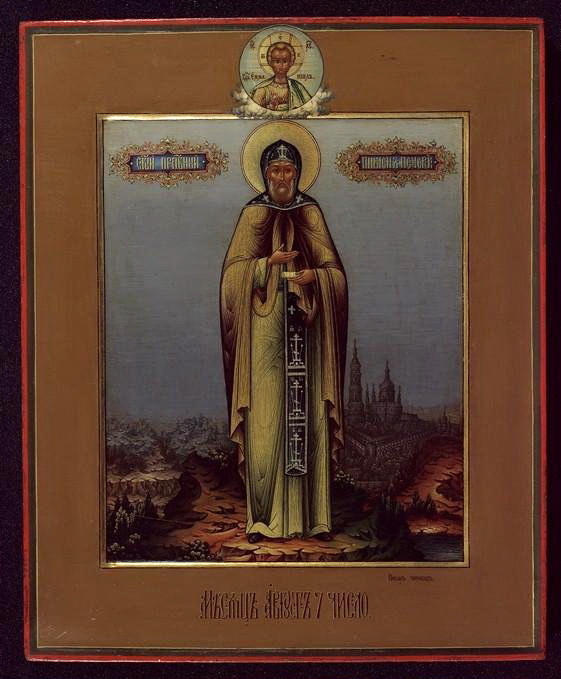
Pimen is painted as a Kiev-Caves monastic: in mantle, koukoulion and the great schema, holding the schema-cross or a scroll, with the Lavra and the wooded bluffs above the Dnieper in the background — the standard setting of the nineteenth-century Caves iconography. He is not distinguished by an attribute of his own; where a scene is given it is the angelic tonsure, monks in shining habit about the bed of the sick youth, the candle burning in his hand.
The stored image is a nineteenth-century menaion icon (about 1850) by the Moscow icon-painter Osip Semyonovich Chirikov, from the set painted for the church of the Marble Palace and now in the State Museum of the History of Religion, St Petersburg. The saint stands full-length in the schema, holding the schema-cross, the monastery behind him at the right, with a bust of the Saviour in the clouds above; the title reads СВЯТЫЙ ПРЕПОДОБНЫЙ ПИМЕНЪ ПЕЧЕРСКІЙ, and the border beneath is lettered МѢСЯЦЪ АВГУСТЪ, 7 ЧИСЛО — "month of August, the 7th day." The date-inscription is what identifies the figure as the Much-Ailing rather than the Faster; the panel itself titles him only "Pimen of the Caves," and that caution is recorded here.
Disputed questions
- Not to be confused with Pimen the Faster of the Kiev Caves (Pimen Postnik, twelfth century, of the Far Caves, principal feast May 8), who is also listed on August 7 in some calendars — the confusion is very easy, since the two share a name, a monastery, a century and, in several synaxaria, a day. They are distinct: this Pimen is the Much-Ailing, tonsured by angels, whose relics are in the Near Caves; the other is the Faster, remembered solely for the severity of his abstinence, whose relics are in the Far Caves and who is counted among the fathers of the Far Caves on August 28.
- Not to be confused with Poemen (Pimen) the Great of Egypt (August 27), the great desert-father whose name he bears — Pimen being simply the Slavonic form of Poemen — nor with Poemen of Palestine, the sixth-century anchorite of the Rouba kept on that same August 27, nor with the later Russian hierarchs of the name.
- The year 1110 is a deduction from the chronicle's notice of the fiery pillars, not an independent record: see above.