
Pionius of Smyrna
The Holy Hieromartyr Pionius, Presbyter of Smyrna
Hieromartyr · Priest · b. 3rd century — d. c. 250, at Smyrna
Commemorated 11 March — Martyrdom by fire at Smyrna under Decius
Pionius (third century, †c. 250) was a learned presbyter of the church of Smyrna who was arrested, tried, and burned alive in the persecution of the emperor Decius, about the year 250. His martyrdom is preserved in the Martyrdom of Pionius, one of the most vivid and historically trustworthy of all the early acts of the martyrs, which records that he was seized on a Saturday, the anniversary of the martyrdom of Polycarp of his own city, together with the Christian woman Sabina and Asclepiades; that he bound ropes about his own neck and theirs so the crowd would know they went to prison and not to sacrifice; and that he answered his judges with long and fearless speeches before he was fastened to the stake and given to the flames. He gave up his spirit with joy, and the Church keeps him with his companions on March 11.
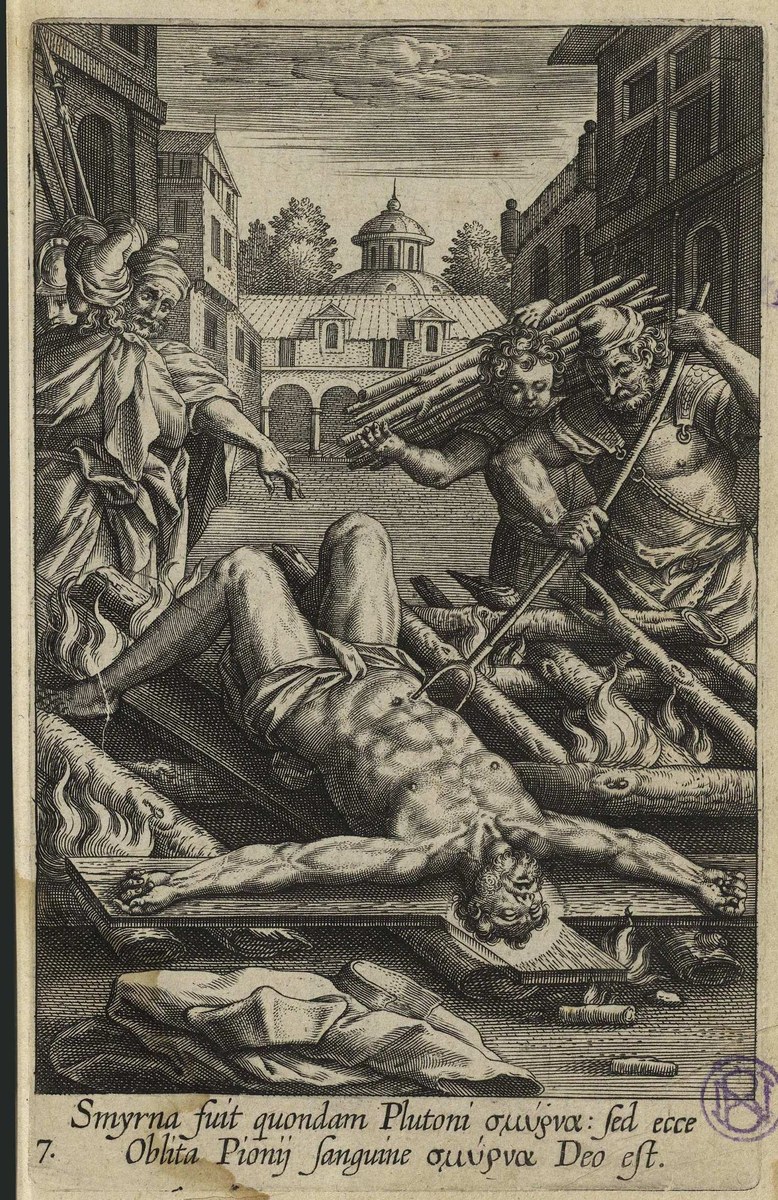

Smyrna under Decius
Pionius was a presbyter of Smyrna, the great Ionian port on the eastern shore of the Aegean, a church already hallowed by the martyrdom of its bishop Polycarp a century before. He was a man of learning and eloquence, well versed in the Scriptures and in the disputes of the schools, and he was a leader of the Smyrnaean Christians when, in the year 250, the edict of the emperor Decius fell upon the Church — the first empire-wide persecution, which required every subject to sacrifice to the gods and to receive a certificate (libellus) of having done so, on pain of death.
The Martyrdom of Pionius, which preserves his story, is reckoned by scholarship among the very small number of martyr-acts of the first rank — a text close to the events, rich in circumstantial and psychological detail, and shaped throughout by the deliberate parallel its author draws between Pionius and the great Polycarp, whose passion Smyrna honoured on the same season of the year.
The arrest on the day of Polycarp
Pionius foresaw his arrest. On the eve of the great Sabbath — a Saturday which the account marks as the anniversary of Polycarp's martyrdom — he kept a fast and a vigil with two companions: Sabina, a Christian woman who in an earlier persecution had gone by the name Theodota to escape a cruel mistress, and Asclepiades. Knowing that the officers would come for them, and that they would be dragged to the marketplace to sacrifice, Pionius took three woven cords and bound one about his own neck and one about the neck of each of his companions, so that all who saw them led away should know at once that they were Christians going to prison of their own will, and not apostates being brought to the altars. When the temple-warden Polemon came with his men and found them so bound, they were taken up and led through the forum, and a great crowd gathered.
The confession and the speeches
The Martyrdom gives Pionius's words at length, and they are the heart of the account. Standing in chains before the crowd of Greeks and Jews of Smyrna — some mocking, some urging him with feigned kindness to save his life — he preached to them a long and grave address: warning the pagans against the idols, reasoning with the Jews from their own Scriptures, and calling all to repentance rather than to the sin of pressing others to deny Christ. Pressed again and again to sacrifice, to taste the sacrificial meat, to acknowledge the gods and the emperor's divinity, he refused every inducement and every threat, answering with the one confession, that he was a Christian and worshipped the God who made heaven and earth. When they asked which god he worshipped, he named the God of the Christians; when they urged him for his own sake to yield, he answered that it was for the sake of his soul that he would not. Sabina at his side smiled under the threats, and was rebuked for it, and held firm; Asclepiades likewise confessed.
Martyrdom by fire
Brought at last before the proconsul and refusing to the end, Pionius was condemned to be burned alive. He was led to the stake, laid down his own garments, and was nailed to the wood; and when the executioner asked whether he would change his mind he answered only that he had felt the nails, and was resolved to rise again. The pyre was kindled, and Pionius prayed with his eyes closed as the flames rose about him; when they died down the onlookers saw his body unmarred and his face serene, as of a man who had fallen asleep, and the Christians took up what remained as a treasure. His death is placed about the year 250, in the persecution of Decius, on March 11 by the reckoning of the East.
Feast and commemoration
Pionius is kept on March 11 (church date; Old Calendar civil March 24), together with his companions. The Greek Menaion styles him hieromartyr, the priest-martyr of Smyrna, and the calendars name with him Sabina and Asclepiades — and, in the wider synaxarion tradition, further companions (Limnus, styled with him as a martyr-presbyter, and Macedonia), the roll varying between the historical Martyrdom, which names Sabina and Asclepiades, and the later liturgical lists. His memory falls, like most of the fixed commemorations of this part of March, ordinarily within Great Lent, so that on a weekday his office is sung with the Lenten order and no full Liturgy is served. The Western Church keeps him and his companions as martyrs on February 1.
Iconography
Pionius is depicted in the type of the martyr-priest: a bearded presbyter in the sticharion and phelonion, or in a simple tunic, holding the small cross of the martyrs, and — where his passion is shown — set amid or before the flames of the stake to which he was nailed and burned, the sign proper to him. As a presbyter of Smyrna he is naturally paired in the tradition with its bishop Polycarp, whose martyrdom his own so closely recalls.
The stored image is a Western work per §34: Collaert's engraving of the martyr from the Triumphus Iesu Christi Crucifixi (1608). An Eastern image remains wanted and is listed among the upgrade-wanted icons.