
Polycarp of Smyrna
The Holy Hieromartyr Polycarp, Bishop of Smyrna
Hieromartyr · Bishop · b. c. 69 — d. c. 155 (some 156 or 167), at Smyrna
Commemorated 23 February — Martyrdom by fire and sword at Smyrna
Polycarp (c. 69 – c. 155) was bishop of Smyrna, a disciple of the Apostle and Evangelist John the Theologian, and — with Ignatius of Antioch, whose friend and correspondent he was — one of the Apostolic Fathers, the generation that received the faith directly from the Apostles and carried it into the second century. He was the living link between the Apostles and the great teachers who followed: Irenaeus of Lyons, who heard him preach as a boy, remembered how Polycarp told of his converse with John "and with the others who had seen the Lord." His one surviving writing, the Letter to the Philippians, and above all the Martyrdom of Polycarp — a letter of the church of Smyrna that is the earliest detailed account of a Christian martyrdom outside the New Testament — made his memory imperishable. Brought into the arena at about eighty-six years of age, he answered the proconsul's demand that he curse Christ with the words, "Eighty-six years have I served him, and he has done me no wrong; how then can I blaspheme my King who saved me?" Condemned to the fire, he was not consumed by it, and was dispatched at last with a dagger. He is kept on February 23.

Origins and the discipleship of John
Polycarp belongs to the Apostolic Fathers — the men of the sub-apostolic generation who had known the Apostles in the flesh and stood as the Church's bridge from the age of the New Testament to the age of the great second-century teachers. Of his birth and family nothing certain survives; that he lived to about eighty-six and died about the year 155 places his birth around the year 69, in the last years of the Apostolic age, so that his long life spanned almost the whole of the sub-apostolic period. The tradition, and his own memory as Irenaeus reports it, make him a disciple of the Apostle John the Theologian at Ephesus, and hold that he was appointed bishop of Smyrna by the Apostles themselves — one of "those who had been eyewitnesses and ministers of the word."
The decisive witness to his early life is Irenaeus of Lyons, who as a boy in Asia had sat at Polycarp's feet and never forgot it. Writing long afterwards to his fellow-pupil Florinus, who had drifted into heresy, Irenaeus recalls the old bishop with extraordinary vividness: "I remember the events of those days more clearly than those of recent years… I can describe the very place where the blessed Polycarp used to sit as he discoursed, his goings out and his comings in, the manner of his life, the look of his body, the discourses he held before the people, how he told of his converse with John and with the others who had seen the Lord, how he recalled their words… all in harmony with the Scriptures." From Irenaeus, too, comes the succession that makes Polycarp so weighty a witness: he "was not only taught by Apostles and conversed with many who had seen Christ, but was also appointed by Apostles in Asia bishop of the church in Smyrna" (Against Heresies III.3.4). Through Irenaeus — himself the teacher of the Church of Gaul — the faith of the Apostle John reached the Latin West by the shortest of chains: John, Polycarp, Irenaeus.
Bishop of Smyrna
Polycarp governed the church of Smyrna, on the Aegean coast of Asia Minor — one of the seven churches of the Apocalypse, and the one to which the Risen Christ said, "Be thou faithful unto death, and I will give thee a crown of life" (Revelation 2:10), a word the Church has always read as spoken over the city whose bishop would keep it to the letter. He is reckoned in the local succession after Bucolus, the first bishop of Smyrna and, like Polycarp, a disciple of John. For the better part of half a century — through the reigns of Trajan, Hadrian, and Antoninus Pius — Polycarp was the pillar of the Asian churches, an unbending guardian of the apostolic faith against the first great heresies, and the acknowledged elder to whom the churches looked. Irenaeus, who is careful to say that Polycarp "always taught the things which he had learned from the Apostles, which the Church hands down, and which alone are true," records that he "turned many away" from the errors of Valentinus and Marcion "to the Church of God."
His encounter with Marcion became famous. When the heresiarch — who rejected the God of the Old Testament and mutilated the Scriptures — met Polycarp and asked, "Do you recognise me?", the old bishop answered, "I recognise you — the firstborn of Satan." Irenaeus, who preserves the exchange, sets beside it the report that the Apostle John himself had once fled the public baths at Ephesus on learning that the heretic Cerinthus was within, "lest the building fall"; master and disciple, John and Polycarp, are of one mind in their horror of the corruption of the faith.
Ignatius, and the Letter to the Philippians
The bond between Polycarp and Ignatius of Antioch, the two greatest of the Apostolic Fathers and fellow-disciples (the tradition holds) of John, is one of the treasures of the early record. About the year 107, as Ignatius was led under guard through Asia Minor toward his martyrdom at Rome, he was received by Polycarp at Smyrna, and from Smyrna wrote four of his seven letters; from the next stage of his road, at Troas, he addressed one of the remaining three to Polycarp himself — a letter of a martyr to the young bishop he was leaving behind, exhorting him to "stand firm as an anvil under the hammer," to bear the infirmities of all, and to shepherd his flock with vigilance.
Polycarp answered by gathering and forwarding the martyr's letters, and it is in his own surviving work — the Letter to the Philippians — that he does so. Writing to Philippi not long after Ignatius passed through, Polycarp sends on "the letters of Ignatius which were sent to us by him, and others as many as we had by us, as you requested," and commends the example of Ignatius and the other martyrs who ran "not in vain, but in faith and righteousness." The letter — the only writing of Polycarp to survive — is a plain, pastoral, deeply scriptural exhortation to righteousness, saturated in the language of the New Testament (it quotes or echoes a great part of it, and is thereby a precious witness to the early currency of those books): a call to presbyters and deacons to their duties, to the flock to flee avarice and to hold fast the word, and a warning against the same Docetism Ignatius had fought — "for whosoever does not confess that Jesus Christ has come in the flesh is antichrist." His witness, like his master John's, is that of the reality of the Incarnation.
Rome and the Paschal question
Late in his life, about the year 154, the aged Polycarp made the journey to Rome to confer with Anicetus, its bishop, on questions troubling the churches — chief among them the date of Pascha. The churches of Asia, keeping what came to be called the Quartodeciman usage, observed the Christian Pascha on the fourteenth day of the moon (the day of the Jewish Passover), on whatever day of the week it fell, holding this from the Apostle John; Rome and the West kept it always on the Lord's Day. Neither would yield: Polycarp could not be persuaded to abandon what he had kept with John and the Apostles, nor Anicetus what he had received from the presbyters before him. Yet — as Irenaeus, who tells the story, is careful to record against the bitterness of a later generation — "they communicated together, and in the church Anicetus yielded the celebration of the Eucharist to Polycarp, manifestly out of respect; and they parted from one another in peace," the difference of custom leaving the peace of the faith unbroken. It is one of the model episodes of the early Church: a disagreement in practice borne without a breach in charity. On the same visit, Irenaeus adds, Polycarp's testimony turned many from the Valentinian and Marcionite heresies back to the Church.
Martyrdom
Not long after his return, under Antoninus Pius (or in the first years of Marcus Aurelius), a persecution broke out at Smyrna, and Polycarp won the crown that Christ had promised to his city. The event is known as no other martyrdom of the age is known, from a letter written by the church of Smyrna to the church of Philomelium and to "all the communities of the holy and catholic Church" — the Martyrdom of Polycarp, the earliest detailed account of a Christian martyrdom outside the New Testament, composed by eyewitnesses within a year of the event, and the document that gives the very word martyrium its classic Christian shape.
The letter tells how, after other Christians had suffered in the arena — the brave Germanicus, who drew the beasts upon himself; the wretched Quintus, who had rushed forward of his own accord and then apostatised, so that "the martyrdoms are blessed which happen according to the will of God," but presumption is not commended — the crowd began to cry out for Polycarp. The old bishop, urged by his people, had withdrawn to a small farm outside the city, where he spent his days and nights in prayer; three days before his arrest he saw in a vision his pillow burning with fire, and said to those with him, "I must be burnt alive." Betrayed by a servant under torture, he refused to flee again, saying, "The will of God be done." When the police came he ordered food and drink set before them, and asked only for an hour to pray; he prayed aloud for two, remembering by name all whom he had ever known and the whole catholic Church throughout the world, so that his captors repented of coming against so venerable a man.
Brought into the stadium before the proconsul Statius Quadratus and the raging crowd, he was pressed to save himself: "Swear by the fortune of Caesar… say, 'Away with the atheists,'" — and Polycarp, looking on the heathen multitude, waved his hand toward them and said, "Away with the atheists." Urged to revile Christ, he gave the answer the Church has never forgotten:
Eighty-six years have I served him, and he has done me no wrong; how then can I blaspheme my King who saved me?
Threatened with the beasts and then with fire, he was unmoved — "you threaten a fire that burns for an hour and after a little while is quenched, for you do not know the fire of the coming judgment." The herald proclaimed three times, "Polycarp has confessed himself a Christian," and the crowd, Jews and Gentiles together, clamoured for him to be burned. The wood was heaped; and when they would have nailed him to the stake he asked to be left unbound — "Leave me thus; he who gives me strength to endure the fire will grant me also to remain in the flames unmoved, without the security of your nails." So they bound him only, and he prayed his great thanksgiving, blessing God that he was counted worthy "to take a portion among the number of the martyrs, in the cup of Christ."
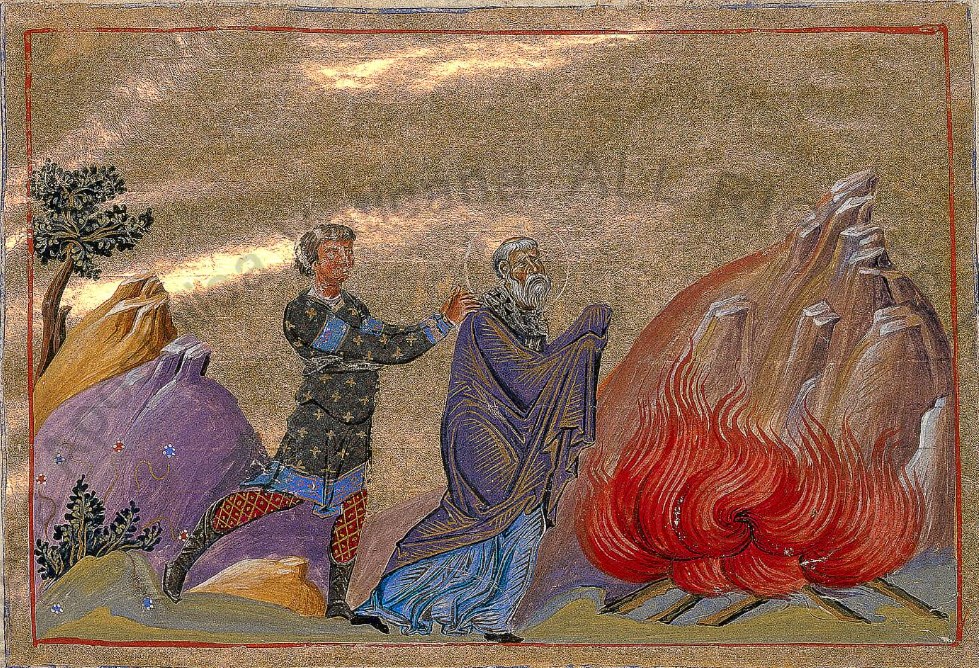
Then the fire was lit — and the wonder the eyewitnesses report: the flame, bellying out like the sail of a ship filled by the wind, made a vault around the body of the martyr, "and he was in the midst, not as burning flesh, but as bread baking, or as gold and silver refined in a furnace; and we caught a fragrance as of incense or some other precious spice." When the fire would not consume him, the executioner was ordered to stab him with a dagger, and at the blow there came out so great a quantity of blood that it quenched the fire, and the whole crowd marvelled. The eyewitness account, the Church, and the calendars have kept every detail.
Relics and the birthday of the martyr
The authorities, "at the instigation of certain persons," refused to give the body to the Christians, lest — the account bitterly notes the calumny — they should "abandon the Crucified and worship this man"; the martyr's remains were therefore burned. But the Christians gathered up his bones, "more precious than costly stones and finer than gold," and laid them in a fitting place, resolving to gather there in gladness "to celebrate the birthday of his martyrdom" — his natalis, the day of his death as the day of his birth into heaven — "both in memory of those who have already contended, and for the training and preparation of those who shall hereafter." The passage is the earliest explicit witness in Christian literature both to the veneration of a martyr's relics and to the keeping of a martyr's annual commemoration — the seed of the whole calendar of the saints — and it draws, with perfect clarity, the distinction the Church has kept ever since: "Him [Christ], being the Son of God, we worship; but the martyrs, as disciples and imitators of the Lord, we love as they deserve." The letter of Smyrna, sending on the account "that you may communicate it to the brethren further on, that they too may glorify the Lord," is thus the charter of the cult of the saints.
Feast and commemoration
Polycarp is kept universally on February 23 (church date; Old Calendar civil March 8), the day of his martyrdom at Smyrna. The Antiochian, Greek, and Slavic calendars agree on the day, and the Roman calendar likewise keeps him on February 23 (having formerly observed him, in the older Western books, on January 26). His feast most often falls in the pre-Lenten or early Lenten season; in years when February 23 coincides with a Sunday of the Triodion or with the Second Sunday of Great Lent (Gregory Palamas), the resurrectional and Lenten offices take precedence and the saint is commemorated together with them. In the Slavic calendars the day also keeps the venerable Polycarp of Bryansk (†c. 1620) and, among many others, the Syrian desert ascetics and Alexander the founder of the Unsleeping Ones (see February 23).
Hymns
Troparion — Tone 4
A partaker of the ways of the Apostles and a successor to their thrones, O God-inspired one, thou didst find in the active life an ascent to divine vision; wherefore, rightly dividing the word of truth, thou didst contend for the faith even unto blood, O Hieromartyr Polycarp. Intercede with Christ our God that our souls may be saved.
Original translation from the Greek
Kontakion — Tone 1
Offering to the Lord the fruits of the reason through thy godly virtues, O wise Polycarp, thou wast shown forth worthy of God, O blessed hierarch; wherefore today we who have been enlightened by thy words hymn thy praiseworthy memory, glorifying the Lord.
Original translation from the Greek
Appointed readings
Epistle — Hebrews 13:7–16
7Remember them which have the rule over you, who have spoken unto you the word of God: whose faith follow, considering the end of their conversation. 8Jesus Christ the same yesterday, and to day, and for ever. 9Be not carried about with divers and strange doctrines. For it is a good thing that the heart be established with grace; not with meats, which have not profited them that have been occupied therein. 10We have an altar, whereof they have no right to eat which serve the tabernacle. 11For the bodies of those beasts, whose blood is brought into the sanctuary by the high priest for sin, are burned without the camp. 12Wherefore Jesus also, that he might sanctify the people with his own blood, suffered without the gate. 13Let us go forth therefore unto him without the camp, bearing his reproach. 14For here have we no continuing city, but we seek one to come. 15By him therefore let us offer the sacrifice of praise to God continually, that is, the fruit of our lips giving thanks to his name. 16But to do good and to communicate forget not: for with such sacrifices God is well pleased.
Gospel — John 15:17–16:2
17These things I command you, that ye love one another. 18If the world hate you, ye know that it hated me before it hated you. 19If ye were of the world, the world would love his own: but because ye are not of the world, but I have chosen you out of the world, therefore the world hateth you. 20Remember the word that I said unto you, The servant is not greater than his lord. If they have persecuted me, they will also persecute you; if they have kept my saying, they will keep yours also. 21But all these things will they do unto you for my name’s sake, because they know not him that sent me. 22If I had not come and spoken unto them, they had not had sin: but now they have no cloke for their sin. 23He that hateth me hateth my Father also. 24If I had not done among them the works which none other man did, they had not had sin: but now have they both seen and hated both me and my Father. 25But this cometh to pass, that the word might be fulfilled that is written in their law, They hated me without a cause. 26But when the Comforter is come, whom I will send unto you from the Father, even the Spirit of truth, which proceedeth from the Father, he shall testify of me: 27And ye also shall bear witness, because ye have been with me from the beginning. 1These things have I spoken unto you, that ye should not be offended. 2They shall put you out of the synagogues: yea, the time cometh, that whosoever killeth you will think that he doeth God service.
Iconography
Polycarp is depicted as an aged bishop of the apostolic type: white-haired and white-bearded, the beard full and rounded, vested in the phelonion or the cross-figured polystavrion and the omophorion, holding the Gospel-book or blessing — the settled image of a hierarch of the first Christian generations, akin to the type of his friend Ignatius. Narrative icons show his martyrdom: the old bishop standing bound and unharmed within the arched vault of flame that would not consume him, or pierced by the executioner's dagger as the fire is quenched by his blood — the visual form of the eyewitness account. A distinct later type, proper to Smyrna (modern İzmir), shows Polycarp miraculously extinguishing a great fire of the city, by association with the flames of his own passion.
The stored image is the miniature for February 23 from the Menologion of Basil II (Constantinople, c. 985; Vatican, Vat. gr. 1613): Polycarp vested as a bishop, an image of the aged hieromartyr of Smyrna (source, public domain, pd-old-work).
Disputed questions
- The year of the martyrdom. The Martyrdom dates the death to a "great Sabbath," on the second day of the month Xanthicus — the day the Byzantine calendars fix as February 23 — in the proconsulship of Statius Quadratus. On the traditional reckoning, followed here, this falls about 155 or 156, under Antoninus Pius. A rival tradition, resting on the Chronicon of Eusebius and followed by some, places it later, about 166–167, under Marcus Aurelius; a few moderns have argued dates in between. The day, February 23, is the fixed liturgical anchor; the year is given with "c." and the range noted.
- The dove. In one strand of the manuscript tradition, at the dagger-stroke "a dove and a great quantity of blood came forth." Many scholars judge the words "a dove and" (περιστερὰ καὶ) a later interpolation — absent from the text Eusebius quotes and awkward in the Greek — and read simply that the blood quenched the fire. This reference follows the shorter reading and notes the variant.
- "Not to be confused." This Polycarp — of Smyrna, the Apostolic Father and hieromartyr, kept February 23 — is distinct from the later Russian venerable Polycarp of Bryansk (†c. 1620–1621), a prince who became a monk, also commemorated on this day in the Slavic calendars (see Feast and commemoration), and from Polycarp, archimandrite of the Kiev Caves. The name, "much fruit," belongs in the calendars first of all to the disciple of John.