
Pitirim of Tambov
Our Father among the Saints Pitirim, Bishop of Tambov, Wonderworker
Bishop · Wonderworker · b. 27 February 1645 (or 1644), at Vyazma — d. 28 July 1698, at Tambov
Commemorated 28 July — Repose at Tambov, and glorification on the same day in 1914
Pitirim was the second bishop of Tambov, a frontier diocese on the steppe edge of seventeenth-century Muscovy, where he served thirteen years among a population of half-Christianised Mordvins and Cheremis, Muslim Tatars, Old Believer schismatics and transported criminals. Born Procopius at Vyazma in 1645, an icon-painter and singer by training, he was tonsured at twenty-one, became archimandrite of his own monastery, and was consecrated for Tambov by the Patriarch Joachim in 1685. He built the stone Transfiguration cathedral with his own hands among his workmen, founded a clerical school and a library, dug wells, and laboured above all at the patient reconciliation of the schismatics. He reposed on 28 July 1698; healings at his tomb were formally investigated from 1819, and he was glorified on 28 July 1914, the last Russian canonisation before the revolution.

Vyazma: Procopius the icon-painter
He was born on 27 February 1645 — some accounts give 1644 — in the town of Vyazma in the Smolensk lands, and was christened Procopius. The Life dwells on an unusually well-documented childhood: a boy who preferred the church to the street, who read the Fathers and the lives of the saints, and who was trained in the two arts a Russian provincial town could teach a devout child — icon painting and church singing. Both stayed with him: as bishop he still painted, and still directed his own choir.
At twenty-one he entered the monastery of St John the Baptist at Vyazma and was tonsured with the name Pitirim. His ascetic seriousness told on the community, and he was elected igumen; in 1684 he was raised to archimandrite.
The removal of the westernised icons
One episode of his archimandriteship reached Moscow and made his career. The later seventeenth century was the moment at which western, "Frankish" painting — modelled, shaded, sentimental, worked from Dutch and German engravings — was flooding into Russian churches, and the question of whether such images were icons at all was fiercely disputed. Pitirim, an icon-painter himself, went through the churches under his care and removed the badly-made westernised images. The Patriarch Joachim, who had legislated against exactly this and who was engaged in the same struggle, took note of the young archimandrite.
Bishop of Tambov
He was nominated to the episcopate on 1 September 1684 and consecrated Bishop of Tambov by Patriarch Joachim on 15 February 1685, spending a year in Moscow in preparation before going out to his see.
The diocese of Tambov had been erected only in 1682, on the southern military frontier where Muscovy met the open steppe. It was poor, thinly settled and hard: the countryside was largely Mordvin and Cheremis — peoples still substantially pagan — with a considerable Muslim Tatar population; the Russian settlers included a heavy proportion of Old Believer schismatics, and of criminals and dissidents transported to the frontier. There were few churches, fewer literate clergy, and no schools.
Pitirim's thirteen years were spent building what did not exist. He raised a two-storey stone cathedral of the Transfiguration with a chapel of St Nicholas, working on the site himself alongside the labourers, and it is remembered that the bishop was seen carrying and laying stone. He founded a school for the sons of clergy and gathered a theological library, both of them first things in that country. He preached constantly and travelled his diocese, which few of his contemporaries did.
His method with the schismatics was not the method of the age. Instead of the denunciation and the police that the anti-Old-Believer legislation of the 1680s made available to him, he used patient conversation and the argument of his own life, and the Life records that he brought many back by it.
He founded the Ascension convent at Tambov in 1690, whose first abbess was his own sister Catherine; and, together with St Metrophanes of Voronezh, the neighbouring bishop and the other great hierarch of that frontier generation, the Tregulaev monastery of St John the Baptist.
The bishop's own rule
Under all this he kept a strict monastic discipline: the daily Liturgy, at which he commonly served and always sang; manual labour, of which the two acts remembered are the digging of wells — one of them, near the town, long venerated and its water carried away by pilgrims — and the making of crosses, which he set up along the roads; long prayer before his icons, of which he had painted several; and periodic withdrawal into the countryside for solitude.
Repose and glorification
He died on 28 July 1698, aged fifty-three, and was buried in the lower church of the Transfiguration cathedral at Tambov, at the south wall of the chapel of St Nicholas — the building he had raised himself.
Veneration began at once and locally, and grew slowly for a century. From 1819 the diocesan authorities began the formal recording of healings at the tomb — the procedural first step towards a Russian canonisation — and the file grew through the nineteenth century as his cult spread beyond Tambov into the neighbouring provinces. He was at last glorified on 28 July 1914, on the anniversary of his repose, in the last weeks of peace: it was among the final acts of canonisation of the Russian Church before the catastrophe, and the ceremonies at Tambov drew immense crowds.
Feast and commemoration
July 28 (church date; Old Calendar civil August 10) — the day both of his repose in 1698 and of his glorification in 1914, so that the one date carries both. The feast is kept by the Russian Orthodox Church and by the OCA, and is the patronal day of the city and diocese of Tambov, where it is celebrated with a procession; he is also numbered in the Synaxis of the Tambov Saints. The Greek calendars do not carry him. The day falls in the open season between the Apostles' Fast and the Dormition Fast, so that only the ordinary Wednesday and Friday rule applies.
Hymns
Troparion — Tone 8 (common of a hierarch)
O guide of Orthodoxy, teacher of piety and holiness, lamp of the world, God-inspired adornment of hierarchs, O wise Pitirim: by thy teachings thou hast enlightened all, O harp of the Spirit. Intercede with Christ God that our souls may be saved.
Original translation from the Slavonic
Iconography
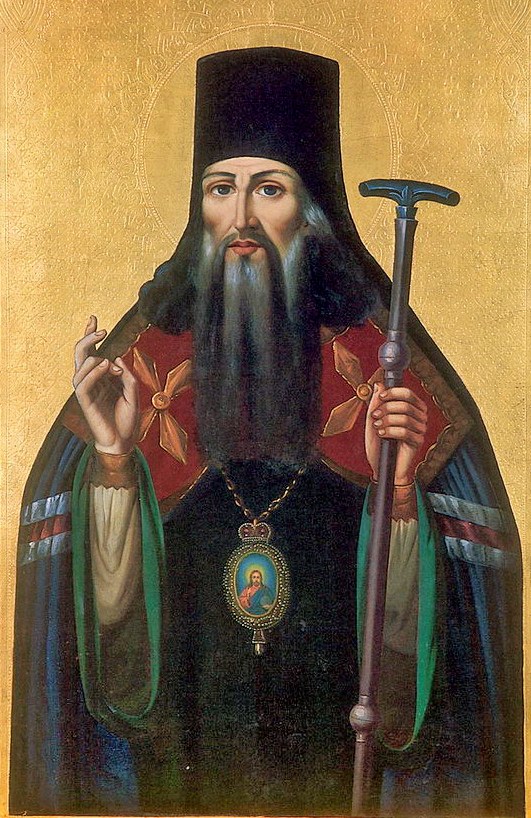
Pitirim is shown in the Russian hierarchical type of the seventeenth century: full episcopal vesting — sakkos, omophorion, mitre — the right hand raised in blessing, the left holding the Gospel book, with a full beard of moderate length going grey and a long, spare face. His glorification icons of 1914 are the source of the standard type, and they were produced in very large numbers for the canonisation; being of that date they are on the boundary of what may be stored here, and no example of unambiguous pre-revolutionary printing has been located under a licence that can be verified. Two attributes are proper to him: the Transfiguration cathedral of Tambov held as a model in his hand, in the manner of founders, and — in the vita icons — the well he dug, shown with pilgrims drawing from it. He is frequently paired with Metrophanes of Voronezh, his neighbour, friend and fellow-founder. The stored image is a 1910s reproduction, published for his 1914 glorification; copyright expired.
Disputed questions
- 1644 or 1645? The sources give both years for his birth on 27 February; the OCA notice prints "1645 (or 1644)." The day is secure, the year is not.
- The relics. As with most of the shrines glorified immediately before the revolution, the relics were disturbed in the Soviet anti-relic campaigns of the early 1920s. Their restoration to the Transfiguration cathedral belongs to the reopening of the Tambov diocese in the 1990s, and lies outside the transmitted Life used here.
- Not to be confused with the several other Russian hierarchs of the name — notably Pitirim, Metropolitan of Novgorod and the later Pitirim (Oknov) of Petrograd — nor with Pitirim of Perm, the fifteenth-century missionary bishop martyred by the Voguls, who is commemorated with Gerasimus and Jonah on January 29.