
Plato of Ancyra
The Holy Martyr Plato of Ancyra
Martyr · d. c. 306
Commemorated 18 November — Martyrdom at Ancyra
Plato of Ancyra (†c. 306) was a young confessor of Galatia who was martyred in his native city during the Great Persecution. Still in his youth, he travelled the cities preaching Christ with a persuasiveness and command of Greek learning that astonished his hearers, until he was arrested and tried before the governor Agrippinus. Flattery, the offer of a noble marriage, threats, and prolonged torture and starvation all failed to move him, and he was beheaded for refusing to sacrifice to the idols. The tradition remembers him as the brother of the Martyr Antiochus the Physician, and his memory was kept with a proper hymn at Ancyra. He is commemorated on November 18.
.jpg)
Origins and early life
Plato was born at Ancyra (modern Ankara), the chief city of Galatia in Asia Minor, a region that gave the Church a long roll of martyrs under the pagan emperors. The hagiographic tradition presents him as a young man of good education, at ease with the classical Greek paideia of his day, who as a mere youth left his home and went from city to city openly proclaiming the Gospel to the pagans. His eloquence and the beauty of his speech, joined to his evident learning, drew crowds and made his preaching effective — and conspicuous.
The tradition also links him by blood to another martyr of the same era, Antiochus the Physician of Sebaste (commemorated July 16), naming the two as brothers. The connection is preserved in the synaxaria rather than in any independent documentary record, and is transmitted as a received tradition.
Martyrdom
Because of his public preaching Plato was seized and brought for trial to the temple of Zeus, before the governor Agrippinus. The trial as the synaxarion relates it turns on a play upon his name. Agrippinus began with flattery, assuring the youth that his intellect might rank him with the great philosopher Plato himself, if only he would also worship the gods of the state. The martyr answered that the wisdom of the philosophers, for all its greatness, was passing and bounded, whereas the true wisdom — eternal and without limit — was that of the Gospel. The governor next offered him his own beautiful niece in marriage as the price of apostasy, and, when this too was refused, turned to threats of torture and death. Plato replied that he chose a temporary death for the sake of eternal life.
He was cruelly beaten and returned to prison; as he was led away he called out to the people gathered about the temple not to abandon the Christian faith. Seven days later he was brought out again, tortured afresh, and then confined for eighteen days more without bread or water. When even this failed to break him, his judges made a final offer of life and liberty if he would say no more than the words, "Great is the god Apollo." He would neither deny Christ nor sacrifice, and Agrippinus at last ordered him beheaded. His martyrdom is placed in the persecution of the early fourth century, about the year 306.
Veneration
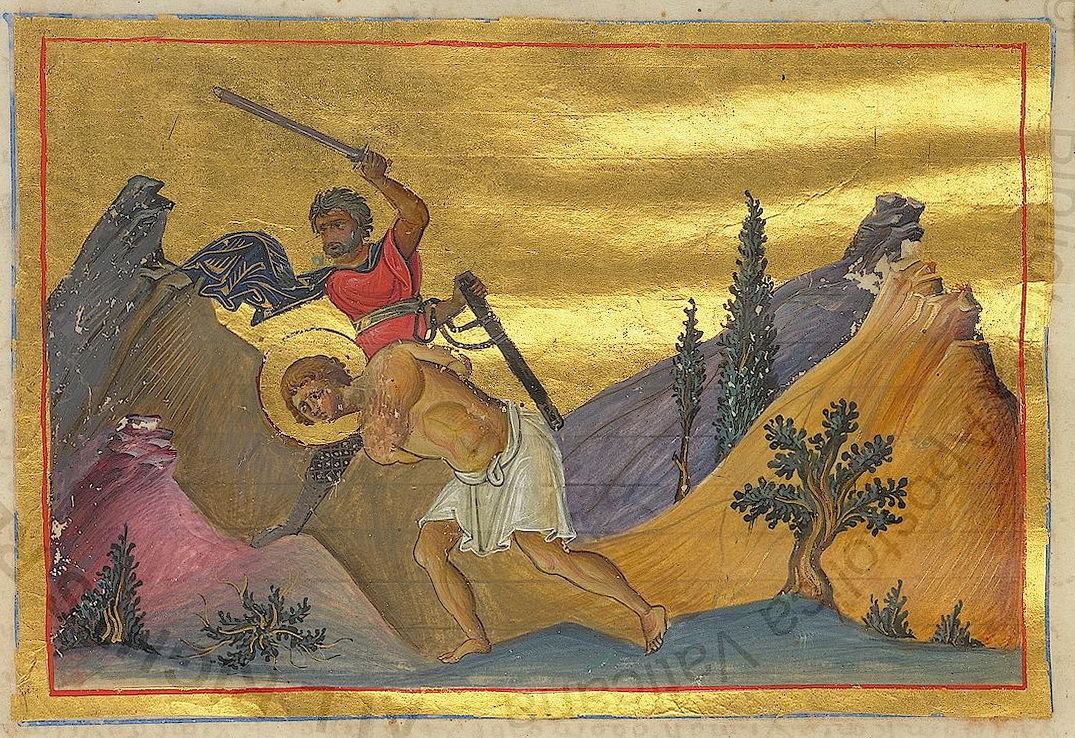
Plato's cult was established early and widely: he holds a fixed place in the Byzantine synaxaria and the Menaion, and a proper kontakion sung at his feast prays for the deliverance of "his city" from barbarian invasion, a sign that his shrine at Ancyra was regarded as a protector of the town. His figure was included among the martyrs illustrated in the imperial Menologion of Basil II around the year 1000.
Feast and commemoration
November 18 (church date; Old Calendar civil December 1), within the Nativity Fast. The feast is kept universally in the Byzantine rite and is shared in the day's service with the Martyr Romanus, the two martyrs being joined under a common troparion while Plato retains his own proper kontakion.
Hymns
Troparion — Tone 4
Thy martyrs, O Lord, in their contest received incorruptible crowns from Thee, our God; for, possessed of Thy strength, they cast down the tyrants and shattered the feeble insolence of the demons. By their prayers, O Christ God, save our souls.
Original translation from the Slavonic
Kontakion — Tone 3
Thy holy memory gladdens the whole world, summoning all the faithful to thy most honourable temple, where now, gathered together in joy, we sing thy praise in hymns and splendour. Wherefore, O Plato, we cry to thee: deliver thy city from the invasion of the heathen, O holy one.
Original translation from the Slavonic
Iconography
Plato is depicted as a beardless young martyr, richly for a nobleman's son of Asia Minor, often holding the cross of martyrdom. The stored image is his miniature from the Menologion of Basil II (Constantinople, c. 1000), which shows the martyr at the moment of his beheading, the standard portrayal of his end in the illustrated synaxarion.
Disputed questions
- Not to be confused with the philosopher Plato of Athens, whose name furnishes the rhetorical hinge of the martyr's trial, nor with the later Plato the Confessor, abbot of Sakkoudion and uncle of Theodore the Studite (†814, Plato commemorated April 4), a distinct Byzantine monastic saint.
- The brother-tradition with Antiochus the Physician rests on the synaxaria; the two suffered in different cities (Ancyra and Sebaste) and the kinship is not otherwise documented.